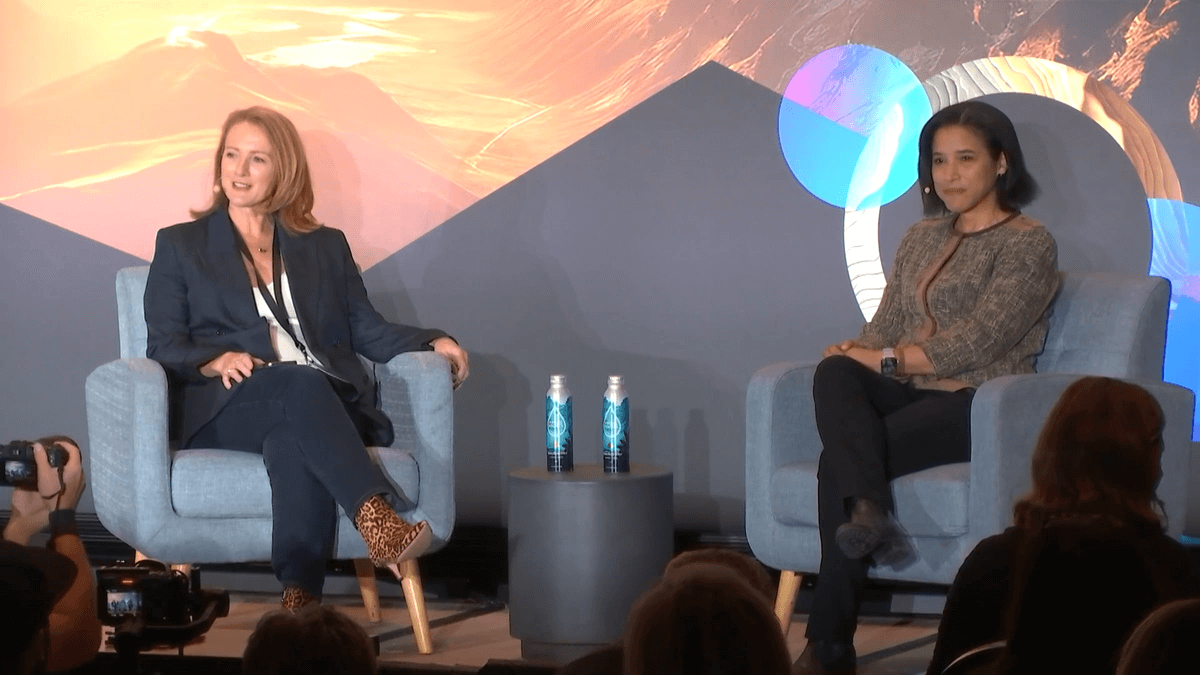
We’ve all seen, heard, or dabbled with artificial intelligence by now. In fact, a recent report says 91% of financial services organizations are assessing or using AI today. But, what does that look like? Let’s explore where the rubber meets the road when it comes to AI in banking — use cases, practical applications, and more.
Transcript
We are here to talk about AI.
Are we dabbling in AI? Are we doing this thing?
And our panel here, I'll have them introduce themselves,
but, what they're going to talk about is some
of those practical use cases for AI.
So we'll go just down the line and introduce ourselves.
I'll go really quickly. I'm not the
most important person up here.
I'm here to get you guys
to give us the real good nuggets.
But really quickly, I'm Crystal Anderson
and I am the Chief of Staff at MX.
Prior to that, I headed product at MX for two years.
I've been here for three years.
And prior to that I was at H&R Block
where I led the financial services business.
I was vice president of financial services.
We loaned $1.8 billion a year
and had $29 billion in deposits
through our financial services program.
So I've been in this space
for quite some time.
I'll have you go next.
Awesome. Yeah. Thank you. Crystal.
John Sun, co-founder and CEO at Spring Labs.
My background is in FinTech lending.
So before Spring Labs, I was the co-founder
and Chief Risk Officer at Avant,
where I oversaw credit risk, fraud risk, compliance, risk,
you name it, as part of the overall risk stack.
My training is really as a data scientist, that's kind
of what I always kind of go back to.
So at Avant, my team
and I built one of the first tree-based kind
of machine learning algorithms
for real time underwriting back in 2012.
I at least haven't heard of another company
that's deployed anything earlier than that.
But again, a little out of practice.
I haven't probably built a model since 2016
or reviewed the model since 2018.
So my knowledge, I'm sure is out of date compared to some
of these guys on the panel here.
And, today, what we're doing at Spring Labs is making AI
accessible to financial institutions.
When I say AI, I mean, in this case, more generative AI.
How do we use the conversational intelligence capabilities
of generative AI to help banks
and financial institutions with regulatory risk reduction,
with operational efficiency, with better kind
of staffing and better engagement with customers to kind
of create more delightful experiences. Great.
Thank you John. Sam? Hey everybody. I'm Sam Maule.
I started in banking
and payments back in ‘94,
so I've been doing this for a little while.
Been a banker, been a worked at TSYS, did consulting,
did a stint at Google, and now I'm
with a payments company called Moov.
So this ought to be fun diving into this. Yeah.
I'm Zach Boyd, Director of Utah's Office of AI Policy,
newly created four months ago.
Also a math professor at Brigham Young University,
where I've been doing research basically into foundations
of machine learning and applications in social science.
Wije. The most important person in the room here,
And least knowledgeable about
finance for sure.
My name is Wije.
I'm co-founder and CEO of a company called Aliya.
We build AI-powered solutions for banks.
Great. Well, my first question's going to be,
tell me a bit more about what your organizations
are doing with AI.
So Wije I am actually gonna
start with you. What does that mean?
You promised me I would go last.
That's why you sat down there.
That's why. Better I know.
What do we do? In this?
The simplest way of explaining it is we take the most
valuable data a bank has, which is the transaction data,
and we support lending
and risk management using that data.
That's in the simplest way.
We go through the ringer in terms of, well,
we've been doing it for six years now.
We've done, you know, close to $7 billion worth of loans.
We work with a very large bank partner.
And it's been a learning process for us in terms of
the biggest constraints to deploying AI.
Yeah. We've been through it living it, regulatory,
compliance, legal,
and all of that is what we do. Great.
Sam, why don't we hear from you next? Sure.
What are we doing? So with Moov,
it's everything about money movement.
So money in money out, storing all that stuff.
So basically just think about all that transaction data
and, I think I said I worked at Google,
so shockingly we're doing a lot
with Google on the BigQuery side, Looker,
and the other tools that we can tie into.
So, I mean, transaction data is the holy grail
when it comes to payments, right?
That's what we all wanna see. So you can, yeah.
Yeah. Use your brain. Think
What we're doing. Use your brains, use
your brain, everybody.
Zach, I'm really interested in this newly formed,
tell us some context around this newly formed
organization that you're leading
and kinda the impetus to the creation of that.
Yeah, sure. Happy to discuss.
So, Utah's Office of AI Policy
is unique in the United States
and maybe in the world now.
Utah moved first. The idea was
to have an in-house government capability
where there's an office with people
who understand AI are following the dozens
of relevant regulatory issues that might affect the state
and are primed
and ready to make good recommendations to the legislature if
and when it seems right for the state to act on AI policy.
So this is mostly regulatory policy, certainly in finance
and banking, in healthcare, schools, you name it.
The legislature specifically wants us
to be wearing both the consumer protection hat
and the innovation fostering hat, which I think has really
been super effective so far
because usually those two people wear different hats
and it leads to a lot of dysfunctions in
various regulatory systems.
So I think that's been really good.
We have a charge to go through topically
and do deep dives on matters of importance.
So, for example, we could do a deep dive on AI and fintech
and banking and think through, you know,
what does the right regulatory structure need
to be in the age of AI?
How can we make sure things make sense,
and then make reasoned recommendations to the legislature
going through topically.
We'll take a lot of time and AI moves fast.
So the legislature also granted us a regulatory mitigation
authority, which is basically a very kind
of nuanced sandbox authority.
If a company wants to use AI in the state
to simplify slightly, I can write a contract to any company
that wants to operate in the state, clarifying that
the regulations of the state shall apply to you thusly,
or that you will be exempted from the
following regulations of the state.
Or we'll give you a curing period, or we'll cap fees.
And so this applies across all the regulations of the state.
So we've had some companies approach us already,
but the idea is we want companies to be able
to explore innovative business models
and we want Utahns to reap the benefits of AI
as rapidly as possible.
How big is the team? Sorry,
I had to ask, ask How big is the
Team? Oh, I was actually gonna ask you about
your
facial expression, Sam.
So no, I'm — How
big is the team? Oh, I mean,
we're a small government office.
I have six people. It's all right. So, no, I mean,
it's actually pretty good. It’s six people doing what you’re doing.
That's awesome. Yeah. I mean, but my philosophy is always,
I've tried to pack as much knowledge
as possible into this small state office as I can,
but we are not now,
nor ever will be resourced enough
to have deep in-house expertise on every subject.
So we have a model of stakeholder engagement.
I've spent a lot of my time trying
to find the smartest people
that I possibly can in all the relevant industries
and engage with them to rapidly acquire
the most important facts.
Sam, so you pointed at John and Wije.
Tell me what makes you say they're the smartest people in
using AI in the industry? Because
they're buried in it
and been doing it quietly, looking at you quietly.
When people work quietly
and aren't all over social media talking about
how incredible they are, I tend to,
they're the people grinding this out.
And this takes a long time.
I'll speak for Wade Arnold, who I work for at Moov.
When you're building out payment rails from, you know,
bare metal connections all the way up, it takes a long time
and it's really, really hard.
What we're talking about is
transformative, what y'all are doing. Yeah,
Thank you. You're welcome.
Hey, Wije, can I have you speak into the mic just
so that the recording can hear you?
I thought my voice is loud enough that everybody that no,
anything that is as transformational
as this is really, really hard.
People completely underestimate how difficult it is,
the cost of doing it.
I mean, it's prohibitive, right? Compute costs now.
It's crazy. I mean, we had to build our own stack of
Nvidia H100s to mitigate some of that.
The talent,
it's very hard to find.
They, the people
who do this are really very special people.
They're kind of not normal
because they're just,
they're not data scientists in a traditional way.
They're kind of artists.
'cause they really just know something
that we don't normally.
The other part of it is, you know,
the regulatory lift.
But I think in terms of one of the biggest hurdles
is finding the right leadership with the right strategy.
Because everybody talks about AI.
In fact, I had my team just run all
of the annual reports of everybody here looking at
how many times AI machine learning
and artificial intelligence I mentioned in the reports.
So you got J.P. Morgan up at the lit top, huge number
of times that they talk about it.
And then the vast majority are about one
once, you know.
So,
but there is a lot of conversation going on about it.
And, but the strategic direction is the really important,
it's like everybody thinks of point solutions.
It's not a point solution, it's a curated offering, right?
Even MX, which is one of the best in the business,
is beginning to realize that it's a curated solution
that has a closed loop to it that makes money.
And banks need money.
Their NII, I mean, I'm speaking for you guys,
but you know it better than I do.
Pretty much sucks, can't grow. What are you gonna grow?
And that's the problem AI can solve
because you can get deeper into your customer.
You can figure out how to price them more accurately
and you can make better loans to more people, right.
As is the single.
Yeah, I mean, I would echo that sentiment,
although Sam, you know, the reason we don't do social media
is because we're bad at it, not because for lack of trying.
But I think that's actually, you know,
Wije, you bring up a really good point, which is, you know,
every time there's a new technology that comes about,
people are like, oh, AI this, AI that, right?
At the end of the day,
a good AI product shouldn't be defined by the AI-ness of it.
It should be defined by its value
to your organization, right?
Ultimately, that's what matters. And I feel like at the
beginning of every single kind of tech cycle, you see a lot
of investment into the AI-ness of products instead
of investment into ROI investment into
how it moves your organization forward.
So that's something that we try
to focus on at Spring Labs is how do we build products that,
again, present efficiency, delightful experiences
to your customers, and ultimately add your,
move your business forward
and add value to your customers where the AI
of it is kind of a secondary. Can
I ask you a question real quick?
Of course you can. Just real quick, I, I like
what you said about don't think data scientists
think artists and all that.
Yeah. Because I've heard it
and you know, stated when we're talking about AI,
it's like learning an alien language
or can you emote on that a little bit?
Yeah. It's, I, most people think of AI
and data science in a, in query form that is
so one dimensional, right?
Because it's about, think
of it like you're sitting there
and you've got a trillion dots around you, around your head,
and it's kind of like, how do I connect these dots
to make some sense of that?
And that's a very complex thing
and that's what these guys do.
If you can imagine that.
And the power of it is
like in categorization, you guys are all familiar
with transaction data and categorization.
When a category comes out,
you can't explain how it got there.
I mean, it's very, very difficult
'cause it's multidimensional.
So it becomes a problem for us
vis-a-vis the regulators when the compliance component
of it is, well how did it get there?
You know, it's like us trying
to explain a multidimensional framework in 2D,
and this is where I think the most amount of work needs
to be done, is a collaboration of people like us
with the regulators, the sandboxes,
or we talked about clinical trials, right?
In the medical industry, there is a lot of AI that's used
to analyze data
and come up with protocols that have to go
through clinical trials.
And the FDA process. We should be thinking along those lines
and we will.
Yeah. And I'll say that, you know,
not just in banking and fintech,
but across the board I'm seeing a transformation
where before we're so used to humans being able
to give us explanation for things.
And, in some sense that, you know, it's a value
to the consumer to be able to be given an explanation
for things if those explanations are actually valid, right?
Like they derive subjective benefit from this
and sometimes hard concrete benefits from it.
But now I, you know, it's gonna take society a little while
to realize that with these, with this kind of model,
there's a complex trade off between the value
of being able to explain things
and the capability of being able to do better, right?
Like the best models right now are the least explainable.
And I know some people are trying to get
around compliance requirements
or to meet compliance requirements by taking the AI
and tacking some explanatory output onto it.
And I, you know, I am sympathetic.
I don't think that this is the biggest priority to go
after as a regulator at this very moment
because it is the state of the technology
and people feel like they need an explanation.
But I think scientifically it's actually super unclear
that these explanations actually are explaining
what the decision making process of the AI actually is.
What I hope society gets to is to the point
where we realize there's just a value trade off here, right?
Like we can have enhanced capabilities at the expense
of less explanation
and we can accept something along this curve of
how much explanation we really need.
Talk to me about some of those use cases.
So we've heard lending and pricing
and improving the experience.
What are some of the most impactful use cases you're
seeing in financial services? We'll start with you
John. Yeah,
great question.
I mean, practical applications, obviously is the key
to success for any technology.
And looking at it from the more generative AI side
of things, and I'm sure kind of Wije
and the rest of the folks have the opinion
on the more traditional machine learning AI,
generative AI is uniquely good at
understanding human language.
So these are pre-trained models
that have such a vast corpus of data.
You can manipulate language questions
and kind of constructs without,
a ton of additional training.
So I would say look around your organization
and just see where there's inefficiencies that involve
a bunch of kind of language related tasks.
I mean, the ones that we're seeing
that's really kind of interesting.
Compliance is a good one.
It's always one of these areas where, you know,
even if you're a tech forward organization, you never say,
let's invest in compliance tech.
You say, let's go throw more bodies at it.
So here now you're presented with a technology that can all
of a sudden change the game in terms of how you interface
with your customers, how you hear what your customers
are telling you, how you turn those insights into kind
of structured data to better inform technology process
and roadmap decisions.
So those types of things are the types
of use cases that
generative AI is uniquely kind of good at.
I'm gonna give an example that's not
banking, if that's okay.
That's okay. So from the Google days, so in Canada,
especially in British Columbia, they went through a period
of excessive drought, ton of forest fires.
Most of those forest fires were caused by truckers,
long haul truckers going
because of the speed of what they travel.
We create sparks, we create fire and everything else.
So this gets to your multi-layered data elements all
coming together at the same time.
So Google, through satellites and weather patterns
and through trackers that they could put on the trucks
could actually say, alright, here are the weather conditions
for specifically where you're at in real
time as you're traveling.
Because what happened was the government came in
and said, all right, you have to drive under 45 miles an hour
that yeah, I know,
but to stop the forest fires because of what we're in.
So just the rule or,
or the regulation is gonna be,
you gotta drive under 45. In trucking and logistics,
that's, you're dead, right? That's killer.
So Google was able to come in
and work with them to say, okay, we can go
and monitor each individual driver, the trucks themselves,
the speed that they're going, where they're at
with satellite data in real time
and what the weather conditions are.
And we can modulate at what speed you need
to go in real time,
which now is impacting dollars and everything else.
So if you think about that, that's a ton
of different data elements all coming together,
which was driving profitability.
And by the way, that's like five years old.
That's not something that's new.
So, you've gotta start thinking
in ways you haven't thought
before, getting back to the alien type brain. Right?
Yeah. I mean, I think you make a
very important point. Good.
That was the only one I'm gonna get for this entire talk.
I've been saving that one up.
Take everything that you've been doing for the last couple
of decades because it really
has been based on not having to take any risk.
When interest rates are zero,
you don't do anything with your customer.
You shouldn't be doing anything with your customer.
You should be taking your cheap dollar cheap funding,
deposits and going and buying long duration treasuries.
That's what happened.
And it has not created any innovation.
And then now you're getting overloaded
by this thing called AI
and it's confusing. A lot of people take a blank sheet
of paper, re-engineer the whole thing,
and your most valuable piece of data, there are three pieces
of data that you need to focus on.
One is the transaction data, your bureau data
and public records data.
If you know how to use those effectively
to serve your customers, you're going from zero
to 60 in no time.
Forget about zero to a hundred.
That's what the zero to 100 is what
highly paid management consultants will tell you.
'cause they'll go, oh yeah, you need
to create the orchestration layer, the data layer.
You need to create all of these things. It's h******t.
Sorry, promised I wouldn't do that. Keep it simple.
'cause banking —
everybody's made banking complex.
If you take away the complexity, it's a pretty simple thing.
Take in deposits from your community,
lend it out safely, make a spread.
That's what the social mandate is.
And you need to use the best tools available to you.
And AI is totally transformational
because you're gonna be able to predict behavior losses.
If you can do all of that, you can price it
more accurately rather than guessing.
There's, if you price it correctly, size it correctly,
then you make a lot of money.
Can I ask a
question actually of the other panelists?
I know in other industries, I tell people, you know,
you've got these weird strategic decisions right now.
'cause AI, especially generative AI, is currently the worst
that it will ever be, right?
It will only improve from here, all kinds
of hypotheses about how much or how little it will improve.
And, I think for a lot of people,
this has a strategic bearing,
but I am hearing you guys basically talking about
the benefits that are already here.
Yeah. What's your opinion?
Like, how much are the benefits already here versus
how much do you think is coming?
Do you guys have like, theories about this?
Sorry, John, but compliance is a bunch of rules.
Well, I mean, it
shouldn't be from my perspective.
It shouldn't be interpreted.
Okay. Like it compliance is, you know,
So don't — You're saying like, you don't need generative
AI to do compliance, in my opinion.
It's a set of rules.
You can build it into ones and zeros.
I hope somebody's not agreeing with me on
that one. We'll
give you a mic in a little bit and
Look, we, yeah, we're doing it.
So with it, with a large OCC regulated bank,
it's built in, you can build it into the workflow.
Yeah, I mean, I think we might be talking about two
different kinds of compliance.
I mean, there's the type of compliance which is,
you know, let's analyze a particular model
for a particular outcome or a particular set of inputs.
And then there's the compliance of, you know,
I just sent out a marketing mailer to this comply with all
of my obligations under, you know, various rules that I have
for marketing this product.
I just received a complaint from a customer.
Did the, you know, three pages of like personal life story
and like my dog just died and all of that.
Did any of that trigger a UDAP concern? Right?
And again, can you do it with traditional machine learning?
Yes, absolutely.
It would be incredibly time consuming and cost inefficient.
What generative AI has presented us is a set of models
where you don't have to start from zero.
So if you think about what GPT stands for, it stands
for generative pre-trained transformer models, right?
Everyone focuses on the G, which is generative.
What you should be focused on is the P,
which is this pre-trained.
It comes out of the box
with a vast corpus of human knowledge.
And you can now use that as a springboard
to do way more advanced use cases than you could if you just
started with the transformer model from zero.
Yeah. As a former Google,
I think the transformer part's very important
because of my stock.
Let's just make sure that gets said.
I wanna make sure we hear — I saw lots of Yes.
That latter example is what I align with.
So tell us more about that. Absolutely.
Can you introduce yourself real quickly?
Not a problem. So I'm Doug Milow, senior Director
of Credit and Fraud Risk Strategy.
I'm also the fair lending officer for Best Egg.
We're a consumer lending platform.
Here's
where I respectfully disagree and agree with John.
It's complaints, right?
We've got so much data we collect to see how we're doing.
We've got online surveys, we've got surveys from our funnel,
we've got customers talking to agents.
You've got that agent shorthand that they love
to write in to describe what happens.
We've got the tracking of escalations
to the management layer,
we've got the regulatory complaints coming in.
We've got all kinds of signals
and it's just completely unstructured.
And that's where Gen AI can really shine.
We're we're working with the Amazon, you know, platform
to kind of figure out where to go with that.
So wasn't talking about, I should have clarified my point.
Got it. I was more about serving the customer,
not the complaint side of it, but
Yeah, some of, some of those. Good
point. Yeah, totally agree with you on that part.
You know, it's, Hey, if your APR is above X
and your state says it can only
go to Y, you've got a problem.
That's a rule. We agree.
Hey, Wije, can you expand a little bit?
'cause you touched on it, at,
Moov, we had Matt Harris from Bain Capital,
if you know Matt, he's been doing this forever.
The OG when it comes to this.
And he talked about AI and agents and some other components
and how it's just gonna wreck havoc with NIM.
I mean, you mentioned that before on the net, you know,
can you expand a little bit on what you were saying
On the NIM? Yeah.
Look, the problem,
the problem is in order to generate the name you
or NII you, you need to be able to lend,
most organizations are struggling to figure out how
to lend one of the spaces is in the Best Egg space.
We should be going after all of the Best Egg customers
because they're taking your customers by the way.
And the reason is they're really good at predicting
losses, pricing, and getting to the customer.
And the banking system isn't, and
because of that, you've left a lot of room available
to the fintechs to thrive.
SoFi who, you know, I was on the board of
for five years, they did $11.5 billion
of unsecured personal loan originations last year.
Okay? I don't know how much you guys did,
but you've done billions
and like total of 30 billion,
if I'm not mistaken in your lifetime.
That's business that belongs to the banking system.
I mean, just bank
because you already have the customers by the way, they had
to go get their customers.
And that's, I mean, that's money, right?
So that's one aspect of, the other aspect of it is in,
Because CAC is a big deal.
It's a big deal. I mean, that's huge.
The other aspect of it is your losses.
You haven't invested in
what companies like Best Egg have invested in.
So your losses are higher.
Then the other part of it is your production costs.
I mean, 27 screens,
and going to the branch to close a loan
And on legacy tech that was built pre-internet for
your course not to go down
that path too much. But we know that,
I don't mean, I'm being, matter of fact here,
this is not a criticism of anybody.
It's just lay of the land
and we're experiencing something right now in terms of AI
that is totally transformational.
That's why I think it needs a blank sheet of paper approach.
First principle thinking, but that's hard to do.
So can it be transformational
without the blank slate, right?
If the regulatory structure doesn't change, what happens?
I think this is a Google / Microsoft type situation
where the big guys are gonna win.
I was gonna ask you guys this question.
How much do you think Chase
and B of A are spending on tech this year?
10 billion, right? Who's at 10 billion? Come on.
This is interactive. Somebody stick their hand up.
10 billion. Good. 10 high end. Anybody more?
Okay, how much? Go for it.
5X that more? Not too much.
You, I mean, you went to the extreme.
It's 30 billion between the two of them. 17 and 12.
So 17 and 13
And 4 million of B of A is just on AI.
Yeah. Out of the 12 billion, 4 billion of
that just for Bank of America is on AI
And J.P. Morgan, I don't know what the exact number is,
but I guarantee you it's a large number.
So let's assume they waste half of it, which they do.
Optimistic. It's still a large number.
And now you're competing against those guys
who now have the chat bots, the products.
They're able to turn products around really quickly
because this is how the AI works, is you start
with the data, you create these dynamic products
through the algorithm,
and then you're feeding the product
to the customer who's generating more data.
And it's a circle, right?
It's a virtuous, and they have,
they're touching too many homes.
There's so many homes, they're getting so much data
and they're constantly changing their products.
Now, I have a J.P. Morgan account,
so I'm constantly getting, Hey,
your car lease is up, or something like that.
And I don't even have a car lease with them.
How the hell did they find that out?
Well, there's insurance data, they connect
to the dots, these dots
around my head. That's what they're doing.
You know, it's a really interesting point.
You know, when, when I started Avant back in 2011, 2012,
I think the feeling in the market was very much, Hey,
like fintechs are gonna eat the banks' lunch, right?
Like, eventually we will own this product category.
And at the time there were a few major fintechs, right?
It was LendingClub, Prosper.
We were probably the third kind of major, you know,
fintech player in the space.
And that didn't end up happening.
I think gradually we all realized that wasn't gonna happen.
So my thesis became sooner or later the banks will win
because they own all of the customers.
They have access to all of the, you know, capital.
And that kind of didn't win either,
because I mean, again, SoFi's been around
for years and Yeah.
But so, a lot of companies have been around for years, right?
So I think the question is like, I'd love
to hear your perspective, you know,
given they've had at this point, you know, a decade
and a half to react, why has the,
you know, reaction been so lukewarm?
I, listen, I was an early believer in SoFi
and a substantial investor.
I couldn't,
I thought exactly what you were thinking.
I bought into Mike Cagney's, Kool-Aid.
I,
you can have a great customer experience.
You can have some tech, but the funding is a big problem.
Absolutely. That constrains growth.
And then, you know, you just,
it's a really difficult thing to build a bank.
Okay? You know, you need a license,
you need to do all of that.
I know of only one company that has nailed it
and they're coming to the U.S.
and that's a company called Newbank.
They're listed on the New York Stock Exchange.
Most people haven't heard of them,
but it's a $60 billion market cap.
It's $5 billion less than PNCs. They're 12 years old.
They went from zero.
This is not a pitch for Newbank,
but they went from zero customers to 105 million.
And this is the interesting stat.
Their revenue per customer per month is $11.
The cost to serve that customer per month is 90 cents.
Yeah.
The average cost to serve is
for the banks in Brazil is compared to that.
Oh, it's
outrageous. It's outrageous. It's not even close
Because it's an oligopoly.
Yeah. It's four banks. Right.
And to be able to do that, I think it's scary
that they're coming here at the time,
Open Banking is happening.
Forget about J.P. Morgan.
I think J.P. Morgan and B of A and the likes are coming
after your deposits.
Yeah. Right. 'cause J.P. Morgan has already said publicly.
They're going from 11% market share to 15.
And it's only a time, once it gets to 15, they're going to 20.
They're not coming. It's not,
those deposits aren't coming from B of A,
they're coming from everybody else.
Newbank.
I mean, listen, I don't know what their plans are for the U.S.
or anything like that, but what they've been able
to do in Brazil, that is the role.
That's the model, that's the new AI bank.
And they went about it exactly the way in
the opposite way to SoFi.
They went and bought a license.
They got a license, and they started from
scratch. It can happen here
And, in Mexico, by the way, they're really close.
They're in Mexico now
And Columbia now. Yeah.
We have about 10 minutes left.
We definitely want to hear more,
but I want to just pause and see if there are any questions
or comments from the room.
Can you see him? Go ahead. Yeah. I was gonna say,
the thing that strikes me the most about this,
'cause we've all been talking about it,
how fast it's coming.
And I think most
of us don't realize how fast it's coming.
And the story that I give back to that is,
Yolande Piazza is the CEO of Google fintech, who, I went
and followed her, or I'm sorry, yes —
Citi FinTech. She left to go to Google now.
She has a payments for PayPal.
When she was there, remember when Alexa came out
and everybody told us we're gonna go to voice banking.
Do you remember that nonsense? Oh yeah, by the way, yeah.
There was people on stage here telling you you're gonna
use Alexa for voice banking.
Citi panicked, they brought all of their executives
and business line owners to meet with her.
And she ran the meeting in New York, flew them all in,
sat down and for 15 minutes they all argued about
how Alexa was gonna change all their business models
with small business banking and everything else.
And after 10 minutes Yo stood up
and said, how many of you own an Alexa?
Anybody want to guess how many hands went up? Zero. Yeah.
Zero. Not a one.
She stopped the meeting, sent
everybody home, bought everybody
an Alexa. They came back a month later.
Well, they set the meeting for a month later,
she sent an email out and said,
does anybody think we need a meeting?
And the answer was no. This is completely different.
This will transform.
I think five years is probably a long horizon.
It is going to be ridiculous.
I don't think you understand the tsunami
that's headed this way for our industry.
It's, you know, the,
I think the problem is that there is a lot
lost in translation when it comes to AI.
That's true. And it's like the blind leading the blind.
We need to figure out where we want to go first.
Okay? So if you want to go
and say, Hey, I want
to have a 360 degree view of my customer at all times,
then set it as that and then figure out how to get there.
Okay. And the source of truth for that
is your transaction data.
'cause every transaction in the world begins
and ends with a bank pretty much.
And you have a very detailed understanding of behavior,
income, volatility, spending behavior. Risk can be managed
because a good borrower is somebody
who's a responsible spender.
You can figure all that out.
This is so, you know,
the way I think about it is if you want
to be in the 360 area, you gotta figure out how
to gain their trust and get more data from them.
How do you gain their trust? You do more business with them.
So everybody talks about product penetration. Do it.
Don't just sit on a deposit account
and say, that's good enough
because you'll lose that deposit account to Chase.
'cause they will take the auto loan
and when they take the auto loan, they will know what
that deposit account is doing
and they'll market the s**t out of it.
That's how it's gonna work.
And they can do it at scale at much lower cost
because of the IP.
So go back to the Newbank
example that I was telling you.
Every new customer per month, cost
to serve per customer month.
That is the new metric. That's the new KPI.
No bank uses it.
And I think that's kind of where, you know,
traditional machine learning, AI is kind of meeting
during the AI is one of the unique capabilities.
Again, I kind of keep going back to its ability to
parse unstructured human language data.
Well, one of the values of
that capability is structuring unstructured data.
So now all of a sudden you can kind
of take data from a variety of different sources
and create structured, usable data out of it.
I think transaction data is probably one
of the most exciting kind of areas in new data development.
I know back in, you know, 2016, again,
when I built my last model in 2016, we were just starting
to kind of tap the beginnings of kind
of transaction data, as a way to kind of add value
to the underwriting fraud, loan assignment,
line assignment process.
And I'm sure kind of the space has
evolved, you know, since then.
But one of the challenges was always
how do you take this kind of pseudo structured,
unstructured data set and make useful variables
and useful attributes and, and kind
of do variable creation from it?
And that's the type of thing
that generative AI can help you do except
to like the nth degree.
You can now take completely unstructured data points,
like voice data from your calls with customers.
Maybe somebody in passing mentions something like,
Hey, I just lost my job.
Well, it's really hard to get your customer service agents
to create a structured data point out of that conversation.
AI can do that across your entire database in a matter
of kind of, you know, minutes or hours
I, on transaction data.
No way can generative AI do that job and do it accurately
because it's not trained on 267 characters.
Okay. Generative AI is trained on sequential language.
So anybody who thinks that ChatGPT can do categorization,
I think, well, you can do it,
but I would argue accuracy is not gonna be
much better than 80%.
I definitely wouldn't use a GPT model for that.
Right? I'd start with like some sort
of like small language model
and, you know, transformer model and train from there.
You would be, you were talking about transaction data,
but the other part of it is these GPT models,
there's an open source issue
and some of the best ones aren't.
So what are you gonna do? Send them your data.
That's gonna be another thing to deal with.
And I don't think you can do that with bank data.
I mean, banks are paranoid about everything
and I would be the most paranoid about data
given all the cybersecurity issues
and so on and running a bank.
That's my biggest risk.
Yeah. I mean, I will say one of the hardest things for
regulators, big picture,
and I think most people are basically asleep at the wheel on
this, is we are gonna digitize all this data.
It is going to deliver immense values to customers.
It is also probably true that in 15 years, most
of it will have leaked somewhere
or a lot of it will have leaked out, leaked somewhere.
It's really a hard thing to deal with, right?
I mean, and so, you know, we're buying this future
for ourselves and I don't know that there's really any way
to avert it, but it's also
probably true that this is happening.
Yeah. I mean, wait till your supercomputers come in.
I mean
Yeah, we didn't even talk about quantum
computing supercomputers.
Right? And what is the, I mean,
we're hearing noise about mid
2030, 2035, that's 10 years out.
But I have a lot of faith in humanity
and the intelligence, and we are problem solvers.
You put a problem in front of us
and we'll figure out how to solve it.
And I think every problem is solvable.
It takes time. Just somehow society is still running
despite all the data leaks.
Right? Like, it's kind of a, despite us trying not
to do our best.
So we have just a few minutes left.
Any questions in the room before I have one last question.
I'm gonna ask the panel.
I have a question for the audience. I
would love that.
How many of you guys are running banks
and working at banks?
Sorry, working what? No, running banks.
Because I mean, you,
I wanna ask you how you guys are making money?
They're all out there Skiing. Yeah.
You see the most
important question is how do you make money?
And
this is an interesting discussion on how to make money.
Where is everybody by the way?
Spa. Spa. Enjoying the weather.
Petting that dog. D**n dog. Oh, there he
is. D**n dog
is here. Don't talk bad about
the dog. So we need a
lamer location next time.
Is that what I'm hearing? Oh God.
My question is, where do y'all, where does
this group see AI
playing in the decentralization environment and space?
In what way, Brett?
Well, as the consumer begins to,
own their data. Own
their data. Oh, okay.
I think my personal view on that is,
you need to own your data.
And that data is yours. It's an asset. It's your asset.
I fundamentally believe in that.
I just, you know,
don't know how it's actually gonna happen.
I mean, obviously it's gonna be on a block
and things like that, but how we monetize
that is gonna be really the key.
I actually think that in the future state,
we're gonna have data hedge funds
because it's an asset,
a really valuable asset of yours.
I think it's, I think part
of this is gonna come faster than you think
and it's gonna come sideways.
So the example is,
how many know about the United Healthcare hack
that took place in February?
I love that. Most of the room hasn't heard about this.
So do you know how much money moves in healthcare payments
in the U.S? We're talking payments.
This is what we do. How much moves a year?
3.4 trillion?
4.5 trillion. Do you know I’m ex-military?
Do you know how much we spend on our military?
It's 3X what we spend on our military moves.
Do you know how much money was moving in February?
Not a fricking dime. Zero. Nothing.
Remember when you went to the
pharmacy and you couldn't get your stuff?
All right. You know, you're like, what's going on?
And they were faxing in all of this.
So I know you think banking and payments is bad.
Oh my God. You are gonna have that.
That's national infrastructure. That's national security.
By the way, Russian hack everybody just so you know,
black cat and hardly got any attention.
And what if that happened in banking? Seriously.
Yeah, Seriously.
I mean, you see what I'm saying?
And that's just digitized again. Identity. Yeah.
Everybody's stolen everything about that.
And it basically shut down one
of the most important industries in the U.S.
I think part of the problem is that 70%
of the market is dominated by Epic.
And the DOJ should be investigating them
for antitrust. Well,
it should have been. And it yeah,
it's a whole, Hey, how you doing? Well,
We're digressing a little. It's
the government guy. Well, no, I mean it's,
it is true that one of the consequences of AI
is introducing more single points
of failure across the economy.
I mean, there are lots of forces making that happen,
but traditional antitrust is all about harm to consumers,
not about national security.
And so there's this, I've been in lots of discussions about
how do we develop a new antitrust doctrine. Yep.
That actually accounts for national security,
not just, you know, price harms
to consumer. Yeah. Because
the New War is digital. Yeah.
Thank You. All right, well, we are at time.
Thank you all so much. This has been fascinating.
I, we had lunch together
and I said, a really great panel,
the moderator doesn't have a job at all
because they, do the job for you.
So I hope you all appreciated that
discussion among this group.
Thank you for moderating. Thank you
So much for your time. Yeah,
thank you. And we have,
happy hour this afternoon.
We have dinner tonight, so there'll be lots of opportunities
for you to grab one of these gentlemen.
One-on-one and to ask questions. So
Thank you all for coming and thank you
to MX for hosting this.
Crystal Anderson is Chief of Staff and VP Operations. She was previously Vice President of Product at MX where she was responsible for delivering on the strategic direction, vision, and roadmap for MX’s product portfolio. Prior to joining MX, she was Vice President of Financial Services at H&R Block, responsible for the growth and day-to-day operations of a $490M financial services portfolio. Crystal also led the company’s lending program that originated $1.8B in loans and deposit products that facilitated $29B in deposits. She is a founder and board member of the Daryl Cronk DASH foundation and chair of MX’s Women’s Initiatives Network. Crystal holds a Bachelor’s from the University of Central Missouri and completed graduate work at the University of Central Missouri and University of Missouri-Kansas City.
Zach Boyd
Director, Office of Artificial Intelligence Policy, State of Utah
Dr. Boyd is a faculty member at Brigham Young University's (BYU) mathematics department, where he teaches applied and computational mathematics. Dr. Boyd’s research lab focuses on artificial intelligence, machine learning, and mathematical modeling in social science applications, such as psychology, economics, and social networks. Before working at BYU, Dr. Boyd was a postdoctoral research associate at the University of North Carolina at Chapel Hill, an NDSEG Fellow at UCLA, a research associate at Los Alamos National Laboratory, and a Presidential Scholar at BYU.
John Sun is a fintech entrepreneur and founder of Avant and Spring Labs. He co-founded Avant in 2012, which has issued over $5 billion in loans to date. In 2018, he co-founded Spring Labs, a data security company with patented technology trusted by major financial institutions. John has been recognized for his contributions to the technology and finance industries, including being named to Inc's 30 Under 30 list and Crain's Chicago Business' 40 Under 40 list.
Sam is an active mentor, thought leader, and sought-after speaker focusing on the human element of digital and banking innovation. Sam is a former U.S. Navy submariner, ex-Googler, banker, start-up executive, and entrepreneur. He has over 30 years of experience working in the payments, mobile, and banking space across North America and Europe for both global banking and technology companies, and in the start-up community.
With over 15 years of experience managing multi-billion-dollar, multi-asset class global macro portfolios, Wije has held key roles at leading investment firms such as Discovery Capital Management, Moore Capital Management, Fortress Investment Group, and Tiger Management. Wije has also spent several years focusing on investments in mid-to-late-stage, data-driven technology companies. His extensive board experience includes serving on the boards of several technology companies, most notably SoFi (SOFI) and Cardlytics (CDLX), both publicly traded entities.
In 2016, Wije founded Aliya with the vision of delivering AI-powered software solutions that empower financial institutions to enhance client service and drive responsible loan growth. His groundbreaking work in artificial intelligence, particularly in collaboration with a top-five U.S. bank over the past six years, has led to the creation of transformative solutions that are shaping the future of consumer and small business lending.