How the Right Data Drives Better Consumer and Business Outcomes
When you put your customers first, everything else falls into place. By placing the right tools and data into the hands of your customers, you can drive better loyalty, engagement, and results for your business. Long story short — better consumer outcomes means better business outcomes. In this session, we’ll explore the best paths forward for using data-driven insights and personalized experiences to power financial health.
Transcript
Welcome everybody.
We're gonna get started here. Just a minute.
If you wanna take a seat and get settled in,
and we'll get, kicked off momentarily.
Yes, let's turn it on.
Let's start. I feel like we have
a quorum.
Good afternoon, everybody.
I'm sad that I missed the session on different
generational attitudes towards money.
I only caught the end of it, but it sounded
quite fascinating.
But thank you for joining us in this breakout session.
For those that don't know me, I'm Jason Mikula.
I publish the Fintech Business Weekly
newsletter and podcast.
Subscribe if you don't already.
I've also spent over a decade in marketing
and product management roles in consumer lenders,
both in the non-bank space at Inova and LendUp,
and on the bank side, at Goldman,
where I worked on the Marcus product,
which I guess now is a more cautionary tale maybe
than a roadmap to success.
Very quick housekeeping item.
We are gonna try to save about 10 minutes
for Q+A at the end.
So if you have any questions as we're going along,
it's also a small room, so if it's like highly relevant
to what we're talking about, feel free to raise a hand.
But otherwise we'll save 10 minutes at the end.
And with that, I'm pleased to be joined by
my expert panel to discuss
how the right data drives better consumer
and business outcomes.
Actually, I'm gonna let you guys introduce yourself.
You don't need me to put words in your mouth, so we'll go,
left to right, starting with other Jason,
just to keep this interesting. Yep.
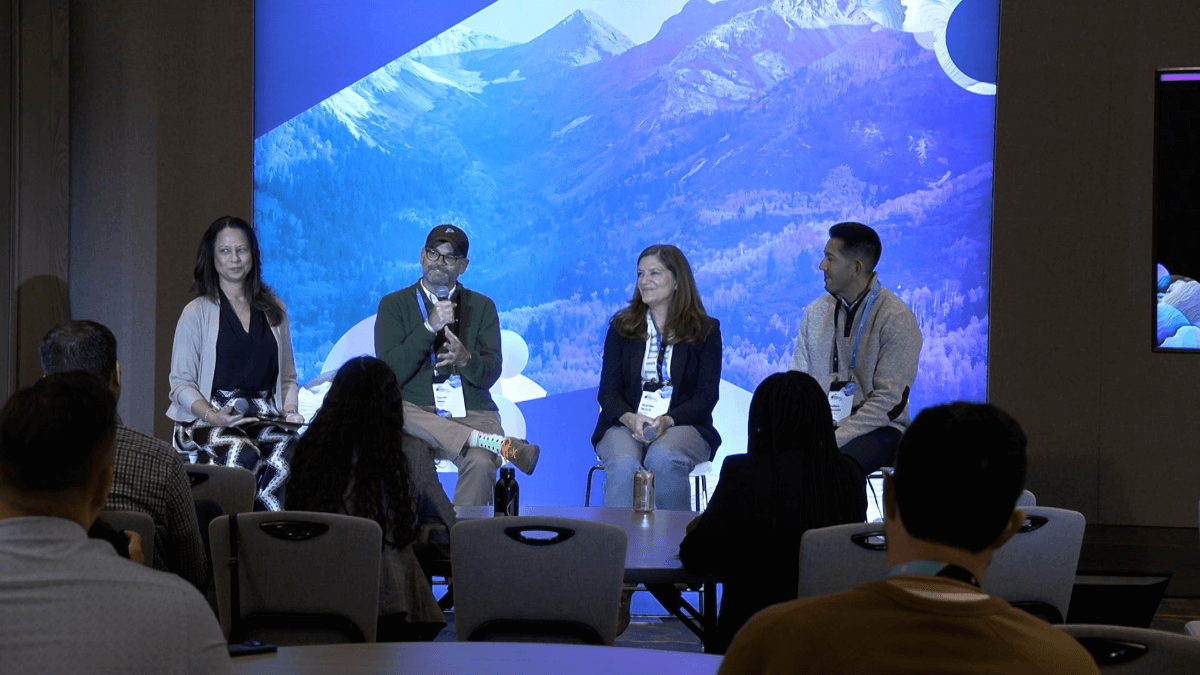
Hi, I'm Jason Lazzerini
the Chief Digital Officer at Central Pacific Bank.
We're about seven and a half billion dollars community bank
based in Honolulu, so I'm a little jet lagged.
Please excuse my punchiness.
Hi everyone, and good afternoon.
My name's Freda, head of marketing
for California Coast based out in San Diego.
All right. I'm Jana Manley.
I'm the Chief Growth Officer for Suncoast Credit Union.
We're headquartered in Tampa, Florida,
and we are about 19 billion, I think,
the last time I checked in assets. So, and growing.
Growing is good. Okay,
I'm gonna jump right into the hard questions,
but you guys have had time to prepare.
You know, at events like this,
we talk a lot about putting customers first
and consumer financial health, both
of which I think are admirable goals,
but like any goal, they require measurement
to understand whether or not you're making progress, whether
or not you are, you are meeting the definition of success.
I'd like to understand each of you starting with Jana,
if this, if these are things that your organization
is prioritizing today,
and if so, how you go about defining whether
or not you're successful?
Sure. I'll start. It's absolutely part of
what we looking at and focusing on.
It's even one of the five anchors
that we have in our strategic business plan,
specifically financial health and wellness.
So we have a heavy focus on that,
but I think most of the industry similarly, has a problem
with defining what is financial health
and some interesting
conversations we have when we look into it.
We're doing lots of different things.
So we've actually created a high-yield checking suite
that specifically geared toward
improving the financial lives of people who are low
to moderate income people, and
how do you help them financially manage their money.
We have various and sundry types
of loans that we focus on.
So we have a lot of different things that we do,
but we're trying to focus on how do you centralize that so
that you can have a metric
or a benchmark that better articulates
how successful you are in that thing.
Individually, we're actually looking at all
of the pieces that we've put in
to serve our members as well.
But I think it's one that we all struggle
with in figuring out what is the definition
of financial healthy or financially healthy.
We had that conversation earlier.
I think that one thing I might think
is, oh, Lord, that's scary.
One thing I might think is financial health,
and someone else would say it's this.
Like, we just can't all seem to come up to what that is.
So it's an interesting topic.
Yeah, I mean, you have to define what it is you are trying
to achieve for your customers,
and then what you're trying to achieve as an organization.
Freda how do you think about this at Cal Coast?
Yeah, so I think it is really, you know,
we talk about financial health
and education in the community.
It's really embedded in the heart and soul of our mission
and all of our goals and objectives,
both in the short term and the long term.
We do a lot of work in the communities to educate
and bring up the financial wellbeing
of our members across all the income brackets.
So not only the income brackets,
but also across the demographics
and of the different generations.
So as you learn today, in the last session
you met the gen alphas, and then you've got the baby boomers
and the millennials and all of their needs are different.
So when you talk about financial health,
it's not just financial health as in one size fits all.
It is really financial health
for those individual demographics, those age groups,
those different communities.
And it all means it's all unique and it's all variant
and it's all personalized.
So we are really seeing a big disparity across the levels
of education and the personalization of
the work that we're doing and the products that we sell
and the services in order to meet the demands
and the needs of the different age
groups and the demographics.
And last but not least, Jason, and,
and you mentioned, you're coming from Honolulu,
from Central Pacific Bank.
I'd be curious in your answer if there's anything
unique about that market that makes it more
or less difficult to meet your
customers’ needs when it comes to these issues of
consumer financial health and whatnot?
Yeah, it's an unusual market, I'll say that.
And
as my other esteemed panelists were saying, it's sort of hard to measure.
So we look at proxies
or are they engaged in the,
in our ecosystem, are they using bill pay?
Are they using direct deposit?
It's a good way for us to sort
of proxy into financial health.
In terms of the uniqueness of our market,
we've got a large Filipino community, right?
So that's, that's a huge demographic in our market,
and they tend to send money to the Philippines, right?
So remittance is a particular challenge that we have there,
and they pay high fees relative
to the amount of money they send.
Also, they don't speak English
as a first language.
So we have a really hard time getting them
to use the digital channels in particular.
They don't wanna deposit the ATMs, they don't want
to use the mobile application.
So we've taken a lot of time
and effort to put our ATMs into Ilocano and Tagalog.
We're putting, we're trying to translate our mobile
application on our online banking into those languages
and come up with a remittance service
that's really based on spread so that we don't have
to charge the individual individual fees for that.
And, you know, that's a win-win
because we take care of that community,
we improve the financial health of that community,
and they're super loyal, right?
We don't even need to market to that community.
They will tell all their friends and family.
So it's a really good win for the bank when we try
to find those underserved communities and tailor solutions.
Yeah, and I think that's a great example
of understanding the lead, understanding the needs
of the local market in responding to them, right?
I mean, I had the benefit of visiting your bank.
I forget what it was like two or three years ago.
I'd never been to Hawaii before,
and I've not been since, unfortunately,
You haven't aged a day.
But it really, you know, I think speaks
to something that, you know, a mega, you know,
money center bank, like a Chase, like a Wells Fargo,
just may not be as well-positioned to understand
or respond to in a local market when, you know, they have
so many other things that they're focused on.
I mean, the three of you do represent, relatively
speaking, smaller institutions in the U.S. landscape.
Suncoast has about 18 billion in assets.
Cal Coast, about 3.6
and CPB about 7.3 billion, if I looked up accurate numbers.
Hopefully close growing. There you go.
And I'd also note that two
of you up here represent credit unions, which
of course have a bit of a distinct mandate versus
their bank depository siblings, you know, as I was sort
of alluding to, I would argue rightly
or wrongly that the largest banks your JPMCs,
Wells Fargos, you know, relationships with consumers
often feel a bit zero sum.
You know, if we think about where profits are driven from,
whether it's things like overdrafts,
non-sufficient funds fees, min balance fees, you know,
these are structured in a way that consumers tend
to incur them when they're least able to afford to,
and are also often difficult to predict when,
when a user's gonna incur those fees.
So I'd be curious if there's something
specifically different in the mandate
of your organizations in the DNA, so to speak,
as a smaller depository, something
that's different versus some
of the largest FIs in the country as far as
how you go about prioritizing customer centricity.
And Jason, if we can start with you.
Yeah, well, that's a hard one.
I'll tell you what — we firmly believe that in Hawaii,
98% of the market share is owned by four local banks.
It's the first Hawaiian Bank of Hawaii, Central Pacific
and American Savings Bank.
There's no Bank of America, there's no U.S. Bank.
There's none of the big players.
And so we believe
that community banks can serve our community better.
That's something that we genuinely believe,
but we're in a very difficult position
because we are publicly traded.
We have investors that want us to protect margin.
So when, you know, deposit rates go up,
we don't phone every customer
and tell them that their CD is below market, right?
So we have to somewhat predict, protect that margin.
And so it's very hard to take care of the community
and also, not inform them at all times.
And one of the things that keeps me up is if you've run a,
the guy from Seattle Bank, who built
CD Valet, does anyone know him?
Howie. Yeah. Awesome dude.
So anyway, Howie built CD Valet,
and you can go get the best CD rate anytime you want.
And to me, if you can get pricing transparency at any point
that the elimination
of asymmetric information poses a real problem
to community banks, because you
can find the best price everywhere.
Why not go to Jenius Bank?
Why not go to a big player that can pay you more?
And so we have to find ways to drive value to the consumer
so that we're not competing on price
or God forbid, competing on risk.
And so it's a really difficult position
that community banks are in to try to find
that value proposition, maintain that ownership
of the customer in that connection to the community.
I mean, I think that's a great point.
I was reading something on the way out here about,
you know, the rise of online only lenders,
online only banks, including Marcus that I worked for.
And it's like the trade off there was, maybe it's more of a,
you know, anonymized
or non, you know, not super personalized experience,
but you're also getting, you know, market leading
or close to market leading rates.
And I mean, that's a trade off on the business side
as well as a trade off on, you know, is
that the right product?
Is that the right service for any given
consumer given his or her needs?
Jana, I'd be curious to hear your,
your perspective on the same question.
Yeah. So I have an interesting perspective
because they like to call me the reformed banker.
I was a banker for 25 years,
and so changing over
to the credit union space was very different for me.
And really understanding how you approach customers,
members for us, and or just what you're doing in general.
And I think that the mandate for us is that
we are here to make sure that we are providing affordable
financial services for members and communities,
and we thrive on that.
Oftentimes from a credit union perspective,
we're gonna go into places where banks typically won't even
go because that's where we're there.
So everything we do at the heart of it is
what are we gonna do to meet a need?
And so, while profit is important,
it's absolutely important.
As you mentioned, it is not the first
thing that we go at it from.
And so I actually did one
of the presentations when I was first starting at Suncoast,
and I was coming up with this new idea,
I'm in the boardroom, I've done my big thing,
here's the ROI, and they were like, that's nice.
What does it do for the,
for the person on the other end of this?
And so, well that to me was just eyeopening
because it is a little bit different if you have to say that
because you're not having to focus as much on,
I've gotta get this certain amount of profit.
It's really focusing on that need of the member.
And one of the things that I've always had the philosophy
on, and Suncoast carries that to heart as well,
so it was a great for me when I joined there,
is if you lead with the need
or if you can fill the need, the profit will follow.
And one of the things that I find truly amazing in the
credit union space is oftentimes where
the banking industry retracts from it.
When you have problems, when people have difficulties
they're wanting to not be able
to have to get into that problem.
We tend to go forward into that space.
We lend through problems.
We help people
before they can get into problematic spaces.
And what happens with that is you talk about getting people
who will be with you lifelong, you talk about loyalty,
the communities that rally around that,
because they know that you're gonna be there
to help 'em in times when many times
financial institutions won't.
That to me is
what the difference in the DNA in the credit union space is.
Can I ask a quick follow up question?
Are there products that your credit union offers
that other banks in that market don't offer?
I don't know if I'll say product specifically.
We've had some interesting conversations that in this,
in the financial services industry in general,
the products are mostly commoditized.
They're not that different.
It's really about how you're serving them, how you present,
how are you reaching the people that have the need
for the product that you have.
So I think it's less about the uniqueness of the products
and services, it's more about the
ancillary services that you can provide.
So for example, when we're looking at MX
and we're looking at the insights they're providing,
how am I gonna use the insights then
to help somebody meet a need?
Or how are we partnering with fintechs
that are offering a financial health type services such
as silver, such as Bloom, there's others that are here.
So I don't think it's the individual products themselves
that make it unique.
It's the how you're approaching in the segmented market
that you're approaching them with.
That makes sense. And how do you think about it
at your institution?
Yeah, so I'd say, you know,
it's really embedded in our DNA to help the community
and to serve our members.
It's, we're passionate about it, and we do it all day long
and all year long.
It's something that we are really proud of doing.
This year, we opened a branch,
we're actually probably the first financial institution
in the Promise Zone in San Diego.
So these are federally designated areas
that are called Promise Zones.
And I think they're 14 of them across the United States.
And they're basically underserved,
underdeveloped communities.
People don't often maybe have a social security number.
They have ITIN numbers,
and it's really an area where banks
and other financial institutions have not gone into.
And so it was really a big success for us this year
as we've opened up our first branch there,
and being able to serve such communities
and have had a proven success of really sort of being,
you know, playing a role model
and being that community leader in there,
really helping the needs
of those individuals and our members.
I mean, I'm detecting a common theme from the three
of you about that really sort of like in-person, human
to human contact, something that
you don't often see at online-only institutions
or at the large money center banks.
You mentioned,
and I tend to agree that, you know, ultimately the products
that FIs are offering are generally
pretty commoditized, right?
You're talking checking account, savings account,
you mentioned CDs, you know, maybe credit cards, mortgages.
I'm curious to hear from the three of you,
starting with you Freda, about what specific products,
capabilities, or features that you offer
that have the most significant impact on your
consumers’ financial health.
So it could be any of those.
So it, whether it's, you know, access to a loan
that they might not otherwise have access to.
Yep. A tool like you know, a PFM
or financial literacy, financial education, like what,
in your experience, and this could vary market to market,
institution to institution,
but what do you see actually moving that needle?
Yeah, so I think again, right, you, we have to go back to
that, commonalities saying
that the one-size-fit-all products, from
before doesn't really work anymore.
So you're really providing now a real, a little bit
of more of a diverse product set.
And that can range from anywhere from our ITIN lending.
So we do ITIN lending, or we do quick cash. Do
you wanna explain quickly what ITIN like,
what the difference is or what that means for folks
who might not be familiar with what that
If you, don't have a social security number,
it's very hard to get a loan.
So ITIN lending is probably is for people
that have an IT number
that are waiting on a social security number,
and we would do a loan to them.
We do quick cash, which allows
OSSA the underserved, underdeveloped communities
or people in need of quick cash that would ever go
to a payday lender and be charged
so much, so many high fees.
So we provide them with that opportunity to come to us for
that, gap funding.
I'd say, you know, on the education side, we do so much
where we go into the communities
and we provide free financial education.
These could be in the form of seminars
or workshops in the branches or at community centers.
We also add, you know, extra things
that really help our members, such as checking
with fraud.
You know, we offer free fraud features
that would help you mitigate fraud on your account,
or, things like that where you're really getting,
I'd say, personalized insights into your spending habits
that help you make better future decisions
as you grow your wealth and your financial stability too.
And Jason, from your experience at
Central Pacific, are there specific products, features,
capabilities, like in-person activations that you've found
are more successful
or less successful at sort of moving the needle out of
what you are trying to accomplish
and what your
customers are trying to accomplish?
Yeah. I mean, and the problem is
for all of us, I think, is that we work in a business
where the products are commoditized
and you have to try to figure out
how you get some unique value proposition using vendors,
which all the other banks can use.
So how do you cobble together a unique
value proposition with vendors?
And MX has been an awesome partner for me in particular.
We've got a great mobile app that's branded,
and I'm the first to say as,
even though I'm the digital guy at the bank, I'm the first
to say that nobody sits around the water cooler
and says, yeah, I'm gonna go to that bank.
'cause they've got a great digital app, right?
But once they come into our ecosystem, if it's easy to use
and we drive value, we earn the right
to ask for more business.
And we do a really good job of making it easy to
get information and then to open a new account.
So a lot of what we've tried to do is decrease friction in
our app and then make it easy to open new accounts.
And then the other thing I'll say that we're trying
to do is try to move
that same paradigm into the small business world.
Like we're a very good small business bank.
We have an outsized share
of market in our business, in our in Hawaii.
And, we're trying to bring that whole sense of literacy
to the small business market.
If you're a small business owner, typically, you know
your business, but you are not financially savvy.
And so they really need help.
They need help navigating that environment
and the SBA is one of the only places they can go.
So finding a way to curate that to be an incubator
for small businesses one way we think we can differentiate.
No, that's interesting. And I think a really good
point, particularly given that commercial entities,
small businesses lack the same kinds of disclosures
and protections that consumers typically would enjoy, right?
I mean, I'm thinking specifically about something like
TILA Truth and Lending Act and a PR disclosures.
I was just doing a keynote on
small business lending recently.
And with those kind
of like merchant cash advanced type products,
it's not always clear what the actual cost is
because it's just not something that can be computed
and disclosed upfront given the structure of the product.
Jana, I'm curious to hear your, your perspective on
what's really moving the needle as far as, you know,
your organization's goals and your customer's goals?
Yeah, we've talked about products and,
and actually that's one of the things,
if you guys heard me speak in one of our classes,
we always tend to go to product
as a solution for what's needed.
And we've just said that they're all commoditized.
So I would lobby it, if you've heard some
of the fintech banks that are out there speak, I will,
one I will not name, but I'll tell you what was said,
it was we don't have anything better than them.
We just market it better than they do.
And I'm like, Ugh, it's actually true.
But one of the things that
we do have great products, so I don't want you to think
that. I love the products we have,
but I think we all have to start looking at the fact
that they are commoditized.
And so it's not, product is not always the solution,
it's finding the need being where they are with that time.
So the things where we've moved the needle in
a good way, has been
through our marketing automation programs to make sure
that we have behavioral triggers.
So when we see an activity
or we see a behavior, we see that there's a need,
we can respond very quickly. Mm-hmm.
With whatever the product is, whatever the service is
that may meet that need.
So instead of doing these batch
and blast marketing campaigns, trying to drive something,
we're trying to build more of the programs
that leverage the data that we need to be able
to provide the products in the right moment for the members.
And those programs have been massively successful when you
talk about being able to drive the
growth numbers that we need.
Now, on top of that, I won't say that's the only solution.
There are still great products, and we do have some
that I think are fantastic.
More than some of the others, I would just say.
But, the other thing is also to your point,
looking at all the channels
and how do we make sure that we can get people
through those channels and reducing friction.
So it's doing that and then making sure we're using the data
to be back in front of those members that we've pulled
through those funnels and helping them
engage with the right products.
You provide the perfect segue
because I was about to say, the theme
of this session is on data, so thank you for that.
You know, I'd like to hear a bit from each of you,
and actually I'll start with you again, Jana, on
how you're using customer data.
So you just described a little bit,
but if you can expand on that,
to drive improvement in financial health,
I feel like we see a lot of folks reinventing the wheel.
Mm-hmm. You know, particularly with things like PFMs,
personal financial management tools,
and I'll admit, you know, I was a diehard Mint user.
But while servicing data and insights
and, you know, pretty graphs and charts, you know,
I think is legitimately helpful, particularly for people
who are already highly engaged in their finances.
And I'm sure that extends
to probably everybody in this room.
You know, it seems like that might not always be enough
for consumers who are maybe less engaged
or less financially literate to begin with.
So yes.
Data beyond this sort of smart triggering targeting,
being at the right place at the right time,
are there other ways you're, you're leveraging, data
provided by infrastructure platforms like MX?
Yeah, we, we actually have data that
we're leveraging a lot of the data with MX
because we find that to be very, very useful
and the data's cleansed.
And so we can be very confident when we're talking
to members or even trying
to recommend things with the members.
In that respect, we also buy data.
I mean, you can buy things that you don't know.
And I get
really interested in having some conversations
because when you do talk to people where you're trying
to buy data from, they're usually
trying to get you to a product.
And you've all heard that.
I'm like, I don't wanna get to the product.
I need to figure out the intent.
And so those are places where you can look at the Experians
of the world or the Claritas of the world
and try to come up with how do I get the data
that not only tells me the product that they need,
which is easy enough,
but then how do I get down to the intent?
So some of the things that we're doing
through our marketing automation programs are being able
to connect the digital footprints that they've got.
Mm-hmm. So I'll give you an example.
We may know that you have been clicking on Home Depot site
and that you've been doing some of these things.
And so we can get in front of you through our paid
media or whatnot to be able to say, Hey, there's a
likelihood that you might need a
home equity loan, or those types of things.
So that's been able
to help us not only very effectively target people
who have a need with a product that they're interested in,
but it's also massively helped
with our efficiency and our marketing spin.
So on the flip side of that, right, we wanna do what's right
for the member and what they need,
but those things are also gonna help
from an efficiency perspective.
So my goal with most of what we're doing with the data is
to build more automation programs that are always on mm-hmm.
Triggered by a need.
And then that way I'm having to do fewer
and fewer of the batch and blast Yeah.
Fall, spring types of things. So, makes sense.
And right now, I'm happy to say we have 37 automation
programs in flight all the time,
and we're building more every day.
And Jason, Central Pacific,
are there some examples you can give us of
how you are using data,
to better meet your consumer's financial health needs?
Yeah, I mean, we have more
data than we know what to do with.
I don't know if anyone else has, I
Feel like that's like, it's like a everyday problem.
I mean,
we got a ton of data.
We don't use it as well as we possibly can.
And I feel like for us, we're sort of in
a war against the traditional marketing arm,
and the traditional marketing arm wants to do
what they've always done 'cause it's predictable
and we're on, you know, we have to have our investor calls
and we have to demonstrate, you know, some return.
And so they want to, I dunno if you know this,
if you've been to Hawaii, we lead the nation in Toyota
Tacomas per capita.
Everybody's got a Toyota Tacoma, it's the car in Hawaii.
So we give away a Toyota Tacoma two a year.
And it drives me crazy
because that's not the best way we could be spending
marketing dollars, we could be driving more value into our
product suite, but it's
predictable and we know how to do it.
And so instead of using the data, we have to do smart things
and new things, and meet people where they are, we tend
to default to those old behaviors we can predict.
And so I find that we have great data, we do good things,
and we're kind of crawling along that pathway,
but we're often at a war with what we can predict
and what's kind of traditional
as we try to forge new ground.
And that's interesting.
As a former marketer myself, you know, I think it is easy
to just fall into a pattern of like, oh, well,
this is the playbook for doing X, Y, Z.
We're gonna turn out some direct mail.
Maybe we'll run some TV adverts.
And easy to overlook
or not take advantage of, like emerging tools,
emerging capabilities, as well as emerging channels.
Like I feel like we're probably mostly too old
to be on TikTok in this room, at least I am.
But that very much is a real place that people are
finding financial information, much of it very terrible
and wrong information.
So it's like, if you're not, you know,
if you're not aware of
where your customers are spending time,
you're missing a key piece of, of how they go about learning
and executing their financial life.
Freda, same question to you as far as
how your organization is leveraging data
and what kinds of data,
to support consumers' financial health.
So I'd say there's a big difference when you look at data
between member-driven data, so the data on your members,
which is your internally owned data.
You get off your banking platforms, you might get off
of your marketing automation platforms versus the data
that you need for growth.
So as we at Cal Coast, we expanded into five new counties
this last year, and we don't have any branches.
So we are fully digital and we don't market now
traditionally at all anymore.
We are completely using advanced digital
tactics and methodologies.
We use generative AI for, instead of before was SEO
or SEM, now we use AI-driven
or geo SEM, which really is targeting all of the
ChatGPTs and the co-pilots of the world, really
to raise the awareness of the brand and make
Sure, so you're actually marketing
to the generative AI bots so
that information will service when people are
Using. Yes. Yeah, exactly. So,
we've completely transformed the way that we market
and how we gather data and what we do with the data.
So there's a two-pronged strategy, right?
One is a member retention
or a member loyalty strategy, which is analyzing
and using your member data to provide you with the insights
and the information that you need to grow that member base
or household accounts.
And then there's the growth data that you need in order
to expand into new markets, target new customer segments,
and really grow your membership base.
And that doesn't come from, you know, lists
that you get from Experian or something like that.
That really comes through using innovation
and advanced digital marketing tactics
to really help you grow the business
and get the data sources from all different places.
Four square, you get it from, you know,
we get it all over the place.
We know how many times, let's say.
So we've completely reversed the way that we do
billboards, we only do digital billboards now,
so we don't do any out of home.
That's all the printed ones.
It's all now sort
of digital displays along the highways,
but we can track you for 24 to 48 hours.
Once you pass one of those digital billboards
for retargeting
or geotargeting, we get all of your information,
we know your habits within 48 hours of where you've been.
Once your cell phone hits that satellite,
we're capturing all that data.
You, we know that on average a new member
or potential member would go to a branch
or visit us online.
They would have about five
to seven different occurrences
before they would open an account with us.
And that could be over a course of time.
So we know the journey of, you know, when they've,
from their first impression with us in a digital billboard,
or they see us on a GDN or Google display ad
or something like that, to when they actually come
through the online channel because we don't have branches.
They go into the funnel conversion to funding,
and we track all that, that whole journey, digital journey.
So there is a lot of data.
We run reports through Power BI, we've got all
of the insights and analytics through lots
of different vendors and our fintechs overlays.
But, it all really comes
and starts with the digital journey
that we really transformed
and did a lot of work on last year to provide us
with the power of data
and analytics to really generate meaningful marketing
campaigns and programs for members and non-members.
That is fascinating how the different ways you're using
and tying together that customer information from, you know,
identifying prospects, marketing through to conversion.
I do want to close the loop with one last topic
before we move to some Q+A.
Of course, at the end of the day, these are businesses,
they need to make money.
I'd like to understand how each of you,
and we'll start with you Jason, think about tying
your customers’ financial health to the bottom line
of the business that you're running.
I mean, I think in the ideal world, you know,
it's the opposite of what I described of the big banks
where, you know, they profit from overdrafts
and NSF, so they're winning when customers are losing.
You know, if you could sort of expand
and explain how you think about the time
and resources your institution puts into fostering consumer
financial health with ultimately
what shows up in the P&L.
Yeah, I mean, the obvious answer would be
deposit growth or loan growth.
But the challenge with that is attribution, right?
As soon as you have loan growth
or deposit growth, I got a line of executives claiming
that it was their amazing
leadership that produce those results.
And so what I've really tried to do is find ways to tie
that growth or what I would call primacy
and share of wallet, or, those are
the two things I wanna measure.
Are they direct deposit customers?
Are we getting their primary core deposits
and are we increasing share of wallet?
And then because of the work we've done,
we can attribute, you know, that directly to the mobile app.
So if they're in the mobile app, they're using the tools
and they open an account through the mobile app, no one gets
to claim that but us, you know?
So we're trying to find ways to really attribute
the growth that we see through the tools that we build
and that we
encourage our customers to use.
Definitely makes sense.
I've had my share of attribution, fights, direct mail,
always wanted credit for some reason.
Freda,
if we can hear from you on the same,
the same question. Yeah.
You know, when I think about really, you know,
growing membership
or how does the membership, how do we add value
to the bottom line of the business?
For me, a happy member means that, you know,
it's a long term member.
We're not just looking at, you know, selling one product
or selling one service at a point in time.
We are really looking at developing a long-term relationship
for with you and your family and your,
extended family for a
through multi-generations.
It's not just one year, you know, a month or one year
or something short term.
So we really think long term, how do you offer,
really capabilities, products
or services for the Gen Alphas right?
To the baby boomers.
And you know, when you look at the demographics now
and your age range
of the membership is getting younger, right?
So you're starting to really see the 18th at 45 being your
main membership base.
You're having to sort of say, you know,
think about this is a sticky product.
You wanna household accounts,
you wanna retain the Gen Alpha all the way from when they're
18 all the way through to when they get married
and have kids and their kids bank with us too.
You know, we've been in the community
for 95 years, it's a long time.
And a lot of those members have been members of ours for
that period, you know, for a long time too.
So relationships
and really being that trusted partner to build
and help them with their financial goals
and success is something that really means a lot to us
and that we pride ourselves for.
And same question to you as far as tying, you know,
these kinds of initiatives that we've been discussing to,
you know, hard and fast P&L bottom line.
Yeah. So I think all of this is all the same, right?
We all try to focus on kind of the same thing to,
we tie it to the bottom line.
But the interesting thing to me is it's sort
of shifting as to what that would be.
So before, it's kind of like
the rates are gonna get you everything you need, right?
I can dial the rates up, I can drive all the business
that I want, and that's still true,
but how long will they stay with you?
The length of time they stay?
So a lot of conversations we're having, of course now is
around the payments and access to money movement,
because rates will get you here.
Money movement will keep you here if I make it hard,
if I create limit too many
limits or all those types of things.
So a lot of the digital wallet things are,
that we're heavily focused on is
how do I make sure I can really engage you in those payment
money movement channels if it's through transfers,
if it's through your card, if it's
through your digital wallet, if it's through cards,
card not present, or cards on file at other places.
Those are some of the big heavy focuses
we're kind of looking at.
And even looking so much at, if you think about
from a credit union perspective, we oftentimes,
we serve a very specific market which is
low to moderate income families.
So when you start talking about bottom lines,
you're often thinking about, how do I
drive lots of dollars right?
To the organization or lots of loans.
Well, that doesn't always work exactly
when you're dealing in the low to moderate income level.
So we've even started saying, how do you do this
with the velocity of money?
How can you make a healthy bottom line
with the sheer velocity of money?
Mm-hmm. That would be the money and money out.
How do I just, even if it's a net net,
how do I keep the money moving in and moving out?
And so those to me are gonna be really interesting ways
to start to look at having healthy balance sheet even going
forward in the future because
we're coming under such increased competition
as an industry from the neobanks, from the fintechs,
from the Venmos and the PayPals.
And so we're gonna have to start really
looking at it from that perspective.
Got it. There are a million other things I could ask you,
but I think we have saved.
Okay. Seven minutes. Not bad for some, some
Q+A so don't make me call on somebody.
I will do it. Do we have any questions
for my lovely panelists?
I just had a question. You mentioned
opening checking accounts
for people without social security,
with the current landscape.
What are some of the impact you're
seeing with those types of
customers? Was everyone
able to hear
the question or should I repeat it?
Yeah. Okay. On opening accounts with ITINs
in the current landscape there,
if there are any challenges, etc.,
I dunno if there's any challenges.
You know, you go through, we go
through our regular due diligence in KYC on the
opening of the accounts.
And it, you know, for us, I think, you know,
in all fairness, so that's part of our, the ethos
and our DNA is really providing these types of services
and financial products to the underserved
and underdeveloped communities.
Now you might have higher guardrails on them
or certain limits attached to them where, you know,
versus someone in a different income bracket.
But at the same time, to be able
to provide these communities with basic checking account
or a loan product is something
that we think as a credit union is
what we give back to the community.
We are here to help them.
We’re here to help them build the better financial future
And, you know, and guide them through it.
I mean, I think I'm gonna add, even though
that question wasn't to me, yeah, I think that something
that the, you know, the ITIN
question illustrates is it's often consumers
or businesses that are more difficult
to serve for a variety of reasons.
In this case, it's like BSA/AML requirements, KYC,
that if they're also perceived correctly
or incorrectly as lower revenue
or less profitable, that becomes the reason why
those big money center banks
don't wanna deal with it, right?
Like, I don't wanna have to stand up a compliance process
for somebody who has an ITIN
or a matricula, like a consular Id.
Like, I could do it, it's within the bounds of the law,
but is it worth the time
and resources to invest in serving
that customer versus the deposits versus the loan growth,
whatever the, you know, interchange
revenue, whatever the metric is?
And I think that, you know, yes, you know,
these are all businesses as well,
but I think, you know, there's a bit
of a difference in the DNA as we were discussing earlier
of like the impetus to serve
a community that, you know, for better
or worse, you don't see,
you're not gonna find that at Chase.
No one tell Chase I said that.
Okay, I think we have
time for one or two more questions.
Anybody?
How do you guys like use the data to ensure
that the customers are engaged, right? Because
essentially now what I'm seeing is
retaining the existing customers, right?
Costs a lot less than going and acquiring new customers.
So do you guys use any specific framework to, you know,
utilize existing data
and see, hey, this is how I can go about, you know,
improving the engagement with our existing customers?
I'm gonna add to his question also.
I mean, so an example of that
and, you were mentioning, you know, Venmo,
Cash App, you know, various apps.
You know, if you are seeing a customer who,
to quote like a Ron Shevlin term is,
is using their account at your bank
as like a paycheck motel.
So the money comes in from direct deposit,
but then maybe it's all going out to other places,
it's going out to Cash app, it's going to Venmo,
it's going to Robinhood, whatever.
Are those things that like your institutions monitor
and attempt to influence to change that behavior?
I don't know if anyone
wants to volunteer to answer that.
I mean, depends on what you're looking at the,
to use the data for.
So if it's to get insights on deposits, then you,
we have definitely, data that's collected on
deposit activity as it occurs throughout the month.
So we know timing of when you see inflows
and outflows of the accounts.
We'll see, we know when
their spending patterns on deposits
and spend analysis for interchange.
We do check, you know,
interchanges, credit cards, and debit cards.
We look at categories such as attrition
or spend attrition.
And then we'd even go as far as looking at segmentation of
that attrition by grocery fuel,
any spend on category on your credit card or debit card.
And we go further then to see the demographics of
that credit card spin and the age range as well.
So your marketing becomes really hyper-targeted.
It's not even just, oh,
I see you're spending less on your credit card.
You're talking about now really cutting your marketing down
vertically and horizontally, many, many layers so
that you know exactly your age range is spending.
So now we know 18
to 25 are spending 30% less in the last six months on
groceries versus our age range of 45
to 55 in that category.
So that's how we really look at it.
And then we'd really target the marketing campaign
to the age range and the demographic so
that it meets their needs
because you're marketing to Gen Alpha or Right Gen Zs
and it's not the same proposition
or message as going out to a baby boomer or a millennial.
So I wanna add to that one.
So, I think that is one
of the most unsolved things out there
that we have not figured out.
And I've said this, actually,
I put it on a sticky note when we were in the off here
yesterday, is the big question that I want to know,
and I've thrown it out there for MX to help me figure out,
is how many billions of dollars have moved off
of our balance sheets into Venmo,
into PayPal, into Cash App?
We do not know. And I would lobby to you, there's trillions
of dollars out there that have moved off of balance sheets
and into those places,
and when they go over there, we lose sight of
what they're spending on groceries, what they're spending,
they could be spending it out of there.
You have no real idea.
So it becomes this kind of ghost dollars, right?
And so one of the biggest things that's on my objectives is
to figure out how do I find out
and how do I figure out how to market to move
that money back to the balance sheet?
I'm gonna tell you I have not figured that out,
but I have challenged our MX partners
to help us figure that out.
Because I think if we could do that,
that's a massive amount of, massive win for us.
Because oftentimes you'll find Gen Alpha,
I've got one at home,
and he's like, he moves it over there to do something
with it, and then you think, well, they spin it.
No, they leave it there 'cause they forget it's there
and it starts to get like just little dollars
that are adding up all over the place.
Well bring it back if you're not gonna leave it over there
and think about how that's benefiting those organizations,
but they just have random cash hanging out on a balance
sheet so that everything that you said I love
and I wanna do that, but I still think there's a
gaping hole with this one.
And that is, as an industry, it's a pin.
It's the little prick pins for us.
It's just money bleeding over into these apps.
And so I don't have the solution.
I love that you're thinking about it
and I think that we should all try to
No, I think, I mean that's a great point that there,
there's clearly a reason why Yeah.
Consumers of any age bracket are doing that.
You know, there's the ability
to detect certain amounts of it, right?
JP Morgan Chase always gives me a notification when I move
money out to like some test account at Robinhood saying,
don't you really want a JP Morgan Chase brokerage account?
But you know, there's a lot of leakage
and there's a lot of opportunity.
Yes. But I think we are going to have to leave it there
'cause we're exactly one minute over.
Thank you so much to MX for hosting.
Thank you to my panelists.
If we could get a quick round of applause for them please.
Freda Amir is a highly experienced senior leader with a successful track record of over 20 years managing global marketing teams for top-tier financial services and brands. Her expertise lies in building consensus, influencing decisions, and taking ideas from concept to implementation through business case development, as well as understanding marketing strategies.
Freda Amir is a seasoned marketing executive with over 2 decades of experience leading global teams at top-tier financial institutions. Renowned for her strategic acumen and ability to drive growth, Freda has a proven track record of developing and implementing successful marketing initiatives.
As Head of Marketing at Cal Coast CU, Freda oversees the development and execution of a strategic growth plan focused on expanding the credit union's reach in Southern California. By leveraging advanced digital marketing technologies, she is instrumental in building a strong online presence that drives membership growth and enhances customer engagement.
Prior to joining Cal Coast CU, Freda held senior leadership roles at industry-leading firms such as AXA Group, BNY Mellon, BlackRock, Fidelity, and Goldman Sachs. In these positions, she demonstrated her expertise in developing and implementing effective marketing strategies, driving revenue growth, and repositioning brands.
Freda holds a Master of Science in Business and Public Policy from George Mason University, a Bachelor of Arts in Economics from American University, and a Postgraduate Diploma in Digital Disruption from Oxford University's Said Business School. She is a CFA ESG Certified professional and is passionate about sustainability and ESG.
Jason Lazzerini
Executive Vice President, Chief Digital Officer, Central Pacific Bank
A financial professional focusing on topline growth and digital transformation, Jason has more than 25 years of leadership experience in the financial services sector. Prior to joining CPB, Jason was a management consultant and served as the President and CEO of Locations, one of the largest real estate services companies in Hawaii, with a brokerage, property management division along with title, escrow, and mortgage lines of business.
Jason has held leadership roles in the banking sector for most of his career. At American Savings Bank, Jason was the Director of Home Loans, led the Investment Services Division and Business Banking group. He was also the Director of Learning and Development and a Regional Executive at ASB. Jason has held leadership roles in consumer banking and wholesale lending at Deutsche Bank, U.S. Bancorp, and the Canadian Imperial Bank of Commerce.
A recovering professional musician, Jason is still active in the arts and the community. He serves on the Executive Board of Hawaii Contemporary and as an advisor on various non-profit committees. Jason has been faculty at the University of Washington’s Foster School of Business’ Pacific Coast Banking School since 2017.
Jana Manley is the Chief Growth Officer at Suncoast Credit Union, where she leads enterprise-wide growth initiatives with responsibility for product and payment strategy, payment operations, marketing, and digital strategy. With more than 25 years of leadership experience in banking and finance, she brings deep expertise in designing and delivering innovative solutions that advance member engagement and financial wellness.
Jana began her career in consumer banking, holding a variety of growth-focused leadership roles including Director of Growth and Engagement Marketing, Director of Activation Strategies, and Senior Vice President of Product Management at regional banks and financial consultancies. She joined the credit union movement at Suncoast, where she served as Director and later Vice President of Digital Strategy before being promoted in 2021 to Senior Vice President of Marketing and Digital Strategy. In 2025, she was named Chief Growth Officer, expanding her role to include product and payment strategy as well as payment operations.
Her work has a significant impact on Suncoast’s growth trajectory. By aligning marketing, digital strategy, product, and payments, she focuses on creating seamless, hyper-personalized member experiences while anticipating and adapting to rapidly changing technologies. Her leadership helps Suncoast strengthen relationships with its members and deliver meaningful value at scale.
Jana holds a Bachelor of Science in Finance from Auburn University, a Master of Business Administration from the University of Alabama at Birmingham, and has completed advanced studies at Louisiana State University’s Graduate School of Banking.
Jason Mikula is an independent fintech and banking advisor, consultant, and investor. He also is the publisher of Fintech Business Weekly, a newsletter going beyond the headlines to analyze the technology, regulatory, and business model trends driving the rapidly evolving financial services ecosystem. Previously, he spent over a decade building and scaling consumer finance businesses, including at Enova, LendUp, and Goldman Sachs.