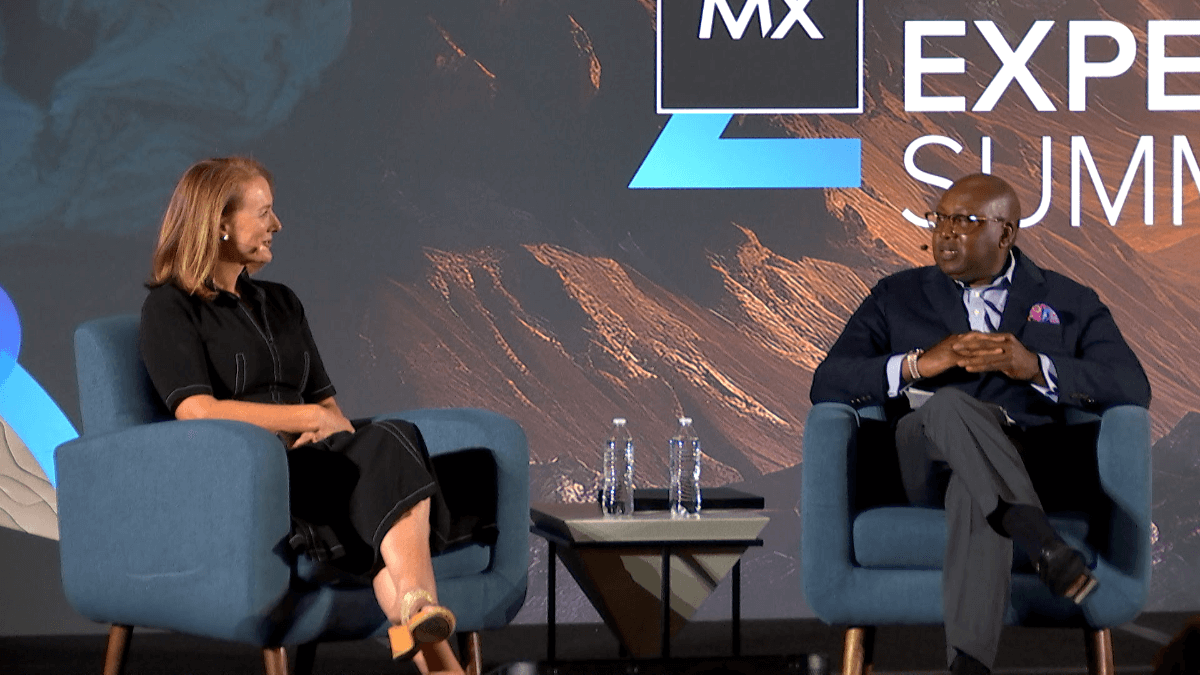
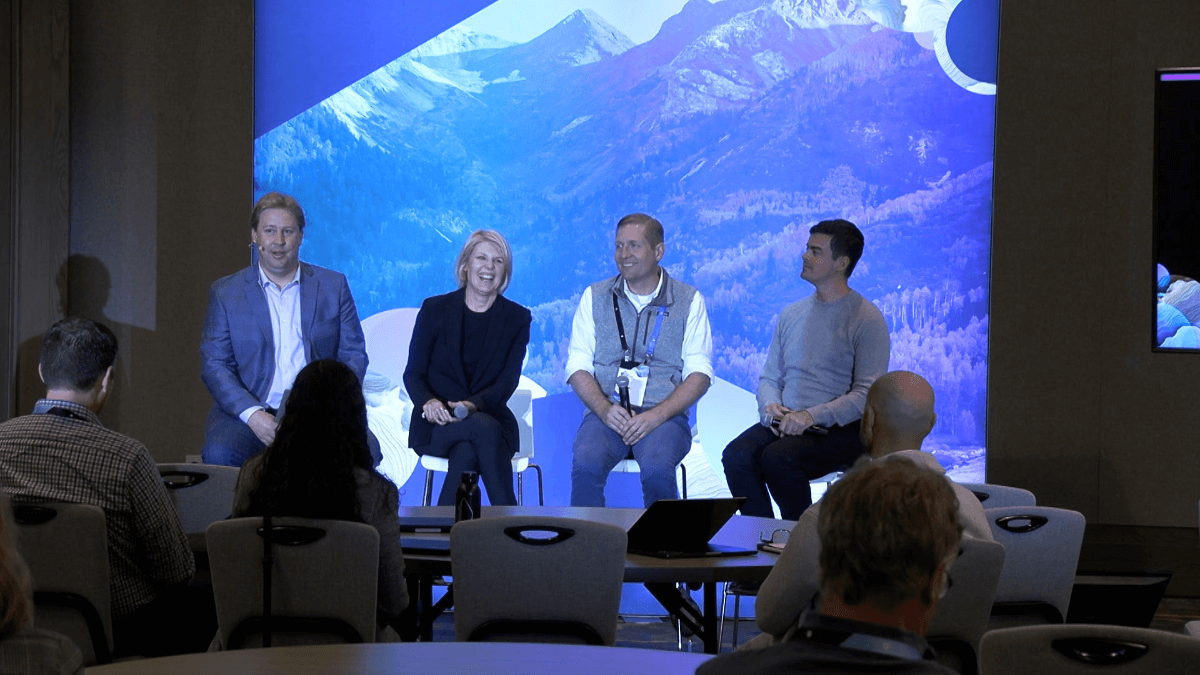
Aggregating the Aggregators … on Stage | From Data Movement to Value Add
For the first time, we’re inviting our colleagues, and sometimes competitors, from Plaid and Yodlee to join us on stage for an open dialogue about how Open Banking is the first step towards turning data into action.
Transcript
Hello everyone.
We have had a really fantastic day talking about turning
data into action,
and I am excited to close this out with,
what I think should have really had a drinking game,
a panel with aggregating the aggregators.
Joining me for this conversation is Eric Jamison, head
of product at Yodlee; Jane Barratt,
Oh my God, I practiced your title… Chief Advocacy Officer
and head of public policy at MX, our excellent host
for this panel and conference.
And the man of the day, John Pitts,
head of industry relations and digital trust at Plaid.
Hello everyone. Hello.
So it feels like every week we are getting an open banking
update and frankly, I'm finding it hard to keep up with it,
but we were not spared news today.
Can we level set where we are as an industry,
both as the aggregators
and then as we think about open banking and using data?
What are some
initial thoughts you guys have on the ANPR
and where the CFPB seems to be in general?
John, I'll start with you.
Sure. So let me try
and condense the last like nine months.
I'll give you a minute.
What?
Okay. A minute. We have an open banking rule.
I've heard that rule is in effect, okay.
In the last nine months, the CFPB has said: we think
that rule is illegal.
Okay? Two, we no longer think that rule is illegal
and we are doing a new rule.
So the right way to understand the market right now is there
is a Schrodinger's Cat rule that is both alive
and not alive simultaneously.
The clock is ticking on everyone's compliance timelines.
But the CFPB has opened up a new front of
what might change in the rule.
Now I'm gonna focus most
of my minute on what's in the ANPR
'cause I actually think it's really, really interesting.
Okay. What you take away from that,
there are four things broadly in the ANPR.
Is a company a representative of a consumer?
Meaning, do they have the right,
if they get the consumer's consent,
to access that data.
For everyone in this room,
open banking does not exist without that.
So that's the big one.
Second, should fees be permitted for cost recovery
in the market? Third, is security good enough?
Fourth, is privacy good enough? Okay.
So those are the four things that are in the ANPR.
I actually want to wrap with
what are the things not in the ANPR?
Because I think the things not in the ANPR are actually more
Interesting. Liability is not in the ANPR.
Data scopes are not in the ANPR.
And, as someone who has fought this battle
for the last seven years, let me tell you, the things
that are actually underlying the litigation
and are the big points
of tension in this rulemaking process are
liability and data scopes.
Okay. And the four things that are in there,
they're all important
— and especially representative is important.
But my sense is we are doing a lot of rulemaking
for what might ultimately turn into very little change
from the little cat in the box we've got right now,
which is the 1033
rule. So I'm hearing more
lawsuits are expected. Yes. Okay.
Yeah. I think from a level set perspective, it's very easy
to make open banking equal regulation,
but open banking has existed in the U.S. long
before there was regulation.
And I know we have many Financial Data Exchange people here.
We have over a hundred million accounts being
shared through open banking APIs,
which means a hundred million accounts are not being screen
scraped. Credential pairs have been
taken out of the ecosystem.
There is better privacy. There is better security.
There are a ton of bilateral agreements in the marketplace
that has enabled data to flow.
I think the real challenge
with open banking is just having its scale deeper
through mid-market, through the long tail.
And that, you know, we've had enormous amounts
of success in concentration in larger banks and
larger fintechs.
Now it's how do we take it to the wider?
And I think there is always the challenge of so much
of the oxygen gets taken up with 1033 and this CFPB,
and meanwhile the industry keeps chugging forward. Yeah.
Eric, would you like to add anything about the ANPR?
You know, it's interesting right now,
we have about 35 days
before the responses are due.
It's the second time that we're doing it. And yeah.
Second time that we're doing it in
as many years, I think.
The feedback loop is there,
which is, I guess, somewhat promising.
But, you know, the fact that we have to do it again.
Yeah. It's like, you know, we've done this
before. We've been down this path before.
You know, the fact that we have to dust the same stuff off,
and respond again is
a bit of a challenge. Yeah.
So something that came up as an issue
and a sticking point potentially in the first ANPR
or the first comment period
and has come up again, John, is that
should banks be able to cover their costs?
Would you like to share a little bit about
maybe Plaid's thinking about cost sharing
and what you'd probably want to see out of an agreement
and whether this is something that is available
to all banks or just some banks?
Yeah, sure. So, uh, I guess elephant in the room for those
who don't read the news…Imagine
not reading the news while you're here, like on today.
Imagine being in a country where you don't have
to open the news the second you land on your airplane
because God knows what happened in the last 15 minutes.
So, Plaid signed a deal with JPMC where we will be
paying for some API improvements
and data access going forward, extending our agreement.
I'll give you my personal view.
The 1033 law
clearly makes paying fees for access illegal.
It says the consumer shall have access upon request.
Okay? I'll give you a preview,
because it's probably gonna get deleted from my ANPR draft,
When Gandalf says you shall not pass,
it's not like you shall not pass
unless you pay me a little bit of money.
It's you shall not, you cannot do this. Right?
So this is an imperative. Fees are illegal.
Congress made fees illegal for this data access.
I do think there is a huge amount
of market uncertainty right now.
Sure. And, in that market uncertainty, all
of us have been dealing with sort
of the negotiation of these fees.
I think that overall where Plaid has landed, um,
is a good outcome for us and for our customers.
Okay. But I do think that sits under the shadow
of, if the CFPB was fully doing its job, none
of us would be in this position.
Absolutely. And these fees would be illegal.
So my plan is I'm going to continue
to advocate throughout this ANPR process that
fees are illegal
and Congress made them illegal when they created 1033.
Well, I was joking beforehand about the
thought experiment of the prisoner's dilemma
and,
how if we all are stay united in the prisoner's dilemma,
all the prisoners get off better.
So fellow prisoners,
Jane and Eric, what would you like to say?
So, I mean, we have a lot
of customers in the room who consume data.
Yeah. Right? So inbound aggregation,
this is a zero sum game, right?
If you're charging for data out,
it's gonna cost more for data in.
So we're just adding cost
to the ecosystem under the guise of covering costs of API.
And if it was covering costs of API, again, there's a lot
of people in this room that know how it actually works.
These APIs also run their call centers.
They also run mobile banking, right?
They're not specific standalone APIs.
You know, you have management layers, you have middleware,
but that's a very different cost proposition
to building APIs from scratch.
So if you are looking at, okay, we're going to,
add costs,
what's the increased benefit? Yeah. Right.
And at this point, there isn't marginal benefit
for adding this cost.
And in fact, we all know that fees eventually roll downhill.
Mm-hmm. And, if we have financial institutions
that have managed to cover the cost of all
of their branches, their call center, their mobile app,
their online banking, open banking is just another channel
the way those other four are.
And so why is this being treated different? Right?
Should there be a tollgate at a branch? Right.
Should you get charged every
time you open your mobile app?
You get charged for paper statements.
Now that used to be free and checks.
Well, you get charged for ATM fees. You do, right? You do
if you go out of network, if you're in network,
The fees don't apply.
So, I mean, is there precedent for banks to charge
for these types of access to data or money?
There is, right? Mm-hmm.
I understand the perspective
that there is some investment to turn those systems
that are in place, that have been in place for a number
of years for different types of use cases towards
the delivery of that data to the market, if you will, right.
To the open banking ecosystem.
I understand that,
but where does the line cross
between the cost of doing business
and the cost of giving consumers access to their data.
Yeah. Right. And so, I mean it's a dilemma
we are all going to be dealing with.
Obviously, you guys were first of that scale.
And it's something that, as we progress
along our journey in there, we'll see what kind
of outcomes it’s going to impact for us and our clients.
'cause ultimately we're not doing this
for the purposes of just having access to data.
We're doing it because there's a consumer on the back end
that wants to interact with their data
through a different type of application.
It's their choice and enabling
that choice is what we do. Right.
Well, I'm excited to tell Chase what I charge
for my data when I give it to them.
And then we can just talk later.
Eric,
are the current restrictions on secondary
data use appropriate?
Should they be loosened? And how should that be determined?
So, you know, they're ambiguous
is maybe the best way that I would describe it initially.
The notion of secondary use of data.
I always try to personalize it
and think about my personal experiences, right?
I might work with an app where I want
to consolidate all my accounts into a single place.
My motivation there is I just want
to get a comprehensive view of my data through
that interaction with that application.
That app says to me, “Hey, we notice that you are more
of a revolver on your credit.”
Right. We've picked up the fact
that you are not paying off your credit card, by the way,
a credit card that has a 33% interest rate, right?
So you're getting charged an arm
and a leg (sorry, credit issuers here)
an arm and a leg for the access
or the use of that application.
They also pick up that I have $10,000
sitting in a cash account
that maybe I could use to either pay off
that debt or they have a comparable program.
Maybe I'm doing it through another bank
that has a comparable credit card
that maybe has a promotional rate for me
that I could take advantage of,
or just a lower rate credit card.
Does that constitute a secondary use? Right.
My primary use was the notion of aggregation.
Bringing my accounts into a single place.
Does that constitute a scenario where
that's a secondary use?
There's again, a little bit of ambiguity.
Getting those types of alerts is why I'm interacting with
that as a consumer.
And you would actually probably think
that's a good use of your data.
Exactly. Or a natural extension almost
of the product itself.
Perfect. Exactly. It's giving me an actionable insight on
my information that's relevant to me.
Yeah. That helps me take action on that
and achieve a better financial outcome.
That's ultimately why I'm trying to use those apps.
And so ensuring, it's going to be hard,
it's going to be a lot of consent driven.
Right. Which again, we might have to,
from an FDX perspective, start dusting some of
that stuff off again.
But to allow a scenario where consumers can interact
with the data in that way is really the key thing. Yeah.
Any other thoughts on secondary use?
I mean, it's been normal course of business for so long.
Right. And the things, again,
what we solved in bilateral agreements were data usage
rights for things like product development,
platform stability, marketing, you know,
infographics, research.
Right? All of these things are considered secondary use,
but they are secondary use for the benefit of consumers.
Right. Developing better products,
getting better fraud signals.
So if someone has to opt into all of those things,
we just immediately bring down the value of
a corpus of data that is de-identified
and incredibly valuable
for the industry. I think it was solving a problem
that could have been solved with a
nail with the sledge hammer.
If we're looking to reduce the resell of data.
If you're looking to move away from predatory
practices, then do that.
Don't do a broad sweeping
“let's take away every secondary use.”
John, can you share one prediction about the ANPR
or the court case that won't leave this room?
And
Everyone, there's no phones in here, right? Yeah.
Off record. So let me give a prediction.
I think we are about to spend three years
to get something that looks
remarkably like the current rule.
Awesome.
And, everyone should be super enthusiastic about that.
I think,
unless there is a change on the representative one,
which would destroy the entire open banking ecosystem, like
that is the one that is the catastrophic risk.
Yeah. Unless that changes,
and I think that there is very little appetite within the
CFPB to, for example, go to war
with cryptocurrency companies.
We all saw they got a little bit agitated over the last
couple of weeks over some of the things
that were being proposed in the market.
Stripping them of representative status
for the consumer would be an agitating moment.
Okay. If that does not happen, this ANPR is set up
to basically replicate the current rule, maybe
with some tweaks around the edges.
And so my second prediction is,
not only are we gonna spend three years to get something
that's 5% different, at most, we will then immediately be,
be met with litigation
from whichever side that 5% was carved. Okay.
So I think the unfortunate reality
of this market right now is it's going to be a market
with a much higher degree
of uncertainty than you would want
at the same time where the consumer
and commercial demand for increasing open banking
is growing exponentially.
And in particular, the use of data in
by traditional banks
and credit unions, largely powered by MX, is
growing much more rapidly than it has in the past.
And you're starting to finally get
to a real equilibrium in the market
where it's not like banks and fintechs.
It is just financial services companies doing open
banking on an equal platform.
Having that level of uncertainty
and like legacy litigation is not going
to be particularly well matched
to the commercial imperatives of this moment.
Any other predictions about the ANPR and court case?
Do we think anyone wants to take the other side
of John's bet? No,
That's going to be dangerous.
Significantly different. No, we're
going to solve it, talking about government here.
No more court
cases. We're speaking about
government here, right?
So I mean, to argue the sense
that we would have ended up with a very different outcome.
With the questions
that we've seen, I don't see it.
Nope. I would have a tough time making that argument.
Right, sure. And picking that in the debate card
tomake that argument.
I think, again, I don't want to just echo,
but I do think John's right.
I think we're about to go through an exhaustive process
and end up kind of where we were in the beginning.
Right now, maybe it's job security, right?
Maybe by the time I'm able to retire. Right.
Maybe there will be some rule,
but, the way it's looking right now,
I wouldn't put money on it. Yeah.
Well, and I think it's also important to,
or there's an increasing,
or maybe there always was, like this market practice
and this like regulatory
thing, right?
And so, for thinking about me as a bank reporter,
The thing
that's scariest for me about the court case is
that it would convince banks
that they don't have to do this work.
Yeah.
and Chase is not a bank that is going to be confused by
that message, but there are thousands of community banks
that will be confused by this message
or won't comply with a rule or won't comply with it
if there is no rule. They won't do it for their customers.
They won't spend the
money, they won't make the investment.
And then I will just see this bifurcation,
not immediately,
but just like a slow bleed
of these financial institutions losing customers,
not keeping up with products, not able
to know their customers
and know what their customers need or innovate
because they chose today to be like, well, chase
and PNC (sorry, this is, this is my personal opinion too)
they believed
and they followed the lead of those big banks.
And that's what's confusing, I think
for the people that I write for.
I have enormous amount of empathy
because we deal with, you know, a lot of technologists
and strategists and digital banking people,
consumer banking people who 100% understand the
competitive opportunity, the security opportunity,
the insights, all of those things.
But many institutions have very robust technology roadmaps.
Yeah. And budgeting is always tied. Mm-hmm.
And it was
the regulation that was actually driving the investment priority.
It was, yeah. Now with that going away,
we are hearing it from a lot of our clients
and partners is oh, we're just gonna kick it down.
the road. And just
that competitive moat keeps getting bigger.
And bigger. The longer you wait…
It's found money and found resources, right?
If I don't have to do it. Yep. Right. Yeah.
It's a bonus. I can potentially wait now.
I think sometimes
that can be a shortsighted view as well, right?
Because there are consumers, they're members, right.
If we look at the credit unions who
are looking to leverage this.
I think that's one of our topics later,
but I jumped the gun.
Well, Jane, you gave yourself this
question, what is the best
case
scenario you see for open banking?
And how do you see open banking fitting
into the future of finance?
So not wanting to go like full hyperbole
but I will. We have very few opportunities
to do a sea change in an industry.
And this actually is one of them
because today, financial services
has been driven by products.
Even if you like, show me a bank website
and I'll draw you your org chart.
Yeah. Right. Here's your lending,
here's your deposits, here's your cards.
It's just very predictable.
Nobody wakes up thinking, oh,
I need a new credit card today.
Sometimes you might
Actually, you may be in the minority,
but there is, you know, with this move towards, okay,
what are my customers actually doing?
Not what is market research telling me?
Not what is my marketing team telling me.
It's like, what are my customers actually doing?
They're showing me the signals of, man,
we suck in lending, or, you know, we need
to have better money management tools.
So you are getting the cheapest market research
to drive your product roadmap,
like instantaneously at all times.
And I would hope — here comes a hyperbole — that changes
how people are actually serviced.
It's not about products,
it's about how do I help you?
And I loved our generations panel earlier.
If anyone missed it, it blew me away. Right.
They all need to be treated differently
with the same digital products.
How do we even begin to do that as an industry?
It was so interesting to hear that the children
talked about how they need financial advice
and that they understand the limits
of their own intelligence
and they didn't mention their parents
talking to them about money.
Yep. Yep. And then it was so interesting to hear
the elders speak about how they're
also feeling similarly overwhelmed by the next stage
of their life and being like, did I save enough money?
I'm not going to go out
and get a job if I don't have enough money for retirement.
I was like, man, there better be someone in this room right
now coming up with some journey
to help like someone in their 50s figure out if you
can retire at 65.
And it shouldn't be
capitulate it to Vanguard.
Maybe it's Vanguard's problem, maybe it's not your problem
as their financial institution,
but that's a choice you're making, right? Yeah.
But then you're going back to being a product provider.
Right? I know. And then as we move forward,
and with the rise of a agentic AI
and sort of bot to bot negotiations,
what role will institutions
and frankly even fintechs play moving forward?
Yeah. If it's just agent to agent,
like now we're the gas company, I don't want to work
for the gas company, that doesn't sound fun.
So I think there is an opportunity to say,
okay, what role can we play
at the different
times in someone's life to actually help move them forward?
And if there's one problem we can solve,
and if everyone takes off their professional hat
and just put on their human hat,
they're different, but it still takes a lot
of work to manage your money.
It does — even with everything that we know in this room.
Why is it still so hard? Right?
So if we can get to a place
where mental road load can be reduced,
better decisions can be made through data.
Actions can be taken either through a click yourself
or by your financial provider.
And we can actually measure over time
how someone's life is getting better.
You are better off banking
with me than Bank X down the street.
Right. That’s a really compelling
argument to make.
I'm hoping for a lot of things
and I could keep going, but I won't
because I know I gave myself a limit.
Any other best case
not mired in litigation. Financial journeys
through from college age to retirement.
You know, I had this this weekend,
ironically enough, I had a friend who was getting together
with his financial advisor for the first time,
and my first thing was, you waited this long?
Second thing was I was like, well, how are you doing it?
Right? And he's like, oh,
I gotta get all my statements together,
And I I'm like,
in today's world, this is how you're doing it?
I was like, you know, there's apps for that.
There's experiences that help that.
So I'm like, who's your advisor? And ironically it’s Vanguard.
Uh, so I'm like, oh, wait a second. I can help you there.
I think people have such a fear
because it's not taught. It's not taught in school.
It's not. Firsthand,
my son going through the education program,
it was not taught in school.
We were taught how to balance a checkbook.
I had a pass book that I would go to the bank every weekend.
Oh, okay. Well, speaking for maybe John and I.
It can seem intimidating. Yeah.
And that's, one
of the things that drives me as a product person is
how can I help change someone's life through an application?
Right. Through the use of data,
through the use of insights.
How can I help put a person in a better position
to retire early?
Maybe his decision is, can I retire at 62
or do I have to wait till I'm 67?
Yeah. And, putting him in a position,
and having it not be such a daunting
task is what we're here for.
So John, what do you see as the worst case?
Yeah, I was saving myself up for worse.
Yeah.
so I talked a little bit earlier about the
uncertainty, right?
Like, we're gonna have a couple of years of uncertainty
and I think a thing that is undervalued in the market right
now, and all three of us sit on the FDX board,
And this is a conversation we're starting to have an FDX,
but need to have much more aggressively
and need to have as a group, is like the competition is not
between screen scraping and APIs.
The competition is between open banking APIs
where everything is interoperable
and everyone is benefiting
and a dystopian future of this market that's going
to have two components to it:
Proprietary API networks, where you try
and control market share by saying we have these APIs,
they only work for us and we have the dominant market share.
and anyone who would like to use them must pay the tax;
and agentic APIs for accessing data in a way
that cannot be controlled.
And, in particular, device-based agentic. Show
of hands, how many people have an AI
on their phone right now?
ChatGPT, Apple Intelligence, Claude, something like that.
How long do you think it is from
that app on your phone being just an app on your phone
that you access to that app being on your phone right next
to your Chase or Wells Fargo
or Bank of America app that is able
to directly access it
and do whatever you are instructing it to
or carry out instructions that you have given it
a while ago and continuously carry those instructions out?
So I, I think the competition
for open banking right now is not bank vs fintech.
It's not fintech screen scraping versus API.
It is, are we going to have open standards
that anyone benefits everyone.
or are we going to have proprietary networks competing with
sort of undetectable untraceable everywhere
new model API screen scraping or reverse engineer API. Why
Is that a worst case scenario though?
I feel like I kind
of feel like we are kind of getting there.
So why is this bad for us?
Yeah. So there's two reasons why
I think it's bad for us.
The first reason is, at the end of the day, the thing
that I'm think is most important about open
banking is competition.
Every consumer benefits when companies have
to fight harder for that consumer's business.
Yeah. That is the single most important thing
that open banking achieves.
And if you have a world where, like Eric, Jane
and I are competing with each other for proprietary networks
and seeing who can grab the most market share
that is a world
where like we are competing against each other
to run monopolies
and everyone inside the walls of
that monopoly has a worse outcome as a result of it.
That's a terrible future.
Don't tell my like CFO
'cause like he might view
It as a great future, but like
that's a bad outcome for the ecosystem.
The agentic sort of uncontrolled
AI-driven screen scraping is also a bad outcome because,
and this is where like banks have a legitimate point,
and aggregators
were not necessarily there at the beginning,
but I think all of us are there now, which is like,
you need risk management in this ecosystem.
ou need a way
to understand when data goes somewhere.
Like what are the potential harms of that?
How do you deal with breach? How do you deal with liability?
A lot of that gets done contractually right now.
It's one of the big values
that aggregators add to the ecosystem.
Frustrates me,
and I know Jane would like absolutely get on a soapbox on
this one when you hear from a bank say, oh,
aggregators don't add any value into the system.
Great. Hey, would you like my 7,000 customers
to come directly to you tomorrow?
Yeah. Right. Fricking luck with that.
So that level of sort of security risk management
that gets baked into the ecosystem, you lose that in a world
where everything is single point.
And the biggest loser is
the consumer when something goes wrong.
And I think there is a, just to follow on in terms
of giant risk
and worst case outcome, this argument around,
what is a consumer.
And is a representative
or an agent, you know, do they represent the consumer
or can only the consumer get data?
Now, if there is a ruling that says, yep,
consumers only. Third parties can't access the data, all
of the data that we rely on to understand our clients,
to get, you know, fraud signals to do all of the things
that we do every day is going to become
infinitely more challenging.
it will accelerate the move to, okay,
so if only a consumer can get their
data, give it to my phone.
And you know what, there'll be AI that can
spread it on out there and it's just going to accelerate a much
more chaotic future
in the short term.
Whereas, you know,
we've barely got the open banking infrastructure together
for the thousands of institutions
and the thousands of fintechs.
And this will just leapfrog all of that work
and take it into a new realm,
which is inherently more risky. Yeah.
Well, the name
of this panel is aggregating the aggregators.
And one thing that I've noticed is some of
the verbiage that's getting thrown around
for these guys on stage.
Quoting a recent Bloomberg article, they said,
and you know, this might be in the past
'cause Plaid signed an agreement,
but JP Morgan argues
that aggregators which connect third party fintechs
to customer account information are freeloaders
that take advantage of infrastructure built by banks.
Would anyone like to dispute the characterization
of freeloading middlemen
and share why, in your opinion,
we need aggregators to build a
financial infrastructure?
I'm not gonna argue. I feel like a freeloader.
I don't want to speak for my colleagues.
I don't like being called a freeloader.
I can't point to any industry
that is built upon other people
Banking in essence was built upon the treasury, right?
Sure. Many moons ago. Right.
Someone needed a place to put their money.
So I don't want to hear anything
about being a freeloader.
I think the key thing that John talked about is
there's an ecosystem, right?
It's not just fintechs that are using the data, it's banks,
wealth management firms as well.
They are looking to access that data.
The only way to do that, right, in an effective way, is
to connect to one that gives them access to many
Our job, not to mention all the connections
that we have to manage, all the data access agreements
that we've all had to slog through.
There's all the integration work, right? Yeah.
There's nuances to every single one of those, which again,
as an FDX member, we wanted to try to, you know, do our best
to help consolidate, come to a, a single standard.
But it's hard, right? There's
so many different size institutions, types
of institutions, products that they offer.
Whatever we set today is gonna change tomorrow.
Sure. If the banks want to go
and make all these connections now, it's only gonna be,
it's like a balance sheet,
it's only as good as a point in time.
It's going to evolve, it's going to change,
and they're going to have to adapt.
They will have to do it already for themselves
as they offer new products.
And now they're gonna have to manage everyone else's too.
So that's the real value that we provide.
Not to mention the structure around, you know,
categorization, merchant identification, all the information
that bleeds into the AI, right?
The AI models that are looking to use this data,
those models are only going to be as good as the data, right?
And so there's a lot that of value on top of that data
that we help structure.
for that type of interaction.
I just want to imagine like,
and maybe we can all close our eyes
and picture this in our mind's eye,
what bad middlemen there are in financial services.
Could you imagine a world where
what someone's business was
they would borrow money from someone
and be like, I'll pay you 3%.
And then they would take that money and go to a business
and they're like, I'll let you borrow this money from me
at 6%.
Oh, no. That's an awful middleman service
that the entire economy is built on, right?
That is the core business of banking
is interest rate management.
And like, I do not have the time to decide whether
I want to loan money to Jason so that he can buy a house.
Like also, I don't have enough money to loan Jason
to buy a house, but like through middlemen,
we have the actual value transformation of deposits
through the freeloading bank middle.
That is the whole thing.
So like middlemen are actually a very important part
of financial services and the best way to demonstrate that.
If you think
that freeloading middlemen should be out of the market,
open your APIs directly and let everyone come in.
Yeah. Right.
And we all three of us should be terrified
of competition constantly of direct connections.
Banks should be building direct connections
that are better than our services.
Like that's great. Put me
out of business by building a better one.
That’s the right
outcome for the market. Yeah.
I got to say, our investors
would probably be pretty upset.
Well, we're not here for that.
But, something
that isn't acknowledged is the years,
and I'm gonna say hundreds of millions of dollars
that we've respectively spent to code up to all
of these APIs, right?
We are the outsourced quality control for these banks.
We are, you know. We have taken what is a
commodity machine readable piece of data
and turned it into something transparent
and actionable for the ecosystem.
So that's, again, so you can say open up the APIs,
but what good is raw data really? Yeah.
Right? And this is where, when, not specific
to any one institution,
but when I hear someone is freeloading off
of infrastructure we've built,
what I actually hear is we actually don't know to how
to use half of that infrastructure.
Yeah. Because the reality is the value
of open banking is very similar
to the value of credit reporting.
No bank, to my knowledge,
charges the big three credit bureaus
when they furnish data to them.
It is expensive. I'm sure it costs some
amount of money to furnish data.
The reason you don't is
because you furnish data from one institution
and you get back when you need to underwrite loans —
data from 10,000 institutions.
Yeah. And in a world where 10,000 institutions charge
for furnishing, your costs of getting
that data are going to be very high.
But that's great because you make money on making
loans and making good loans.
Right. And the reality is, fintechs, banks
and credit unions that have taken advantage of data in know
that the value of data in
is higher than the cost of data out.
Right? Right. And there is no financial organization in this
country that is 51% of data out.
So if you are, let's say 10% of the data out market,
that means 90% of the time,
if you have a great open banking use case,
you are getting data from other people.
Right. That is a net positive transaction.
And that is the shape of this market. Yeah.
If everyone figures out how
to build really good use cases,
if you don't have a good use case, then yeah,
I'm sure you are unhappy about data out,
because you're just thinking about it as a cost.
You're not thinking about the holistic picture of
what great products you can build based on consumer data
from thousands of sources other than your own institution.
My personal open banking story is that
I'm a financial reporter for 15 years,
but wasn't that good with money.
Who among us, I mean,
but, one of my friends told me to start using,
You Need A Budget, which is powered by MX and, I think, Plaid,
but mostly MX.
My first 30 days
with You Need A Budget was radicalizing.
It changed my relationship to money I used to have,
and I didn't even understand that.
Like, I had money anxiety,.
I was constantly doing mental math in my head.
I constantly worried about having money.
I felt out of control of my money and I did not understand.
I was like, I don't need open banking.
Like, this is so stupid. Like,
why do I need my consumer data?
Because in part, because I already had it, right?
Like, I had my digital accounts, so I had my data
and then the budget and all the transactions
and putting in like how I wanted to spend my money
and where I needed to allocate it,
it both took all of that out of my head.
and it made me feel like I was finally in control
for the first time in my life from my money.
My main bank is Chase and
Chase never worried that I had this problem.
Chase was not interested in giving me this tool.
I had to go out and buy this tool
and I had to pay for this tool,
and then I had to download all my data
and I don't even get eight, nine APIs from Chase, so I have
to do one account fully, manually.
But it was, to me, I was like fully radicalized
by this experience,
and I was also disgusted that Chase
didn't care to offer it to me.
And that's when I think about banks saying,
we know your customers and we want to
help you in your life.
I think that that's kind of a lie
because they didn't care about this problem that I had.
Now I still use their credit cards
and that's a different thing.
But it is still, like, I don't,
when they talk about buying a house
or when they talk about retirement, right?
Like, I don't trust my bank to do it
because they didn't do that.
So speaking outside of my personal banking use,
we did talk about consumers driving most of this market.
Jane, what has MX seen when it comes
to end user consumer cases
and what they want… from financial customers other than
me and my beef with
Chase?
So we have well over a decade of experience working
with both like Jesse at YNAB
and a lot of third party tools,
but we've also developed a whole suite
of our own digital money management, right?
So net worth tracking, budgeting, debt reduction scenarios,
everything that can be white labeled and
inserted into a mobile app or into online banking.
And we also have a standalone white label mobile app.
So we really can help our clients control
that end-to-end experience.
So we're on the other side of that. Yeah.
Which is our clients care deeply about their
customers’ outcomes and them having a great money experience.
And the sort of things that we've seen over the years is not
static is good.
Okay, now you've got your budget and check a box
and you'll be fine for the next 10 years.
Right. Expectations always get raised.
And it was why, you know,
a few years ago we launched an insights tool,
like just an embedable widget
that is based on your data.
What's something that's very specific to you that's
coming up and then
that those expectations keep getting raised.
And what we see is, every time we add more
value, consumers add more data.
Yeah. Right? So that's good.
Right? Right. It's amazing how that works.
So, um, especially when we launched Insights tool,
we went from, say if someone had two accounts aggregated
and that's what they were looking at their net worth
tracking or budgeting, we'd implement insights
and they would double their number of accounts.
So if they had three, it’d go to six, four to eight.
And that was like mind blowing. Yeah.
For us and for the team to be able to say, okay,
there is always more that we can do.
And, you know, people have an average of five
to seven accounts, and I'm sure most
people in this room have more — I have
like 14. It’s really
hard to keep track of even for all of us.
So, um, it is such a,
privilege to be able to go on this journey
with so many of our clients
and to then give their customers the sort of tools
that really promote
better data sharing practices
and this very mutually beneficial data exchange.
Any other use cases
that we're seeing from consumer preferences?
One of the ones, again, firsthand,
subscriptions, right?
Trying to get a handle on all my subscriptions.
that's one of those applications
that open banking really,
I don't want to plug Rocket Money,
but if you haven't tried it, it’s powerful
to see all your — you probably have an idea in the back
of your head how many subscriptions that you have — but
until you see it on screen,
you don't realize how many you really have.
Oh yeah. The duplicates.
To Jane's point,
it's not static, right?
I, maybe a year ago, had 15 subscriptions, right.
I might have canceled three but seven more pop up.
So it's like being able to be alerted to
that, “we picked up a new subscription.”
Those are powerful types of experiences
that do help people
find ways to save money
and turn it towards, again, better actions.
How can I better plan for that?
So those are tools that are really powerful for users.
Well, I wanted to let our audience know
that in about five minutes I'm gonna
open this up for questions.
We have runners with mics,
so if you could just raise your hand,
the mics will come to you.
In about five minutes I'll open it up.
John, what are some ways that open banking,
or sorry, what are some technical improvements
that can be made to make open banking better
for fintechs and banks?
So I think there's a couple of things.
One,
right now if you are a bank
and you have a API for data out,
you almost certainly are not taking enough advantage of it.
And I know that's a weird way to talk about this
because you think about like data in
as the value proposition,
but I think the $20 bill lying on the sidewalk right now,
And Jane alluded to this earlier with
how much free market research you can get. I you use
that API correctly, you can see
what your consumer is doing in places
outside your organization.
We've actually started doing a little bit of scoring work
and are gonna be rolling out something a little bit later
this year where, with a pretty high level
of predictability based on your customer's behavior outside
of your organization, you can identify the small percentage
that are a churn risk in the next six months
and intervene to prevent that churn.
And that is really, really nice. Yeah.
Amazing to know like who your churn risks are
and not just who your churn risks are,
but who your recoverable churn risks are.
That’s gold,
rather than just waiting till they leave.
Well, or rather than just like blasting out mailers
of like, “Hey, by the way, sorry you left us,
or sorry, you're not our customer.
How about we give you $600 for free?” Yes.
In order to open an account at our bank, as long
as you keep enough money in it for the first couple
of months, like
that's an incredibly imprecise helicopter drop of money.
When APIs offer you a level
of precision in knowing your customer
that most institutions are
not taking advantage of right now.
The second big technological improvement is
to stop thinking about these APIs
as a static system that does not evolve.
And one of the things in our conversations
with JPMC that I think was
really enlightening was like, okay, well, like how do we
reach a deal that means the API is better for everyone?
We're not just talking about European
regulatory minimums, but like, how do we make this better
for the entire ecosystem?
How do we make it perform better?
How do we get the right SLAs?
And I think getting in that pressure of this needs
to be something that's continuously improving
and ultimately, like we should be going from a world
where it's, you are calling the API a couple times a day
to see if there is new data
to we are pushing new data when new data happens
and we are doing this real time
because that ultimately gets better data quality, better
timeliness for the consumer and a real time world.
That's what you want. Like my dream is to one day have
a shopper be able to be like, I am in a grocery store,
I have $5 more groceries than I have money in my account.
Can I instantly make a decision
between whether I want to do an earned wage access transaction
that costs me $1
or an overdraft transaction that costs me $35
and can I do all of that in real time on my phone during
that checkout process so that I get
to the optimal outcome for myself?
We are not there yet,
but improving the technology can get us there.
Any other technical improvements
that we should be thinking about?
This isn't so much even technology,
but it's the use of technology.
One thing that we talk about a lot is the ability —
like fraud is on everybody's mind.
There are always
new apps popping up
and also there's a bunch of zombie apps still out there.
Right. And so the technology exists today to instead
of going, oh, let's have a very laborious process to go
and analyze each of them, you can use push notifications
and say, is this app from, you know, 2012?
Do you still use it, Kiah? Yes. No.
And we ask Kiah and five people,
and if five people say no, then we ask 50.
And if they all say no, then maybe that's pretty good signal
to say we might want to start to look at
reducing access to this app.
Yeah. So there are the sort of things that there's
a lot of leeway within the existing terminology
that can really help reduce risk
and build insight into what's actually going on out there.
Sure. Versus, you know, the big boogie man of like
all the data is just being sucked out
of the ecosystem at all times, and which frankly isn't true.
Yeah. Because someone still needs to pay for it.
But I think it would go a long way to, especially
for fraud and risk teams to, to have some
play offense, not defense.
Sure.
Eric, I
think completing a transaction is another
one that I think of, right?
Again, it’s a use case scenario,
but being able to identify savings
and then trigger, okay, I want to move that into savings.
Or to John's point, being able to make
a decision rapidly and execute on
that right at point of sale.
So I think that there's a lot that
you can connect the dots
between the open banking that exists
and the types of other transaction based
scenarios that also exist.
You can connect those dots as well. Perfect.
Do we have any questions for our freeloading middlemen
and women? You are
hilarious.
Did I see any hands go up?
Oh, in the back? Uh, yes sir.
Hi guys. Hey, could you say your name please?
Just so we know who you are. Alex Johnson.
I write Fintech Takes and am obsessed with open banking.
And my question is about open data more broadly.
So obviously a lot of the fights
and drama that's happening right now is happening over a
relatively narrow patch of ground with deposit accounts,
credit cards. But there's a much larger set of financial data.
There's a much larger world of commerce data,
and then there's kind of the largest possible world
of all the data that's connected to consumers.
And I was curious to get your take on
what the current fights over all
of this maybe indicate about the future
of open data more broadly?
And Jane, knowing you, maybe you want to take that one first.
Well, I always sound very parochial when I lead
with an Australian example,
but if anyone is unaware,
Australia passed a consumer data right
maybe five or six years ago.
And how that's different
to pretty much every other jurisdiction is it is a
legal ownership
of your data regardless of category. Right?
So they started at this very ambitious place of,
it's your asset.
You legally own it. And now everything that falls under
that — privacy, security, access — it
falls within a legal framework
of ownership. In the U.S., we're talking about a
legal access right.
Not an ownership right.
And so I think Australia did a really good job
of setting the path and they moved quickly.
They did start with open banking, open finance, they moved
to open energy, open telco,
and it was just an expectation now that people can access,
compare price, shop
and switch much faster between providers regardless
of categories.
I think the speed of open making in the U.S. does not bode
well for open data in the short term.
However, again, with the speeding up
of just data access, AI agents,
it is very possible that we'll take the lessons
of open banking and start to apply them across others.
And, you know, it's something
that we talk about a little at Financial Data Exchange,
could this interoperable standard actually scale? Right.
And we don't know the answer to that as yet.
Any other thoughts on open data?
People are used
to it in other aspects of their lives, right?
Yeah. Energy is a perfect example of where you can shop,
you know, which energy provider you want to use
you might get serviced by one,
but you're getting power from another.
I think there's
obviously a market for it.
There's a need for it. We're unfortunately
fighting over that small piece right now.
And it felt like we were starting
to drift into open data
and it's unfortunately kind of hit a wall
for a little bit, but I still think
that is ultimately the goal.
Yeah. Because, you know, creating a will, right?
Having a plan
around life insurance is not covered under the current open
banking notion.
That's an important part of anyone's plan. Yeah. Right?
If you don't sit down and have that conversation, right.
If you're scared to have that conversation
'cause you don't have access to the data,
it's a challenge for consumers.
I optimistically wanna see us get
there, but we’re not right now. Jane,
do we need the government, like in Australia?
did they need the government to like do this? Well,
I mean,
We’re living in the middle
of this right now, right?
Because without the regulatory imperative,
many companies, we're not embracing of banking.
So I'd say the answer is not empirically yes.
It's for certain, especially for longer tail that need
that regulatory push to get involved.
Any other questions?
You’re pointing that way.
Yes.
Hi guys. Since , Alex opened the door to
tough questions, reciprocity, Jane,
you brought up other regions, some regions, Brazil,
Canada, although budding, have enshrined reciprocity into
their regimes,
should data recipients also be required
to be data providers?
And many of them are —
and I think we have. I mean,
you're better on the numbers
'cause you work with more of them,
but like an enormous amount
of the data flowing is actually coming from fintechs.
Yeah. I mean the short answer is yes, Al, like,
whether it's legally or privately,
the answer is yes, Jane referenced it.
But I'll give you the overview. Of Plaid's
30 largest data providers,
about a third of them are fintechs, not banks.
And what that means for most banks
who are not thinking about
what data they could be getting from fintechs is like
literally money on the table
because they're only thinking about themselves as sources
of data or aggregating against other banks
in the banking data.
My personal opinion is that
the wall between financial services
and commerce, which we've held for quite some time, is
Swiss cheese to the extent
that the holes are bigger than the cheese at this point,
and is only going further in that direction.
And so, you're going to have to have reciprocity
and also the consumer demand for reciprocity is going
to outpace any regulatory requirement
I think.
We had a question on this side of the room also in there.
Back row.
Back row.
I'd probably piggyback on that same question.
From a customer
or a member perspective, in my case,
I need to be able to control my data
and I need to be able to say where it can
and cannot be used.
And the thing that that depends on is the three
of you working together to make it so
that I can create a single point of access for
controlling that data.
Is there a question in there?
So my question is, while
I love the services all three of you provide,
like we use all three of you
and love what you provide to us.
The question I would have is,
who is the blocker in you working together?
I want one of you
to point their finger at the other one
and say it's their fault
And no. So, so
like the, the blocker legitimately is DOJ, FTC.
Like there are limits to how much we should work together.
You should be getting great services from us
because I am constantly trying
to steal market share from Eric and Jane
and they are constantly trying to
Steal market share for me.
Like yes, it would feel great if we just had one,
but like there are real problems.
Yeah. Shouldn't there very quickly just be one
data aggregator instead.
Yeah. One ring to rule them all.
Like nothing has gone wrong with that in the past.
Right. I I think if I'm going to paraphrase Bryce's question
though, it's like if he has to direct his members
to three different places to control access.
Yeah, that is, and and I think that is something
that could potentially be solved through FDX.
There is a lot of, let's say working groups, on
consent, on authorization
and having more clarity there, I think, is gonna help a lot.
I do think the sort of proliferation
of a unified control panel for data controls,
that is something that we all have
our individual efforts on.
I think some of the FIs have their individual
efforts at some point asking the consumer
to control their data 30 different ways is telling a
consumer they can't control their data
and you're going to need something.
I don't think..
the honest answer is I don't think there's
a blocker yet.
I think you just don't have enough momentum built up
to do a consolidated approach to it.
So far.
One more. Yeah, go ahead.
At the risk of making Eric charge out here
because I call him a freeloader
or something, I think the key
to the freeloading argument is volume, right?
When this was originally designed, access was I come
and get that access once a day or something like that.
Apps today are doing that by the minute. Right?
And so that is a massively different conversation in terms
of that infrastructure and how that infrastructure is built.
So I agree that the infrastructure is there
and it's available, but if all of these apps start coming in
and getting their data every minute,
all you're gonna do is kill all of us.
Yeah. You know that, that's a good point.
John's point of the conversation that they had
with JP Morgan around updating the APIs, right?
Moving more towards a push scenario, right.
Where we don't have to knock on the door.
It's getting sent is something
we've all talked about, right?
It's been a topic of discussion before.
And,
again, maybe this is something that, you know,
optimistically starts to move the market in that direction.
Maybe this is a way we can start implementing standards
that allow for that.
The goal we've been,
I guess, we've been referred, to as a grandfather, right?
of this industry?
It's not necessarily what I'm ready to be referred to
yet as, but, you know, a lot of
what we did early on was just based upon the access, right?
We've always worked very closely with the FIs to ensure
that we weren't bringing down their systems.
The last thing I worked at a little .com startup
and back in the day, we did an update for Discover,
and we did the update,
pushed the code out into production,
get in the car on the way home.
I get a call, say, Hey, what did you do?
I'm like, I didn't do anything.
What do you mean what did I do?
They're like we just got a call from Discover.
It looks like we're trying to do a denial of service attack.
'cause we were trying to refresh some customer's days.
This is circa 2003.
I turned the car around,
we figured out what was going on.
But we've always tried to, and that was
before … that was at a different company that I was at.
But Yodlee has always tried to work very proactively, right?
And to work with scenarios like look,
we have application providers, we have clients
that are looking to have much more
rapid access to that data.
How are the ways that we can work with you to ensure
that we're not impacting your ability
to service your customers where
and when they want to interact with you,
but allow them to have the same types of options
through the other apps that
they're choosing to interact with.
So I think that there's opportunities, again,
I think we're all kind of dealing with this ANPR right now,
but you know, this is going to open the door
for other things down the road.
That was always the plan with FDX
and open banking.
And I think we just gotta kind of crawl,
walk, run to get there.
Any other freeloaders wanna chime in?
I think we can get a lot more
precision now on use cases.
Yeah. And so it was often the earned wage access providers
that needed to know have they been paid yet?
Had they been paid yet? Had they been paid yet? Yeah.
And so that would spike, you know, every two weeks.
But it wasn't, have you been paid
yet every 30 seconds for the whole week?
But I think there's a lot more precision
and control you can put around limits through a lot
of our respective infrastructure.
But, you know, we hear you.
It had been a problem.
I mean, let me end on a downer note
with a positive element to it.
Please. No, I was hoping you would.
You are absolutely right.
And the downer side of it is: it's going to get worse, right?
From a volume perspective
because that volume is not driven
by like the app feeling like one day,
once a day wasn't enough.
Now let's do it a hundred times.
It's based on use case and consumer demand. Right?
And now let me tell like the positive AI part,
That's a good thing though, right? That
it's
a direct correlation to consumer value.
And you can question like how much the marginal value is,
but there is a real correlation there.
AI is coming on the scene, right?
And when it is agentic-driven decision making,
I think we are going to see an exponential
increase in the data and demands.
We've already seen it in other parts of the ecosystem.
Not financial services
where AI is operating like the data
demands go through the roof.
And we all need to build the infrastructure and build cheap
and efficient infrastructure that powers that
because of the value that that's going to deliver.
So I've said some bad things about AI,
but let me say a good thing here.
Because I love audience participation, show of hands.
Who in this room thinks you are in the top 50 percentile in
America of managing your financial services?
Managing your finances?
Oh, your personal FI top 50 percentile.
Are you better than the average? We got some people
who are below average in this room.
Okay. Who thinks they're above average in this room?
Okay, so some of you are wrong
because half of you should have raised your hands.
By definition, half of you are the best in this room
and half of you are worse.
Right. And you can take any group of people
and half of them are going to be worse.
Yeah. And with agentic AI, that's not true anymore.
Right. We're all gonna be the best you can all not naming
not all be the best, but you can all operate
as if you were like 75th percentile.
Sure. Fairly easily.
And you talked,
Kiah, about the immense relief you felt
with YNAB
under like getting yourself under control, like
exponentially multiply that.
Yeah. I've got someone
who is better at me than financial services
who is taking action at my broad direction that I don't have
to think about and my outcomes are better.
Yeah. And half of the people in this country just by going
to the median, are going
to have a better outcome in their financial lives.
Yeah. So that is a thing we should be not just aiming
for, but like we should be linking arms
and running as fast as we can to that outcome
because of the amount of consumer
and human benefit that comes from it.
But the price of that is going to be we need infrastructure
that can handle data amounts
that make the API volumes today.
feel like dial-up modems.
Well, John has kept you guys from drinks long enough.
Please join me in thanking them.
Thank you everyone. Thank you. Thank you.
Speakers
Jane Barratt
Chief Advocacy Officer and Head of Public Policy, MX
Jane Barratt is the Chief Advocacy Officer and Head of Global Public Policy at MX. Jane is a long-time investor and champion of financial strength. In her role, Jane collaborates with financial institutions, regulatory bodies, and industry groups to ensure people have better financial outcomes via secure access to their data. She is a financial educator through LinkedIn Learning. Prior to MX, Jane was CEO of GoldBean, and spent two decades driving growth for Fortune 500 companies.
Kiah Lau Haslett writes about banking at Workweek, where she nerds out about all things banks. Her special areas of focus include accounting, transactions, balance sheet management, and how technology is changing banks. She spent 6 years at Bank Director, first as managing editor and then as their banking and fintech editor overseeing the FinXTech platform, and was a financial institutions reporter at S&P Global Market Intelligence for eight years. Kiah has a bachelor’s in journalism from the University of Nebraska.
Eric Jamison is the Head of Product for Open Banking Platform at Yodlee. Eric is responsible for
driving strategy for the Yodlee platform that brings together powerful capabilities to connect data,
uncover hidden intelligence using advanced AI and ML that delivers data-driven insights
throughout an organization.
As an accomplished product and sales leader, Eric has worked with countless Yodlee clients to
solve complex challenges, embrace digital transformation, and deliver unique and differentiated
interactions to better engage and serve their customers.
Eric is a long-time veteran of the financial services sector. Prior to joining the company, Eric spent
a combined 10 years with FIS/Metavante. His role in the payments division primarily focused on
the online bill pay and payment fraud management space, helping to drive product development
and innovation. Eric began his career with Bear Stearns where he worked with various cash and
asset management systems.
Eric is a graduate of Rutgers University and earned his M.B.A. from Rider University in New
Jersey, where he currently resides with his family.
John Pitts
Head of Industry Relations and Digital Trust, Plaid
John Pitts is the Head of Industry Relations for Plaid, a financial services technology company. Plaid helps consumers control their financial data to get the best digital financial services possible, from popular apps like Venmo and Coinbase, banks like Citi and Wells Fargo, and companies like Comcast and Tesla. In his role as Head of Industry Relations, John leads industry efforts to create a safe, innovative, and fast growing digital financial services ecosystem. He previously served as Head of Policy at Plaid, advocating for open finance laws in North America and Europe, and has consulted on financial data and consumer protection laws and regulations in the United States, Canada, the UK, the European Union, and Australia.
Before joining Plaid, John served as the Deputy Assistant Director for Intergovernmental Affairs at the Consumer Financial Protection Bureau. At the Bureau, John worked with the state Attorneys General to promote cooperation and coordination between the states in enforcing the Dodd-Frank Consumer Financial Protection Act. He was a regular speaker on NAAG, CWAG, and State Center panels on topics including student lending, payday lending, and emerging financial technologies like cryptocurrencies. John started his career as an attorney with Orrick, Herrington & Sutcliffe.