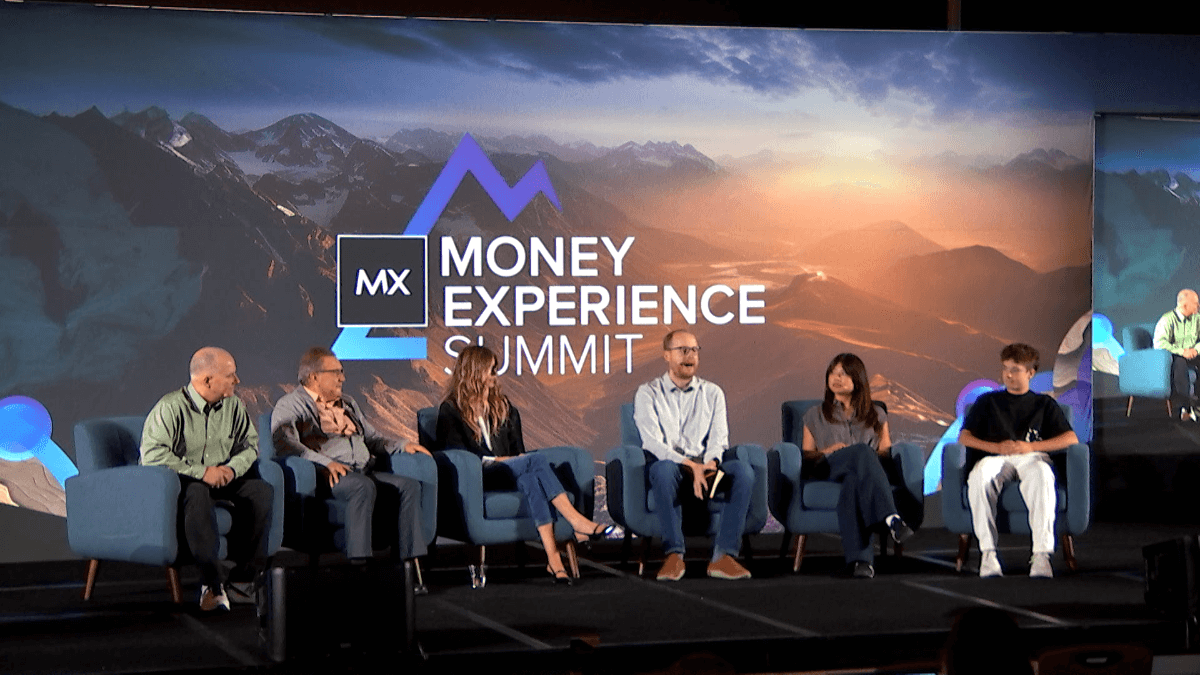
Primacy, Schimacy: How Data is Changing Primary Banking Relationships
Primacy used to be more straightforward. It was all about hometown banks and lifetime relationships. But, most consumers no longer have just one financial relationship and consumers have more choice than ever in where to turn to meet their financial needs. In this session, we’ll weigh in on what primacy means today and how data is changing the way consumers view — and financial providers build — primary banking relationships.
Transcript
Okay.
Good afternoon everyone.
Welcome and thank you for coming to the session.
Today we're gonna talk about primacy. Primary financial
institution and how is that still important,
and if so, what does it mean to different generations
and what does it mean to financial institutions as we begin
to have deeper insights and data
and access looks different.
So let me introduce my panel first,
or I'm actually gonna ask them to introduce themselves
and then we'll dive into some really hard questions.
David, you wanna go first?
Sure. I'm David Metz. I am CEO of Prizeout.
Prizeout is a pay by bank
and reward solution based in New York.
Hi, I'm Martha Beard.
I'm with JP Morgan, and I run our pay
by bank emerging payment rails
and payments advocacy in Washington. Off to you Nathan.
Hi everyone. Nathan Quezada. I'm from Bank of America.
I lead our financial health
and wellness strategy as part
of our client experience group,
and I'm based out of Phoenix, Arizona.
Excellent, thank you.
So I was kind of popping into the sessions
that were happening right before this,
and they were teeing us up so nicely,
and the session next door talked about data
and how we serve members
and customers through access to greater data.
So first of all, can we jump in
and talk about what does primacy mean
and does access to more data change
that definition moving forward?
David, do you wanna start with that one?
Sure. Um, I think primacy,
if you really wanna boil it down, means capturing the
customer's deposits, right?
That's what everyone cares about. Access to data.
There's multiple levels, right?
I think it's becoming more about personalization, right?
I work a lot with credit unions
and I was actually reading up on the history
of credit unions a few months ago,
and what I learned is that for decades,
credit unions dominated in customer satisfaction.
And then in 2010 to 2012, they fell
behind traditional banks.
Do you guys know why that was?
What happened in that period? What was it?
The experience went digital.
It used to be you walk in branch, it's like, Hey Bob,
hey Sally, how's that golf swing?
How's the kids? Right?
That experience has now become digital
and for the first time credit unions have fallen behind.
They're, they're doing a good job of catching up,
but that personalization is still super important.
Healthcare and finance is a very personal thing,
and people want that, and you can't walk into a branch
anymore, so you have to leverage their data
to make the experience personalized.
Awesome. Martha, how about you?
First of all, I would say that
primacy is not only about data,
but it's, it's about being at the center
of somebody's financial life and what does that look like?
And I think I've heard
so many great stories about different types of institutions
and different types of businesses
where those companies have figured out what that center is.
And I think that's what we need to do.
It could be deposits, it could be something else
and somebody else's lifestyle.
Maybe it's not deposits, maybe it's loans
or maybe it's access.
But, you can't understand what
that center is without having the data
and understanding the right data points, which is also,
I think, part of the key too.
Yeah, and I think for banks
and financial institutions, we think about primacy in terms
of products, right?
Do you have direct deposit? Is your paycheck going in there?
Um, do you have a set number of products
with this financial institution?
But I try to flip it
and I think about the client perspective
and think about primacy from the fact of
what it means for them.
It means that I trust this institution,
I trust this institution to know me
and also to provide me with advice
and guidance for banks, credit unions,
and other financial institutions.
That's our role. That's why we were created is
to help others be financially successful.
And so data is a huge component of that.
If I am giving you my trust as a customer to do,
to use your services, to use your product to transact
with your card, I'm expecting that you are using that
and providing some sort of value to me.
And that value happens to be what we can provide in the form
of financial advice and guidance,
and helping our clients be successful.
So again, I think we've been stuck in this mindset
of primacy being focused on products,
but shifting it from a focus of, um, the client's needs.
Another component is digital engagement.
So at Bank of America, we think about this in terms
of digital engagement to as well,
where are our clients going
and spending their time the most?
And are we making it easy for them?
And are we breaking that trust with our clients
by having processes that are too difficult for them to want
to transact with us?
So again, how do we build trust with our clients?
Excellent. So many times through these answers,
I heard the word access and trust.
So can we talk a little bit about the generation
that's coming up and in today's world at their fingertips,
they can access pretty much anything that they need
and they do it seamlessly through
multiple interactions and multiple apps.
It's not unusual to look at a 20 year old's phone
and they have 50 apps on their phone, right?
And so with that ease of access, how do you think
that impacts the primacy conversation?
And do you still think
that we should put the marketing dollars that we do,
we spend a lot of marketing dollars behind trying
to convince a consumer
that we should be their primary financial institution.
Should we still be doing that?
Is there, or is there a different
approach that we should be taking?
So let's talk about access
and then what approach we should be taking
to gain additional rev share.
So you wanna start, David?
Sure. It's a good question.
And to your point is like what does primacy mean?
Is it deposits? Is it payments, is it loans?
Whatever it might be.
And you're right, you know, there are so many apps
and there's so many companies
that are specializing in one thing
and that one thing is they go to bed
and they wake up every morning thinking
about and perfecting.
So like as a financial institution,
how can you compete with that?
There's a saying, we say at my company's like,
the fastest way to make no one happy is try
to make everyone happy, right?
So you can't be good at all things.
So I think one of the,
the most important things is who are you?
Right? Do you serve the affluent?
Do you serve the underserved? Right?
We work with a
credit union in California called SchoolsFirst,
and they've seen a lot of growth over the last decade.
And one of their execs there told me about a decade ago,
they made the decision that we are a teacher's credit union.
That is who we are.
We can open our membership to everyone,
but that's not who we are.
And they thrive because if you're a teacher in California,
that's where you bank, right?
And they dominate that market instead of trying
to be all things to all people.
So I think it starts with who are you
and really perfect that.
Mm-hmm. Excellent.
Yeah. I'm gonna take a little bit
of a different approach to the answer.
'cause I, I think one of the things
that we've already talked about and
and we'll continue to talk about is that digital experience
and the digital experience being the channel.
And you brought up something
that really is extremely important in the way we think about
the dollar spent
and value of the dollar spent in trying
to acquire a customer
to keep the customer in terms of loyalty.
But one of the things I think that's so critical right now,
particularly in you know, kind of the stage
that we're in in terms of technology adoption, the choices,
you know, the phone blowing up with lots of apps,
and that's education.
And using your platform
and using your channel to actually educate your customer
in a very user-friendly way, whether it's about scams
or whether it's about, you know, kind of a did, you know,
and we find
that if we use our digital channels in a smart way
with consumable bite-sized pieces of information,
you'd be surprised how many click-throughs we get
on education.
And it also gives you an opportunity to mine that data
for customer sentiment.
So if your customers are clicking constantly on scams,
You should be paying attention,
or if they're clicking on something else, like, tell me
how I can get a, you know, kind of a mortgage,
or anything that's more educational.
It doesn't always have to be about
marketing to create that loyalty. Excellent.
Yeah, I think about the generations panel
that we heard a little bit earlier and how we heard from,
I think it was Jack at the very end,
and how he was talking about
how my generation just wants something
that I don't have to think too much about.
That's super easy and I get instant gratification.
And while that was kind of funny to hear from someone from
that was a Gen Z, you know, member, you know,
I think we all think that way to some degree, right?
We just want it to be simple.
We've got so many other things going on in our lives
and in terms of access to information,
we just want it there.
And we want it to be easy.
And I think about this, this phrase from one
of my colleagues, and this is the, the mindset
that we think about in terms of how we want
to create our digital experience is just do it for me,
educate me, but also just do it for me.
I don't wanna spend the time going through the math
of creating a budget
or having to go through a long process.
Do it for me as long as I consent
and we're doing it in an ethical manner, I want you
to just do it for me and make it simple and easy for me.
When I think about the marketing dollars
and in that specific aspect of it, we could spend tons
of money on that aspect,
but I think the more important piece of
where we should be spending our money is again,
simplification of processes.
So that again, we are creating another reason
for our clients to want to be their primary bank for them.
And thinking about why are they going
to another fintech app?
Why are they going to another financial institution?
In all honesty, it makes things more complicated, right?
When you've got money in bank A, bank B,
and then you've got tons of different apps.
If we just did things right the first time with our clients,
there wouldn't be a need for them to be going
to all these different places.
That's excellent. That was actually my next question.
And oh, sorry. You hit on it. So that's perfect Nathan.
So Nathan, I'm gonna start with you this time.
Can you continue to have the conversation a little bit about
what experience do you think we should be focused on
as an industry to reimagine primacy
for this new generation
that is really all about ease and access?
'cause we understand that having 50 apps,
and I have a checking account here and a CD there
and a loan, there probably isn't the
easiest way to transact.
They're just accustomed to that.
So what experience do we need to lean into to try
to bring primacy back to the forefront?
Well, being the head of financial health
and wellness, I'm gonna say that it's gonna be all
around the financial health and wellness experience,
and that's gonna be the value that we provide
to consumers.
And that's what we should lean into.
You know, MXs mission is helping people be financially
strong or their financially, their financial strength.
And everyone wants that same thing.
We want financial freedom, right?
And so, you know, I think that's
where we can lean in and leverage data.
Again, providing insights to our clients using that data.
The sad part is we've got so much data
that we don't even know how to use all of it yet.
Even at Bank of America, I can say that we are not perfect.
We've got tons of data that we are still trying to learn how
to use, and with a bank of our scale,
we have to get it right.
So that's also what takes us a little bit more time.
We're not as nimble as some of our fintech partners
or maybe some of our smaller bank competitors.
/so I think just leaning into helping our clients
whatever stage of their financial journey that they're in,
one, understanding it, and then meeting them where they are,
and then helping them achieve to where they want to go.
Excellent. Martha, how do you see that?
Not a whole lot to add to what Nathan said.
I think he hit the nail on the head.
The only other, you know, kind of focus I think that
I would add is that if there's,
if there's one thing that I, I think that we've heard
that we just need to find a way to kind of turn that into a,
you know, kind of a stickiness, that we want
to create in terms of customers wanting to come back to us
and be a repeat customer, is that loyalty and trust factor.
I think we all understand it.
We all have been able to see it in action.
And I do think that there is,
that's an under leveraged asset
that banks have with their customers.
I think we're starting to use the right toolkit in order
to convert that into, you know, that stickiness,
whether it's financial health and wellbeing
or anticipating a consumer need
or identifying, you know, a point of,
decision making and the like.
But I also think that there's still, we can dig deeper,
I guess is really the the point I wanna make.
For example, many of us in here are,
remember the financial crisis of 2008.
Maybe remember when Silicon Valley Bank happened
to tip over?
But what did you do?
You probably called your main primary bank and said help.
You didn't call cash app.
I would imagine you probably didn't call another fintech
to say, can you help me with where my money is?
You called your bank. And I think that that, you know, kind
of primal primary kind of reaction
and trust is something we really ought to dig into
and say, you know what, what's that compelling thing
and value that we want to invest in, that we want
to safeguard and that we want to try
to continue to replicate.
Excellent. David, I'm gonna change up the
question a little bit for you.
So we've talked a lot about
how much financial institutions have
a tremendous amount of access to data.
We have more data than any of us know what to do
with then we haven't harnessed that yet.
And so if we're trying
to help financial institutions understand how to become
more of the primary financial institution,
are there specific segments of data that you would
recommend we should be focused on that could help drive
that primacy over others?
Sure. Um, couple things.
Just to double down on what you said,
we just ran a survey, a quarter million people
and 24% of them, when we asked them
who their primary bank was, they said Cash App
or Venmo, which blew my mind.
And that's just because it's a frictionless,
it's easy, right?
On the data side, what my company does,
we specialize on transaction data
and we leverage that data,
so merchants can target customers.
And as a result of that, we allow, in this case, members
to earn cash back on average around 7%.
So that's just one instance where we partner
with credit unions and banks
and we integrate with their core
and we get access to that financial and transaction data.
And then on the other side, you have merchants like Amazon,
Walmart, Home Depot, pretty much all the majors.
They're creating these campaigns
and they're saying, um, can you get me a 25-
to 35-year-old male that lives in Florida
that loves sneakers and we know that this customer
or this member spent $3,000 at Adidas
and Reebok, Nike will pay a ton of money
to acquire that customer.
And the vast majority of that money we give back
to the customer in the form of cash back.
And these are predominantly debit card users which do not
get cash back.
So that is just one small way we really hyper-focus on
transaction data and then we connect them with merchants
that are trying to acquire those customers.
But that is just one sliver
and a huge pool of possible data that you can leverage.
But it is massive and you can get lost in it.
But for us, that's where we're hyper-focused and,
and it seems to be working with members and customers.
So Nathan, you talked a lot about Bank of America and
that data that you have access to
and we're all trying to harness it.
So are there specific data points
that you've narrowed your focus on for
around this topic of primacy? Yeah.
So we've gone all in on financial health
and wellness around segmentation.
So every bank and financial institution probably has a
segmentation strategy for our consumer bank,
we've leaned into financial health as part of that,
that segmentation strategy.
So we have a lot of on us data from our clients.
We know about their checking account balances,
we know about their credit card
activity if they're a revolver, if they're a transactor.
We also know if they are on unemployment.
So many different things
and so many data, different data points
that we have taken an interpretation
of a client's financial health based off that data.
The challenge with that is it's just on us data.
So unfortunately, because I can't see your accounts
and we know that
many individuals bank at different institutions,
I can't see your off us assets.
So again, it's just an interpretation of
what we think your financial health is.
And we've taken our, 32 million
clients in the consumer bank
and we put them into these eight different segments.
And so everyone from the, that is living paycheck
to paycheck to those
that are financially secure and in a good place.
And we've used that data right now,
and we're just in the learning stages of it right now,
and there's so many more possibilities to this.
But we've taken this
and we've used this data from a marketing
and communication standpoint, so that when Bank
of America emails you
or communicates you, if you are living paycheck to paycheck,
I'm not gonna talk to you about Merrill Investing
and talking with a financial advisor.
If you're just barely trying to get by, I'm probably going
to provide you with information about our products
and services that relate to your specific needs.
And so we've been able to implement that.
We've been able to implement that for more complex
situations too as well.
So if our clients have told us that they're working on
credit and their goal is to improve their credit,
we are connecting them with our non-profit partners in the
community so that they can then work with them one-on-one
for coaching that we cannot provide to the same degree
that a nonprofit counseling service can provide.
So again, it's the power of the data,
and again, this is just on us data.
I could imagine the possibilities if I could see everything
going on in someone's financial portfolio.
Sounds like we need an aggregator out there, right?
Let's share data. Would everybody in the room
be willing to share data?
That'd be amazing. Yeah, we can do that.
Martha, let's talk a little bit about AI
and how we think We've all had conversations around
how is AI going to disrupt our industry?
How will AI potentially replace human interactions?
And David, you said it as we started the conversation,
it used to be easy to be the primary financial institution
because they walked in your branch
and you talked to them about their grandkids and their dog
and their vacation, all those things.
And through that you were building trust and
therefore you were the first person they would come to.
But we know there's a lot of information out there
that we're aggregating across different channels
and we are going to have to lean into
how AI plays a role there without replacing humans.
So Martha, can you talk to us a little bit about
what your strategy is there?
Yeah, I think I'm going to mention two strategies.
One is, it's off that kind of Venn diagram
that you saw this morning that saw Rashida put up around
autonomy, augmentation,
and, the third one was fragmentation, I think.
And, I think that's right.
Because those are three operating models
that help you get efficient or make better decisions
or are, you know, helping you augment your strategies.
But it goes further than that.
So I think the conversation, at least my bias was I heard
that as it related to what do I do with data
and what are the types of, you know, kind
of operating tools I should think
about as it relates to data.
So that's why I was thinking, you know,
automation augmentation and fragmentation.
But it actually goes further than that.
There are other types of operational activity
that now I think we're starting
to see some very exciting things
and we should consider them such as a agentic AI, where
that is about actually creating the way
with which you can augment a decision or a strategy
or execute on a, you know, product.
And so it's not less about honing the data
and allowing for better human decisions, human led.
I love that too. That was great.
But it's also about other types of tasks
and, you know, she only had 30, 45 minutes,
so she couldn't get into all of it,
but I think we are starting to see kind of
that next pivot, which is exciting.
It's early, but it's promising, which is, you know, yes,
there's data, yes, it's about efficiency.
Yes, it's about augmenting strategies,
but it's other types of operational tasks that now I think,
you know, I'm sure there are a few of you
with other examples, but I think the agentic piece,
particularly in commerce is, you know, going to explode.
Excellent. David, I know you have some strong opinions
about AI and how we integrate it into
the financial strategy.
So you wanna share that with us?
Yeah, sure. I think it's,
nobody really knows it's moving so quickly.
I equate it to like, fire, you can use fire
to cook your meal and it can also burn down your house.
There is no doubt
that it's gonna make financial
institutions way more efficient.
It's gonna take that data,
it's gonna make better recommendations, it's gonna be,
not only be able to show them what they need today,
but predict what they need in the future.
The thing that scares me — I recently went to Italy
with my wife and I was using it, which restaurant, which
that, and as a vendor, I've been using it as
if I was this financial institution,
which vendor should I choose?
And AI says this one, right?
And then I started doing, which bank should I use?
And it said that one, right?
Like, how is it making that decision?
At least with Google, we would Google banks near me
or something, we'd read.
We do all our own research.
And if you ever listen to Sam Altman, he's like,
his biggest fear is
that the young generation is not
making decisions for themselves.
It's AI telling them.
So if they say, which financial institution should I choose?
How is it making that decision? Right?
And I think that's, that's the
burn your house down scenario.
Thank you. Nathan, have you started
to implement AI into your strategies?
And if so, can you share a little bit about it?
Yeah, we're still kind of, so we have our,
Erica virtual assistant.
So that was our first kind
of test at dipping our toes in the water around AI.
And so, that uses natural language processing to be able
to help our clients out with simple self-service,
getting responses to certain questions that they have.
I'd say we're thinking about the future of
what does this look like to continue to go down that path
of automating certain tasks for our clients,
and also thinking about it from a financial advice
and guidance standpoint.
Um, but
before we even get there, I think we're already starting
to think about how do we lay the foundation to get ready
for, the future of AI.
We serve a large number of clients across the United States,
and so we're thinking about all different generations,
all different types of financial needs,
and how do we make sure
that we're protecting our clients with AI?
So how are we helping them to build trust around AI?
How are we helping them to avoid scams
and how are we helping them, to your point,
think critically about how to use AI
and still apply critical thinking too as well.
So again, that's just kind of where we are,
with ai.
Excellent, thank you. So we heard
earlier from some different generational consumers,
potential members and how they engage
with financial institutions
and how it's very different to them.
So as we continue to think about whether
or not primacy is still important, and we know that
although we can't be all things to everyone, we are all
interacting with different generations, which we need
to continue to do to, you know, build our brand, continue
to build our product sets.
So are there certain actions we should be focused on
that we can implement
to gain different primacy across the
generational gaps, that word did not roll out.
David, do you wanna start with
Yeah, I think Nathan said it,
it is all about trust, right?
And since the beginning of time people learn
by telling stories and I think we can't forget about that.
Like how do we tell stories in a digital error?
Because it all begins with trust.
I have a friend who started a company
and he was getting VC backing
and he's like, where should I bank?
And I was like, I love this community bank.
You could pick up the phone and call the CEO.
It's amazing. And he's like, I love it. He signed up.
And then the investors were wiring it
and they were like, this is the most archaic process ever.
So he closed his account
and then he opened it up another way.
Like they accomplished step one, the trust.
I love them, they're great, they're personable,
but they were so far behind digitally, he's like,
I cannot run my business with this
and it's a $15 billion bank.
But like, they were so far behind
that he closed his account and opened another one.
So I think telling those stories is super important.
A lot of my partners talk about,
there's three pillars of every community.
There's education, there's healthcare,
and there's access to finance, right?
And the three things that they say is important to get
that finance is credit, collateral, and character, right?
And I'm always like, how do you quantify character, right?
Like, that's so hard to do.
So I think establishing trust is the most important.
And I think telling stories,
I'm gonna tell one quick story and I'll make it quick.
This is about Darlene.
'cause she told me this story and I've told this story about
1,200 times because I'm so impressed.
She had a member that was sitting at the bank
an older man, he's about 83.
And he sat there for about an hour until one
of the tellers came out and said, are you okay, sir?
And he's like, oh, I'm just, just sitting here
waiting like, would you like some water?
He is like, that would be amazing, right?
Gets him some water. And an hour goes by
and he finally gets up
and he walks to the teller and guess what he does?
Anyone? He slips them a
note and says, “I'm robbing you.
Give me a thousand dollars.” So Suncoast,
the manager comes around and says, what are you doing?
And he's like, I've fallen behind my bills.
This is the only thing I know that I can do, right?
So he's like, come around,
we're gonna give you a thousand dollars.
We're gonna do a plan, we're gonna get you in a good spot.
Right? Like that is, you know, it's a wonderful life,
George Bailey type stuff.
And Suncoast is a $25 billion bank, right?
So like those stories I've told,
and I am sure the people I've told have told, right?
So I think we need to do a good job of continuing
to tell those stories because
they still resonate with people.
Thank you, David. How about Martha?
Is there something — I cannot add to that at all. Okay.
It's a good story. Yeah, it's a fantastic story.
But also, there's like eight lessons in there, right?
Yeah. It's the human touch, the fact that community matters,
that you can't just expect digital only to always be there
for you or something that's going to serve every need.
I could go on and on, so I'll,
but I'll pass the baton. Yeah.
You know, just going into to what David said,
like stories, data tells one story.
It's a quantitative story, right?
It's the qualitative piece.
And so one of the things that we're gonna do when we go
back, is Jessica gave me the idea we're gonna do that,
generational panel at Bank of America with our clients,
so that we can hear directly from them.
We have the data piece, we need
to hear from them too as well.
And we do those on a regular basis.
But we're gonna do this again with the mindset
of financial health and wellness
and how do we meet those different generational needs.
And that's been our strategy for a long time,
is listening to our clients.
And it's served us well.
You know, we were seeing transactionally, lots
of people were sending money over to Venmo and Cash app.
We started talking with our clients
and asking them, why are you doing that?
And we started hearing from parents that said,
I'm sending this money over to Venmo and Cash app
because that's how my kids pay for
their different purchases.
And that's how I'm giving them money so
that they can transact.
Venmo has a debit card that they can use.
Bank of America does not. Wow.
That was an eye-opener for us.
And while we weren't first to market with it,
we did create a family banking product to serve
that specific need.
And now we're capturing children under the age of 13.
So you think about primacy, going back to that,
you probably still have some sort of tie
to the original financial institution
that your parents set you up with.
So again, when we think about that, we're starting with
that too, as well as part of our growth strategy.
If we can get the individuals early on in their lives
and being a banking partner with them, it'll create them
a customer for life.
I love that. And it really is about understanding the
needs of our consumers and our members.
And Martha, you said it as well.
Deposits used to be the strategy for primacy. At Suncoast,
we're not a Zelle provider today,
and we often, we serve a community
that leans into the need to have Zelle.
They either pay their bills that way,
they pay their employees that way.
They're in the gig space.
And because we don't have the ability today, MX is fixing
that for us to have Zelle, then
we don't win that, that membership necessarily.
And so for that segment of consumers, Zelle,
who ever providing that becomes
potentially their primary financial institution,
that's the first thing they ask when they walk in.
But for everybody, it's different.
Which is why data supports that journey that we're all on
to understand what does it take to gain the trust,
ease of access to bring a consumer in and potentially win
and be their primary financial institution.
So with that, we have about 10 minutes
left or a little less.
Who has the first question for this panel?
Don't let them off the hook.
So let's have some really good, hard questions.
Somebody's got a question? Yes, thank you.
You talked about trust. I think there's a microphone
coming, hopefully
I can speak.
We just, sorry, sorry.
You talked about trust,
but kind of missed out on the loyalty side.
So one
of you guys does merchant funded offers, right?
Yeah. It's, I'll use an example of my wife.
She has 21 credit cards, she has a binder, right?
She knows that X bank gives 5X on groceries.
So when we go to Disney with the kids, she buys $3,000
of gift cards in the grocery store.
So she gets points on grocery spend, right?
So she's not loyal, right?
Whatever is the best situation at that moment,
that's the card that she's going to use, right?
So for us, you know, we really focus on the underserved,
which is debit cards, right?
We all know since 2008 interchange is too low,
so no one can afford to give debit card rewards.
We're able to do that, which how I explained.
So that for us is really low hanging fruit, right?
It's an ignored sector. Um, so we've really focused on that.
And for our user base
that's going from nothing to something.
It has meaning, right?
As opposed on the credit card level, you know,
it's fractions of basis points that everyone's fighting over
or this lounge or that lounge, right?
So that's a really, really hard, um, demographic
to compete against because they're so savvy
and they're loyal to no one.
If you're going from nothing to something,
they will be loyal to that, right?
Because it's that first time that somebody's seeing them
and it's the first time someone's recognizing them.
So that's where we've specifically hyperfocused in on. Yeah,
I mean, what I was getting at was, you know,
JP Morgan, how much did you pay last year in rewards?
Do you know?
I don't want to share share
that. I'll tell you.
It was $23 billion. Yeah.
That's bigger than the revenue of
the sixth largest bank in America.
Mm-hmm. Isn't it about bribery loyalty?
I would say no. I mean, it's choice, right?
And there are lots of different ways that we try
to create loyalty and that's off of $150 million,
150 million card holders.
So let's, you know, put it in perspective, but,
but it's also about choice.
And so if you think about the leverage that
that rewards program creates for the way
that people wanna spend their money, it's very similar to
how choice
and points are given for the debit card
concept, which I think is fantastic.
So I see it as if there's going
to be a way with which you want to spend your money invest,
then we should be helping you leverage that lifestyle,
whether it's travel or dining or education.
And we've also created our, you know,
I call it ultimate rewards,
which is not necessarily credit card base,
it's about extending the community in terms of those types
of companies that want to create loyalty,
but maybe they don't have a credit card.
So we are trying to expose those same, you know, kind
of loyalty opportunities so that it's easy for someone
who has a bank account and wants to leverage it.
They can, they can go and they can create points
or use points outside of credit card.
So, that, that's the way I would think about it.
Yeah. It's interesting though
that you would tie the amount
that they paid out being the size that they are
and the number of cards they have.
It's interesting that you would tie loyalty to the amount
that they paid out in rewards, because I would argue that,
and I don't know the data,
but I would argue that a large segment of
that payout was probably to people like David's wife
that aren't loyal at all.
They're going into whichever card is gonna solve the problem
that they have today.
They want to travel, they're gonna go
to their best travel card, they want cash back,
they're gonna go to their best cash back card.
So it's interesting that you tied that together.
I think David's wife is pretty unique. I
Do it too. I do it too.
I would argue it's not 20, what?
21 cards.
I don't quite have 21 just
'cause I don't have that organization.
Yeah. So I don't — You'd
be surprised how quickly people switch. Yeah.
I think they lean into the card
that meets the need in the moment.
I really don't think that — so there is no loyalty.
That's what this whole conversation is. We are —
but how do you then, how do you create it? I mean
that's, well I'd like to turn the question around
and just, also as we did with center
and primacy, which I think would be a great conversation
to have, and that is how do you want
to define loyalty, right?
Is it every, every bank account,
all your credit cards, all your spending.
And I think the way that so many of the companies
that are here at the conference kind
of target their customer base
and then how do you build that ecosystem
or that financial, that set of financial services around
that experience, whether it's financial health
or others, maybe that's loyalty.
And I think that's a great debate.
Yeah. And, and I wanna give,
if anyone else has another question,
I wanna give the opportunity, but I will,
the question I think we should be asking ourselves is
how important is primacy anymore?
I would rest assured that the dollars earned
on the money they paid on rewards superseded it.
Correct. So, so does it matter that they're not loyal to
that primary, that financial institution?
I don't know. Maybe it matters,
but it's a, that's a whole philosophical question.
I know specifically for credit unions that we have,
'cause that you said that that is
what we have stood on for so many years.
We build relationships differently, right?
Not the case anymore because we've gone into this digital
space that doesn't allow that to happen.
I personally poke the bear all the time
with our executive team because is that important anymore?
Or is it more important that I'm meeting the needs
of our members in the space when
and where they need to be met?
I'm giving them easy access to it
and I've priced that product in a way that it's beneficial
for the cooperative, for the movement, for the membership.
I'm okay with that. If you have 22 other cards,
okay, I'm okay with that.
It's also harder to get loyalty from the affluent than
the underserved I think.
I think a lot of people who gave me a chance, right?
Like that's, you know, whether it was that teacher
or that boss or whatever that, you know,
so I think there's a lot greater opportunity to create
that royalty loyalty with the underserved
where the affluent has so many choices.
So it's a lot tougher. Yeah.
Are there any other questions? Excellent.
Another one. Yes, absolutely. Microphone's behind
This is really interesting to me.
You know, most companies,
I'm from the tech world, so I have very simple KPIs, right?
So if I was thinking about a bank, I would think
of three KPIs, revenue per customer per month, cost
to serve customer per month, and primacy.
And to me primacy is how much
of the business am I getting in my account?
Okay. So I want the paycheck,
I want all the bill pay, I want everything.
'cause that's how I make money.
You're a tech company. Yeah. CAC, LTV, and retention.
There you go. Yeah. Those are the three
things. So yeah,
I, that's, so I'm asking, when it comes
to loyalty and trust and everything, what is the measure?
Is it rewards? Is it what, what is it how,
I think it's different for everyone
because speaking for our credit union, we don't lead
with am I making money?
A matter of fact, when we sit in our ALCO conversations,
our CEO says the margin is too big.
I need you to take that margin down.
We need to be under, under a certain, I'm capitalist.
So it, it's, I'm sorry, say I'm
a capitalist. And
Yeah, so it's just, it's different.
So I think everybody answers that question differently
'cause we don't lead with ROI,
but someone else on the panel might have a different answer.
One thing I would say is that,
you also are looking for what are the needs of
that particular, this goes back to the use cases
and the loyalty and the life cycles of services that,
you know, goes to the panel right after lunch.
What can you achieve with that 19-year-old?
What can you achieve with a woman getting
ready to, to retire?
And that's where data is helpful.
Yes, of course we want to be able to do things
that don't lose money
otherwise we can't serve other customers.
So we have to come up with smart ways
with which we can acquire that customer.
And we use digital channels
and lots of different things with the panel
talked about to create that.
I actually think that loyalty is important,
but defining that in a way that creates the ROI
that you described is also important.
So I do think that data helps
and the ability for us to decide
how can acquire everything that
that particular person needs at that point in their life
or their particular profile should be a goal because
therefore we're serving our customers.
So we're always gonna continue to try to learn
and acquire that information so
that we can produce a product that they wanna buy.
I think loyalty is very important.
We will end on that note.
This sounds like it was a really good conversation
that maybe should be continued.
So I wanna thank my panelists up here.
That was great conversation. Thank you for your insights.
Thank you for your willingness to share openly with the,
with the crowd here.
And we can continue having the conversation perhaps
over drinks tonight.
So thank you so much.
Speakers
Martha Beard
Managing Director, Head of Pay by Bank and Payments Advocacy and Strategy, JPMorgan
Martha Beard is a Managing Director and head of Pay By Bank and Payments Industry Advocacy and Strategy within JPMorgan Payments. In this role Martha leads the launch of pay-by-bank and digital methods of payment for JPMorgan Payments. In addition, she spearheads Payments' director and board-level memberships across financial networks and advocacy groups and aligns firmwide initiatives impacting JPMorgan Payments.
During her over 30-year career with the firm, she has held a variety of positions within JPMorgan Payments, including head of Public Sector Payments, North America Corporate Sales Head, and overseeing the integration of lnstaMed, a healthcare fintech. As head of Healthcare and Public Sector Payments, Martha's advocacy with members of Congress for administrative simplification across financial transactions on the Affordable Care Act led to enactment and implementation of further work with the Congressional Budget Office and scoring of the legislation.
Within JPMorgan, Martha participates in development initiatives through CIB Women on the Move and Advancing Black Pathways. She is a board member, and Executive Committee member of The Clearing House, LLC. She previously served 2 terms as a board member of CORE; the entity responsible for transaction standards for the U.S. healthcare system. She also served for 6 years on the board of Kamen for the Cure, Greater NYC. Martha is a graduate of Rutgers University's Center for Women's Senior Leadership Program and has a Bachelor of Arts from the University of Kentucky.
Darlene Johnson
Executive Vice President and Chief Strategy and Transformation Officer, Suncoast Credit Union
With 35 years of credit union and member services experience, Darlene Johnson is the Executive Vice President and Chief Strategy and Transformation Officer of Suncoast Credit Union. She began her career at Suncoast Credit Union in 1990, immersing herself in member services before transitioning to lending operations and member financial wellness and coaching.
Darlene has held a variety of leadership roles at Suncoast Credit Union, including Consumer Loan Manager, Vice President of Loan Originations, Vice President of Member Solutions, Senior Vice President of Member Experience, Chief Operating Officer and Chief Growth Officer before assuming her current position as EVP/Chief Strategy and Transformation Officer in April 2024.
Her primary area of responsibility is strategy and executive leadership with a focus on member and community impact. As Chief Strategy and Transformation Officer, she is responsible for creating growth and operational strategies for all lines of business within the credit union and continually scaling the organization, while providing exceptional experiences to members to create greater authentic engagement.
In addition to her current areas of responsibility, Darlene is dedicated to ensuring Suncoast employees are provided with continuous development and training opportunities translating into exceptional member experiences. She is committed to supporting the Suncoast value of building trusted relationships while providing financial guidance to improve members’ lives. She is focused on delivering top of market products and services that are financially beneficial to its members and the communities it serves.
She has earned her Certified Credit Union Executive, Certified Lending Specialist, and Credit Union Development Educator designations, as well as completed the Credit Union National Association’s Financial Counseling training.
Aside from helping members save more for life, Darlene is passionate about supporting and volunteering with Relay for Life and the Susan G. Komen Race for a Cure. Although quite busy growing Suncoast’s presence and expanding member engagement, she enjoys spending her free time with her family or traveling.
David Metz is the Founder and CEO of Prizeout, an adtech company that partners with various industries to optimize money flow and put money back into consumers' pockets. A career entrepreneur, David started his first company, Flugpo, in 2006 after a 10-year stint in financial services and equity trading. Before Prizeout, he was the CEO and co-founder of a mobile trivia app called FleetWit where users could take bets on their trivia skills. His broad leadership experience in finance, marketing, and tech across both large firms and startups put him at the ideal intersection to lead an industry disruptor like Prizeout. David attended Drexel University and lives in New York City with his wife and two kids.
Nathan Quezada
Senior Vice President, Consumer Client Experience and Governance, Bank of America
With 20 years of experience in the financial services industry, Nathan has developed and executed strategic initiatives that have supported digital transformation and driven long-term business growth and loyalty. He has held progressive leadership roles in sales, marketing, learning and development, communications, and strategic planning at Wells Fargo, PayPal, and Bank of America, where he currently serves as a Senior Vice President (SVP) within the Retail Banking strategy team.
In his current role, he leads client experience strategies that drive Bank of America's financial health vision across its Consumer Banking division, partnering with Data, Digital and Global Marketing and Product to enhance its holistic offering of financial health solutions and tools such as Erica®, Life Plan®, and the Better Money Habits® financial education program. He is also an ambassador at the Greater Phoenix Economic Council, where he advocates for key regional economic development issues. He is passionate about solving complex problems and developing innovative solutions that improve the customer and employee experience, leveraging his skills in strategy, communication, and problem solving, as well as his credentials as a Scrum Master and a Prosci® Certified Change Practitioner.