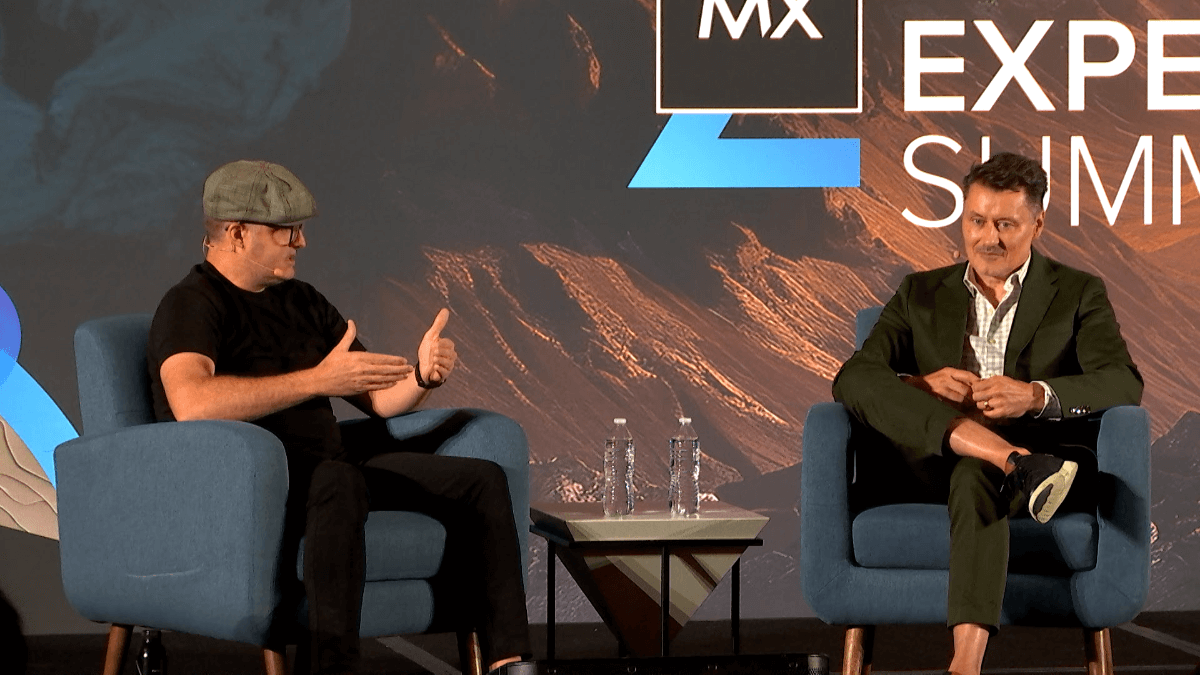
Well, before we jump in, actually, I wanted to kind of give the audience a little bit more of a, kind of a background of Jenius Bank. So, Jenius Bank is a newer bank. They just went live in 2023. They’re a subsidiary of SMBC, and they had a bit of a non-traditional entry into the marketplace in the sense that they really are focused on loans and high yield savings accounts. Right. They also are a digital only bank, which is important because what that has allowed them to do is pass on a lot of those savings in the form of interest rates to customers. So I think as of today, your high yield savings account is at a 4.2%, correct? Yep. Correct. Awesome. John, you joined Genius in 2021 as the bank president, right? I started it, yeah. Started, yes. After two decades in the financial space? Correct. Awesome. And, under John's leadership, within the first year, actually, before you hit 1 year old, you guys had over a billion in deposits and 700 million in loans. Loans, personal loans, yes. Yeah, which is fantastic. Thank you. Prior to coming to Jenius and I guess even prior to your financial industry experience, you also served in the military. Cool. nd Special Forces as a Green Beret. Yeah. Well, thank you for your service. You're very welcome. I'd like to maybe start with what are the things that you learned as part of your military experience that you've brought with you into your experience, both with Jenius and just in the financial space? Yeah, so, probably one of the first things I learned was if you take off in a plane, it's a lot more convenient, safe, and less stressful to land with the same plane. jumping out is a little, you know, more stressful, a little more anxiety, But also it can be fun. But seriously, the military taught me a lot of things about leadership, taught me a lot of things about how you approach challenges. There's a great quote, it's been probably the most re-quoted things I've ever heard. Mike Tyson re-quoted it recently. He said, you know, everyone has a plan until you get punched in the mouth. Right. That quote actually goes back to 1880. A guy named Field Marshall Helmuth von Moltke, who said that the greatest military plans don't survive contact with the enemy. While I've also heard it expressed in business terms, which is you can have a great plan, but it likely won't survive when you launch to the customer. And what it really means is you have to learn, you have to adapt, and you have to overcome. And so it's true in the military, it's true in business. You're going to have challenges, you're going to hit obstacles. How you respond to those differentiates the best from everyone else. I'm curious in your experience, especially launching a digital only bank, have there been any challenges that you didn't anticipate that you've had to overcome? And anything you'd like to share that others might learn from? Yeah. Well, I'll tell you two really cool things we did that were really smart until they collided. So we figured when we launched the bank, we didn't want to have to deal with a lot of credit applications from people that we would never give credit to. We also didn't want to open ourselves up to more fraudulent applications. We wanted to manage how much, you know, volume we were going to put through a brand new platform that's 100% cloud-based. And so we said we're only gonna offer loans through aggregators. And aggregators are folks like Credit Karma or LendingTree, and I call 'em food courts for finance. Right? You go there, you're planning to eat, you can pick from multiple options. You can see the prices, you can smell the food. Same thing with Credit Karma or LendingTree. You can see all these loan offers from different banks. And what they typically do is behind the scenes, they only offer loans... They only make the offers from different banks to customers that meet the credit criteria that those banks have said that they would lend to. So we really liked this model because it really narrowed our target audience, if you will, to people that we wanted to lend to based on our credit models. So this approach seemed really smart and it worked very well. And then we say, well, how are we going to differentiate? Well, let's not have an origination fee. So a lot of the banks today that make unsecured personal loans will charge you a 3% fee upfront. You don't have to pay the fee. It just comes out of the principal, right? So when you, let's say, get a $40,000 loan and you have a 3% origination fee, $1,200 is already paid. It's part of that loan. You're only going get, what is it, $38,800 in actual money passed out in cashflow when you get that loan. Some of that money's already sunk in that origination fee. We said, we're not gonna do that. You want a $40,000 loan, we're gonna give you $40,000 and then you're gonna pay a little higher rate because you're not paying the origination fee. Well, that worked well for a while. It actually attracted a lot of customers, but then these aggregators are smart. They reach back out to these customers a few months later and say, “hey, there's better rates available on Credit Karma.” They don't mention that there's an origination fee. So now they're comparing my rate at 13% to another rate at 11% with this origination fee. And we started seeing a lot of customers refinancing the same debt. Guess what? Credit Karma got paid twice for that loan. We didn't even make enough to offset the acquisition cost. So we call this the pre-payment problem, if you will. So the two strategies made a lot of sense separately, but when they came together, it really didn't work out as well as we expected. So we're revisiting our whole approach there. Okay, you've worked in both big banks and also a lot of digital ventures. What's harder? Innovating inside legacy systems or building something completely new? Oh, I'll answer that with a question back to you. If I asked you to design a brand new luxury sports car that's electric, by the way, would you rather start from scratch and buy components or would you rather I hand you a used Ford Pinto? Well, uh, my mechanical skills are terrible, so I'm going to say, I'm going to hire somebody else to do it all. Exactly. Well, Ford Pintos were designed in the 1970s, or they launched in the 1970s, and they were a great car until they started blowing up. But, you know, the funny thing is a lot of bank technology was also designed in the 1970s, and it's sitting on data centers and basements of buildings and, you know, it's harder to work in on those engines and those platforms. So I think the advantage of starting digital and starting new, almost separate like, well, you know, Steve Jobs launched Mac as a skunkworks operation within the Apple Company. Same concept. Launch it, allow it to kind of fertilize and grow independent of the mothership. And then it's whatever point, you know, you desire, you can then decide whether you flip over or you somehow merge the two. And so the approach you're taking is merging the two. Well, for us at SMBC, I hadn't even heard of SMBC by the way. When they sent me an inquiry about working with them, I had worked for a several larger U.S. banks. I was shocked when I found out they were one of the top 15 banks in the world. The reason I had never heard of them, I was in consumer banking my entire career. And, they don't have any consumer presence in the United States, so that's why they called me. They wanted to build a consumer bank in the United States. And so, you know, I would say we launched it. We had the opportunity to build something that was kind of separate because there wasn't anyone else in the company that had expertise that would come in and tell us how to do it. Uh, so I got to hire pretty much the entire team from scratch, and that was a huge advantage. That's awesome. One of your, I guess, visionary claims that you want to work through is how do you humanize digital banking, which is an interesting goal being that you have no branches. So kind of talk me through like what is it you're trying to do and what's your strategy to try to execute that? Yeah. So I've worked for large, in fact, three of the top 10 banks in America, all of them branch based. And they're all doing digital initiatives. But what I found was every single one of them had things that you couldn't do online. You had to go into a branch. And the reason was, it was easier. So somebody gets married, they want to change their name, they have to bring in their wedding license and their, you know, new social security card, they want that in in person 'cause they want to verify that it's valid documents, right? So that was one example and one of my banks that we've never able to move that online. So to be a humanized digital bank, you have to empower customers to do everything that they need to do with their bank digitally. So that's step one. Yeah. Step two is everybody that I've ever met at some point wants assistance from somebody else that looks like them. I.e., a human, right? And so you have to be incredibly available. There are several digital banks and startups that have tried to build things that basically block out the humans and they say, Hey, we're not gonna let you talk to a human because it's very inefficient. We’re going to try to make sure that you do everything digitally. In fact, some of these digital banks, it's hard to find a phone number. So we said, we're not going to be like that. We're going to put our phone number on the homepage and we're going to make it. I didn't get this past my marketing department, but I wanted to, you know, put on it, speak to real humans and then the phone number. But basically we decided to launch a call center that's open 24 hours a day, seven days a week. Very few banks in America, we'll answer the phone after 2:00 AM on a Sunday night. We will. So that was one approach. And then honestly, our partnership with MX was a key part of humanizing it because MX is helping us identify real-world life situations and then give customers insights and advice as to how to be more confident in their decisions. Awesome. Part of a process that you, I guess your claim to fame is, is that you made bill pay free. Talk to me about that. So I joined Bank of America, that's long ago, so I can talk about it now. Back in 2000, and at the time, Nations Bank and Bank of America had just come together. They had two separate online, back then we called it e-commerce. The term kind of died away, but, online banking and e-commerce were the same thing. And we were merging the teams. And, I joined right at that time to lead the combined team. And I started looking around saying, well, how are we going to make a real difference? And one of the services that had recently been launched was bill pay — online bill pay. I was like, oh, that's kind of neat. You know, you don't have to lick stamps, and remember the day when you licked stamps? Yeah, that’s still gross. Yeah. But you didn't have to mail your bills in. You could just do it all online. Well, I got my analytics folks in the room and I said, do we know how these customers behave compared to people that aren't paying the bills online? They said, yeah, we have all — oh, John, no one's ever asked us that — we have this whole deck. And they pull it out. They're so excited. They're like, look at this. They call us fewer times because they're seeing their information. They basically are all primary bank accounts. In other words, they have their primary checking account with us. 'cause that's where they pay their bills from. They actually have a higher percentage of customers that get loans from us because again, they're comfortable with this experience of being able to do it all in one place. So all these things I said, do they have monetary value? Can we calculate how much that's worth? They said, yeah, we did, it's $120 a year per customer, more value to the bank if they pay bills with us. I said, how much are we charging for the service? They said, well, you know, $4.95 or something per month, so that's what, $60 bucks? I go, so they're paying us $60 bucks on top of the $120. They said, yeah. I said, well what about if we just gave it to people that aren't getting it now because they don't want to pay $60 bucks? And they said, well, we offer it to premiere customers for free. I said, well, who's premiere? And they said, well, you have to meet these criteria, you know, and if you ever look at a billboard and it says free, you know, if you qualify, the majority of Americans assume they won't qualify. Right. It's like a natural assumption. They're going to catch me somehow. So many people were not taking advantage of this even if they had been able to get it free. When we made it free, about a third of the customers that took the service were folks that never would've paid for it anyways. But the perception was that they were going to have to pay. And so the amount of people that were paying bills online at Bank of America in the 2001 to 2002 timeframe grew exponentially. And by the end of, I think it was 2002, we had more people paying bills online at Bank of America than all the other banks in America combined. Wow. And it just took off. That's crazy. I love that. Big topic for the conference is AI. So what's your take on using generative AI in a customer-facing banking tool application, especially being that your presence is all digital. I think it's going to take what we're doing. Ryan mentioned the tsunami. I think it's going to be a tsunami. 'cause if you think about it right now, you know, he talked about you have to get the data, then you have to be able to analyze the data. Then you have to do that third part he mentioned, which was the idea that you have to create insights that are of value to the consumer. That third part, we're still at the beginning of, right? Trying to figure out all the things that we could tell customers about. And can I a do a little exercise here? Absolutely. How many people in here have their paycheck go to a bank on a fairly regular basis? Raise your hand. That's good. Most of them are employed. That's a good thing. How many of you also have like, regularly scheduled bills that come out of your account? Like mortgages, auto payments, it's good. They're consumers. And so how many of you have had your bank notify you that, based on history, they know when your check is coming in and they know when your payments need to go out? How many of you have had your bank tell you that in a couple weeks you're probably going to overdraft your account? The lights here, I can't see any hands. Can you? Yeah. Well, geez, that's a pretty basic thing, right? I mean, anticipating, based on your mortgage payment and your paycheck, when it's going to go sideways, why won't banks tell you? Because they get fees when you screw up. So I think what's going to happen is the banking industry is going to get turned on its ear when banks come out and design a new business model that's not based on generating 30-40% of their income from punitive fees, late fees, overdraft fees, extended overdraft fees. I mean, all these things are punishment to customers who make a mistake or are lazy in managing their money or not paying attention. What if your bank actually helped you do those things and avoid those mistakes? And that's what I think is going to change the game. And AI is going to help us identify these opportunities to give customers insights when they need it the most. And, if I can, I'll take one more example. Absolutely. My neighbor asked me the other day, he goes, John, what was your water bill last month? And I go, I don't know, $200 bucks. He goes, mine was $400. and he lives next door to me. He's my best friend. And he goes, and I don't even water my lawn as much as you do, and I don't have a pool. He goes, why is my water bill so high? I said, and I started thinking about it. I said, maybe you have a leak. He did. One of his toilets was leaking, which he found. And can you imagine $200 for a leaking toilet for the month? Imagine if he didn't pay attention. Well, as a bank, I could have known what his normal bill was. I also know where he lives. I can go on Zillow and find out how big the house is. I can look at the weather and find out if it was warmer that month and he had to water his lawn mower, I could, I could probably estimate his bill pretty darn accurately. So if it was twice what I estimated, why wouldn't me, as an advisor, tell him you need to look at your house for some leaks. Imagine that's an insight that would've saved him $200 bucks. Yeah. It's a pretty simple one to put together. Yeah. Well, one last question. I'd love to understand, what's your vision for Jenius Bank and how is it going to refine consumer banking in the U.S.? So our vision is to help our customers live a richer life. And when I say a richer life, I don't mean more money, although that's always nice. I really mean more confidence, less stress, people feeling like they're making better decisions. And so we're empowering. We created this thing that we internally call evolved banking. We have core banking, which is what every other bank in America does. Stores your money, pays bills, transfers, funds, et cetera. Evolved banking is this whole idea of becoming your personal advisor, your CFO in your pocket, help you make better decisions and feel better about the decisions you make. That's fantastic. Well, thank you so much for your time today and, uh, thank you. We hope you enjoy the conference. Awesome. Thank you.
Read Transcript