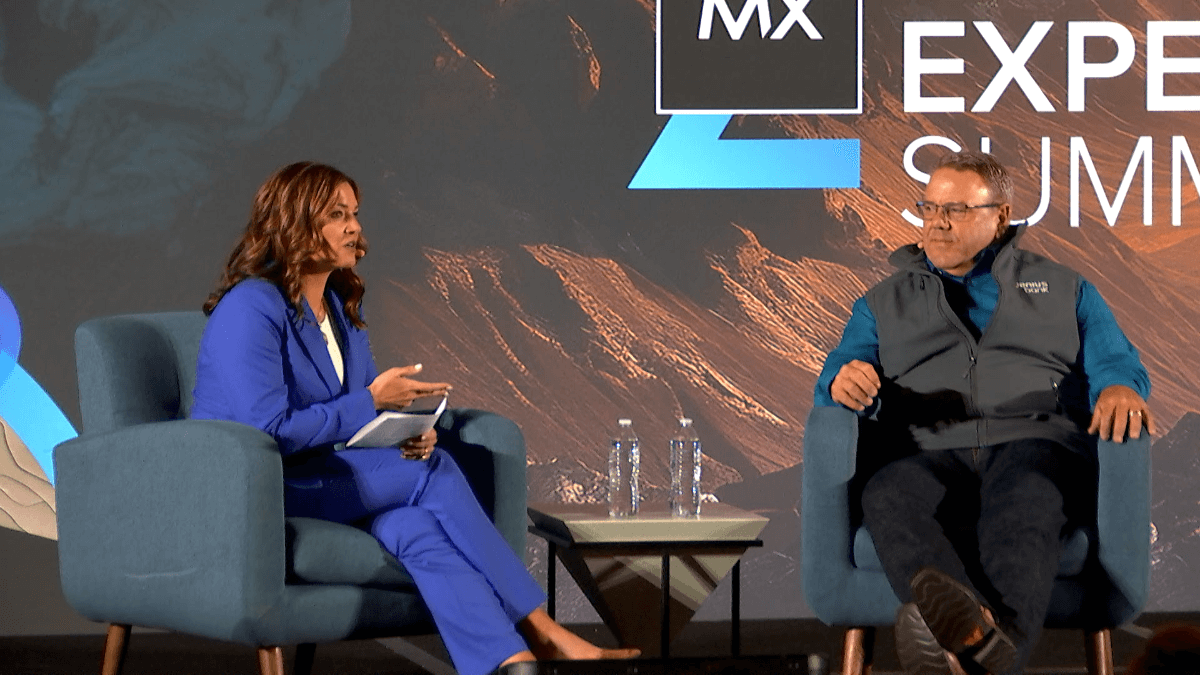
Somebody told me we were gonna do this in the spirit of Peaky Blinders. Oh, Is that what we're do in gov? Alright. Alright. I actually am from England, so I might be able to land the accent. I'm not sure. Well, I didn't bring any of my, you know, brass and knuckles, so We'll, like to discontinue as such, you know, Jason, I was thinking about your, the title you carry at BECU, EVP, Chief Member and Digital Experience Officer. This role is massive in terms of what it touches, The responsibility it has, and just like those, that combination of what it carries in terms of responsibility, interaction, et cetera. And so you really sort of engage in the whole member journey in many different ways. Tell me what experience actually means to you from a philosophy standpoint, because that's so much of how you start in the way you think about this role and a lot of how things have been structured and really how this has an impact on the membership as a whole and how you choose to interact with them as BECU. Well that's a big question. It is. Yeah. I'm gonna see if I can land the plane. So first off, thanks for the opportunity to talk a little bit about BECU. Experience of BECU is digital first human noise, and it's grounded in our purpose, which is ultimately as one of the nation's largest credit unions about improving the financial wellness of our members and the communities in which we're in. So we serve 1.5 million members. We're a $30 billion asset company. So I'd like to say we're small enough to get your arms around, but big enough to matter in the scheme of credit unions and what credit unions can do. if we go one step further, what we're trying to do is to move at scale, our members from financial access to financial health to financial prosperity to financial freedom. And that's really, really important to us because I think a lot of people would say improving financial wellbeing of members and communities is important. I think the outcome of that, and what we're really, really focused on is creating pathways so that our members can create lasting generational wealth, which is ultimately the unlock that we see if we do that well. And then as you asked about the experience that we have and the philosophy of what we're driving towards, a reminder that we're also solving for five generations at scale and at speed who often have very, very different relationships with and practical application with their money. And we have to build an experience that is both scalable and also addresses the individual needs of those five generations and how they turn and how they show up. So as we think about experience, I think about a few cornerstones. The first is, as we've heard here, digital isn't a channel anymore, right? It is a mindset. As we think about delivering human centered experiences and how we do that across 1.5 million members and growing. And how we do that at scale. And digital is also not just the front end experience. I'm fortunate my team has responsibility for the digital experiences in new palm of your hand, but we also have to work very, very deliberately thinking about digital as the backend experience. 'cause if you fix the front end and the back end doesn't work you haven't solved the problem, you haven't built a true experience. I think the second point is we're guided by four Cs to keep it really simple. We're trying to deliver experiences that are consistent, convenient, compliant, and contextual. And so that enables it. We on a daily basis give not only our members, but our employees, too much homework, right? There's paper floating around. We haven't quite killed the facts even in 2025, which is a little scary. And so thinking about the homework that we give our members and how we reduce that friction, how we make it easier for them to do business with us, and then ultimately can propel them on that journey to financial wellbeing. I think the other thing about the philosophy that I have for the team is you have to walk the walk of the people that you serve. I'm not unbanked or underbanked. I have not been, how can I possibly solve the need or understand the needs and solve the needs of the unbanked and the underbanked that come through our physical, virtual, and digital doors every day? If I don't walk the walk with them and understand what that is and listen at scale and then embedded in that philosophy is I think the ability to bring it always back to people. In order for us to deliver the experience that we're attempting, we have to have the right people in the right seats. And that's really, really important to us. The 3,200 people that wake up every day, and have the honor and the responsibility to do the right thing by our members as a member own business. We need to invest in them so that they understand and they're very, very connected to the experience that we're trying to deliver. Embedded deeply in that is this concept of empathy with a pretty broad group, you know, five generations Yeah. The different stages that individuals are in, in these phases from a financial sort of journey themselves. And I think one of the hallmarks of BECU forever that I've known them has been this commitment to financial success in all these different phases. You know, from the financial centers to the way that you think about digital in this experience and kind of the unification of that across the board. As you all think about technology and the way that you're utilizing that, recently you made an acquisition of Earn Up. And as I understand it, that was very oriented around how it is that you fuel this mission of financial wellness for the members of BECU and all these phases. Tell me more about that. So again, grounded in your question about experience, as we think about the journeys we want to create, I mean, we are on a mission to move BECU from a product led, experience to a journey led experience. So whether that be the journeys that we build, the digital, the mobile experiences that we create, the financial health journeys that we, that we curate, technology. And increasingly, AI is at the forefront of that, but it is anchored very much so in the needs and the wants of the members that we serve. And so, as you mentioned, right, and we've heard AI has the ability to personalize at scale, rapid scale experiment, and enable us to develop new solutions in order to test those with our, with our members. The acquisition of Earn Up, is what we like to… when you read about AI, many companies are taking bold strokes. And so Earn Up was our first bold stroke. Earn Up is a financial wellness FinTech company that has been spending time creating easy to use solutions to help fuel financial wellbeing and financial wellness. And so we acquired their gen AI capabilities and a number of their team members moved over to BECU. And so if you can imagine a financial advisor, that understands your, in these unique situation and it's in your fingertips, when we announced that's what we're building, our AI advisor will be personalized. And it is being built in order to understand your unique situation and then be able to guide you through that continuum that I mentioned from financial access all the way to financial freedom with personalized steps along the way, and delivering not only sound advice, but also delivering action. 'cause at the end of the day, if I give you advice, but you don't take action, we're not gonna be able to realize the improvement in the financial wellbeing of our members and our communities that we seek to serve. We'll do that in a fair and an ethical way, of course. That's incredibly, incredibly important to us. And it's also important if you think about the members that we serve and the communities that we're in, because we fundamentally believe we have an opportunity to democratize financial wellbeing at scale. If you think about whether you're starting out, Rodney talked about the fact that there are 40% of Americans don't have $400 to be able to do, you know, fix something that broke yesterday. Or whether you are ready to start taking that first step. You've earned enough, you've got enough assets to be able to take that step to building that first step on generational wealth. We firmly believe with the Earn Up capability, we have the opportunity to serve those five generations wherever they are, to be able to do that. And in a very, very meaningful way. That's the beginning of the journey. The Earn Up acquisition also enables us to, again, personalize at scale. We'll be able to infuse AI into our digital and mobile experiences beyond the advisor. And we will continue to experiment and learn and thoughtfully add that throughout the journey that we're on to transform our digital experience. So very much in the bold strokes perspective, it's maybe not so much getting your feet wet, but really diving into how you start to use this in the pursuit of the breadth of experiences that members are having in this kind of multi-generational thesis. I've got this little 8-year-old daughter, we've talked about her, Grace. Yeah. I watch her oftentimes today in her life. And it occurs to me that she will never know a time that she's not able to sort of ask the genie for help. You know, like she will progressively get more and more guided by this as the years go on, as generative a AI gets embedded in the devices around the house. And I sort of realize she's being raised in this, I speak English because I never had any other concept of it, she's gonna be kind of raised on this notion of AI. As you think about that work that you're doing now and this future generation that's coming rapidly, 10 years from now, she's gonna be having financial expectations. You know, how do you, think about this in the vision making within BECU of being relevant within the ecosystem of what my little Grace is going to expect in her financial existence with that kind of a shaped mind? Well, I think if I knew the answer to that, I would be, We could do, that I feel like I wanna invite Sol back to actually answer that question. I think she might be in a better position. So a few thoughts. I mentioned at the top of the conversation our purpose. And so I think the first thing is don't lose sight of your purpose or your North Star. I am a lucky man to do what I do. I really am. The work that I do is joy, it's joy work. And at this stage in the career, I'm incredibly thankful for that. There's a team of 3,200 people at BECU that are thankful for the opportunity, and dare I say, very, very keen and responsible to doing the right thing because we're a member owned company, right? We're a not-for-profit cooperative. And so at the end of the day it's our members' money. So we have to be incredibly thoughtful and incredibly responsible with what we do. So I think that's mission one. Do not lose sight of your purpose or your North Star. Number two for me right now is, I like to say Vision 2030. So I'm in the midst of 2026 planning right now, and it would be very easy for me to be mired in 26 and starting to think 27, the puck is already at 2030. So how do I inspire my team? How do we think very, very thoughtfully about the things that we've got to think about now that we, we will need to deliver in 2030? How do we do that internally? How do we work with partners like Amex to figure out what that looks like and how do we start to take those steps? And you mentioned kind of jumping in, you know, full force. I think we have to meet this acceleration of evolution as, Sol had said, but at the same time, we have to be both courageous and thoughtful. So I would say we are putting our toe in the water not jumping in very, very deliberately. And then I think the third for me, in answer to your question about vision, it comes back to people, right? So deliberately engaging with employees and members and communities, listening to them and understanding what's on their minds to be able to do that. And in the context of AI, just being very thoughtful about workforce enablement and productivity. So we're spending a tremendous amount of time with our teams, really, really engaging them in the basics of AI to understand how it's gonna impact their lives, and therefore how that will impact the experience. As an example you know, in our contact center, right, there's gonna be a tremendous evolution with AI and other technologies transforming your traditional contact center to a voice enabled experience. And so, as part of the earn up acquisition, we've actually have created an AI agent, and that takes, for our contact center agents, it takes 3,300 info point articles. I'm sure you all have them. How do I figure that out? It's been written and then it's been overwritten, and then it's been overwritten again. And so we've deployed for 33 for our agents a curated AI agent that essentially using natural language curates, how do I help a member do that in seconds and minutes as opposed to that taking 10, 15, 20 minutes to be able to enable our contact center agents to engage with AI in a way that's comfortable, and then also ultimately show them the power of that as we continue to extend that and other technology solutions we have to build the experience that we're aiming for. These are some of the baby step paths that I hear you talking about. You know, Clay Christensen, well-known for Innovator's Dilemma talks about how sort of the incumbent loses on the basis of them not being able to get out of their own way with culture steeped, infrastructure steeped, kind of sacred things that can't be disrupted internally. When you think about these baby steps and sort of some of the large changes that entities of your size or larger need to make, what kind of courage, what kind of thought process, what kind of mindset do organizations like yours and larger need to be able to have in order to participate in this? In a way such that the relevancy is there in 2030 and beyond? Yeah. And not sort of bypassed? Well BECU is 90 years young this year. That's what I like to say. 90 years young. December 7th of 1935. Although we will not be celebrating on Pearl Harbor Day, I can promise you that. So I think it's really, really hard for organizations to not have any sacred cows. But I think my responsibility as part of the executive management team is to push and say, Hey, we need to re-look at that differently. Three things come to mind. The first is structure, right? So another bold stroke led by our CEO, Bev Anderson, that actually brought this team together, right? So I have responsibility with my team for essentially getting people to our experience and getting people through our experience. So that is marketing a brand, digital, physical, and, and voice or contact center growing into voice. And that's a new team. We've been at this for 18 months. They weren't always together, they were in three different parts of the organization. And very often, as you can appreciate in three different parts of the organization, siloed thinking would happen. And actually what one team would do would create friction for another team. And so we brought that team together, and that's actually paying dividends very, very quickly. I think the second for both internal partners that work with us and then also external partners such as MX, is common aligned goals, simply put, we have a SOAP strategy on a page. It's one page. We're very, very clear about what we're aiming for, how we use data, what we're focused on, and essentially what's essential, right? That power of essentialism that in a sea of infinite opportunities. And believe me, BECU is a target rich environment where we, we can, we have, may sound like a lot, but there are 20 things on that page. And every single person on my team should be able to look up and say, I see myself in one of those 20 things. And then we take that to our partners in risk. We can bring that to our partners at MX and say, here are the 20 things that we're attempting to do. They won't all get done in a year, right? They may be multi-year. But the power of SOAP and essential essentialism is really guiding us from a vision and a culture perspective to actually teach our organization and our teams to actually say, not right now, which is also really, really hard. Not right now. And then I third, I think the third very quickly is intentional impact. And as an example of that would be the work that we're doing in Spokane, in eastern Washington. You know, for the longest time we actually weren't focused on Spokane. We entered the Spokane market in 2016. We built a couple of neighborhood financial centers, which is what we call branches. And then we stopped building in 2018. And if you think about our purpose, which is about improving the financial wellbeing of members in the communities we serve, we stopped. So we had this community that we started, and we actually didn't finish the job. So fortunately a number of us got together when a number of us joined in 2023. We took a look at the data. We understood the marketing, we understood the environment, the members, what they actually needed. There was a unique, there are similar needs to western Washington and also unique needs within Spokane. And what we committed to is we said we're going to refocus and rebuild our efforts in Spokane. So we, this year, we just opened our first NFC in seven years in South Hills Spokane. We're gonna open a few more. We built our first for Spokane advertising campaign. We're here to help based on data, based on insights, you know. So, for example, Spokane under indexes on social media engagement, but overindexes on gaming, we had never asked that question. We never looked at the data. And so what we had done is we took a western Washington approach, put it into Spokane, and surprise, surprise, it didn't work. It didn't resonate. So we changed that. We engaged in the community, community engagement for credit unions. I say we do that particularly well, but we saw an opportunity to help fund and open Spokane's first open air farmer's market. It's quite fascinating. Spokane is the bread basket of Washington and yet had or deals with such high levels of food insecurity. And until this year did not have an open air farmer's market to curate and build local businesses and, and feed people in a way that can be incredibly purposeful. So that gives you a sense of how beyond digital and and mobile experiences, that vision is all encompassing. And why the MX team that again, is marketing brand, digital, physical, and voice. Putting that together enables us to have very, very unintentional impact that connects to the fact, and we're incredibly proud of this, that in 2024, BECU returned $490 million to our members in the form of low or no fees. We reprice loans, we don't ask for it, right? We reprice loans and we are continuing this march to helping our members improve their financial wealth and their finance, their financial health, and indeed the financial wellbeing. Bravo. That's beautiful. This conversation has ultimately been about, I think this confluence of empathy fused in with the way we think about the use of technology, whatever it is, particularly as we look to the now and future of how AI fits within that. But allowing that empathy to shape priorities in terms of driving strategically so that relevancy is what remains in the future. You know, you also have this podcast: More Elephant. Talk a little bit about that to close and sort of how that fits in with this philosophy of experience and basically having that shape the lives of the humans that we serve. Thanks for giving a shout out to the podcast. Yeah. The tagline of the podcast is, listen, learn, live better. We just opened up season two a couple of weeks ago. First guest of season two was Reverend Naomi Tutu, Desmond Tutu daughter, just talking about ideas of change. And now ultimately we have two of these and one of these. And if we use this more than we use this, we might be actually on a path to creating meaningful change in the world and in the work that we do. If I bring that back into kinda like the corners of BECU, what I love about our members is they're not afraid. They compliment us when we do it right. They're not afraid to tell us when we actually miss the mark. And we added more friction into the, process and the experience than we should. And so we listen intently. We do all of the traditional things. We look at NPS, we look at all of the surveys, and then there are a couple of things we do that I'm incredibly proud that the team does. We have a member advisory panel where any adult member of BECU can join, give us feedback, help us shape the products, the solutions, the journeys that we're doing. And we use that. We are, true believers in human centered design. And so we use that very, very thoughtfully as we innovate and we build. But it also extends to community. Last Friday, I was at a board meeting with the Urban League of Metropolitan Seattle. And we were talking about affordable housing, job creation, financial health, the connection between financial health and physical health. We just extended our agreement with the Seattle Storm, where we bring in 600 kids on an annual basis. And our role there is to have true community impact linking physical and financial health together, which you might not naturally think that a credit union would do, but that's about listening to the needs of the community, particularly marginalized communities and figuring out how we, BECU, can, again, put them on a path from financial access, encourage them to get to financial freedom, and again, put them on that path to creating lasting, durable, generational wealth. And then at the end of the day you mentioned you have an 8-year-old, right? So, I think each of us, I'll personalize this for a moment. I know each of the, every single person on my team takes this so personally. What I'm most proud of because we listen at scale, is that it enables me to go back to my 12-year-old and my 9-year-old. And they turn around and they say, well, what did you do today? And I turn around and I say, we changed lives. And I truly mean it because we do. I love that. This is why BECU and Max as partners have fundamentally been so key to one another, empowering the world to be financially strong, changing the lives of others. Jason Rudman, thank you so much. Thank you my friend. Really Appreciate this conversation.
Read Transcript