Your Key to Future Proofing Your Business: Data in Action
From leveraging AI to upgrading legacy technology to meeting evolving consumer needs, future proofing your business centers on one key thing: data. This session will unpack the headwinds and tailwinds facing our industry — and how to win with data.
Transcript
All right.
Hey, everybody. We've got a fun panel here.
I'm sure we're gonna say this more than once,
as people are gonna filter back in for us.
But this panel is called: Your Key
to Future Proofing Your Business: Data in action, implying
that data inaction would also be the key
to not future proofing your business.
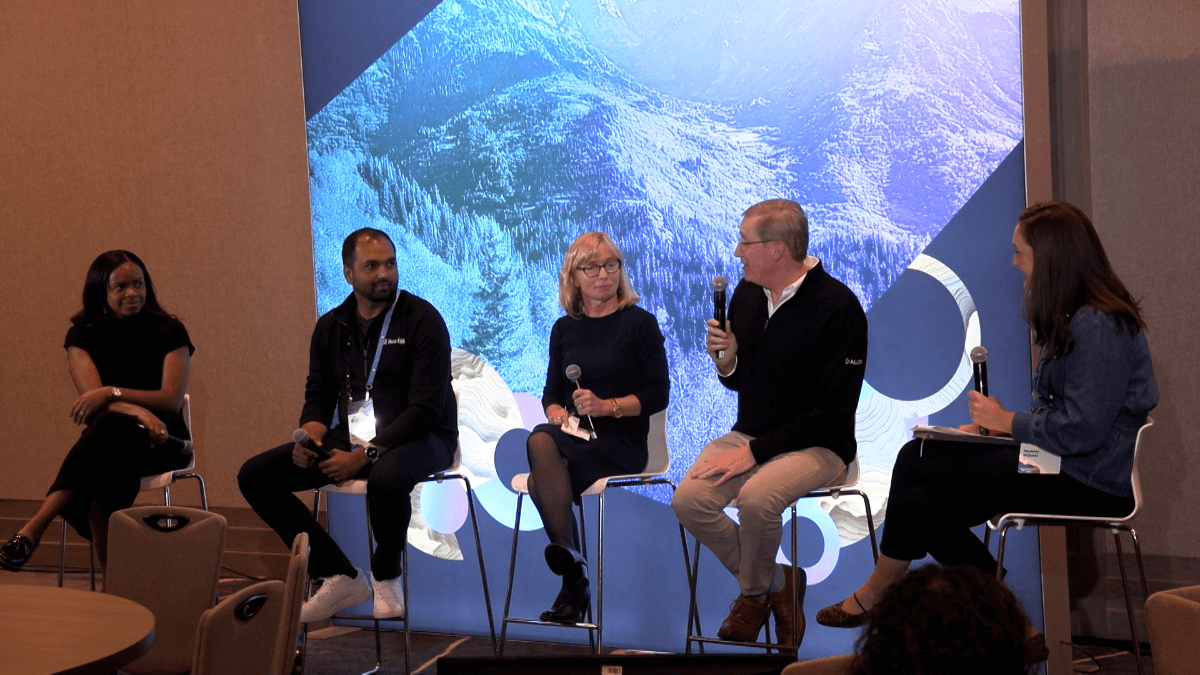
We've got three great panelists joining me here today.
We've got Kirk Benson of US Bank, Chris Griffin of Narmi,
and Penny Lee of the Financial Technology Association.
I'll turn it over to each of you just
to do a quick introduction on yourselves.
Chris, I'll start with you since you're on the end.
Sure. Yeah. Chris Griffin. Hello everyone.
I'm one of the founders at a company called Narmi.
We do white label digital banking
and are fortunate enough to partner
with MX. In a prior life,
used to be a CIO at a small credit union
and then worked at a larger
global bank for a bit as well.
Kirk Benson, nice to be with everybody.
I am part of our digital data
and AI team, head of a customer success team,
which does all of the, for reusable tech, does all
of the things a normal customer success team
does, but not for profit.
So want to distribute all
of our apply work, doc management,
money movement stuff across our 50 plus
businesses, most that are over a billion dollars in revenue.
Hi everyone, thanks for coming today.
My name is Penny Lee, president, CEO
of the Financial Technology Association.
We are trade association based in Washington, DC
representing large FinTech companies ranging,
I like to say a lot of the one syllables:
So Plaid, Stripe, MX, Brex, Ramp Chime.
But working on both shaping U.S. policies
for the modernization of payments and FinTech.
Excellent. So three very different
viewpoints on the industry.
Again, the topic is gonna be really talking about
how we're using data in the industry,
how can we be using it better?
And I think a lot of us are coming from the session just
before this, listening to a lot
of different ages of consumers.
And so, I'd like to start the question,
with a very open-ended question, which is really just,
as customer expectations are changing,
obviously the nature of our roles, the nature of the way
that we engage with data is changing as well.
And I'd like to just kind of go down the line
and hear from each of you how things have changed over the
last five years, how you sort of expect them to continue
to change over the next five years.
And I'm gonna go reverse order
this time. So Penny, I'll start with you.
Thanks, Greg. You know it was a fascinating,
I think, session, to hear how people are
not only using financial products,
but how, what their expectation is.
And so it was so fascinating to see the various generations
and how they interact.
I know from my own personal experience moving from
checks into digital payments,
recently somebody asked me, a contractor asked me
for a payment and I said,
can I provide an electronic payment?
Well, if you use a card,
that's three and a half percent.
And I said, what about ACH? Oh, you want a ACH by check?
I said, no, just ACH,
if you can provide me an electronic link.
And they're like, oh, better yet, if you could provide me
with a PDF of your voided check,
then we can get your account
and routing number, then we can then put you
through our system to then send you a check.
I was like, yeah.
So my expectations are greatly changed, in
that I want instantaneous, I want to be able to
with the PDP, with Venmo, with Cash app, with
so many of these other services, bank transfers
and others to be able to move my money faster, cheaper,
easier, without the friction to be able to do it seamless,
to be able to pay bills instantaneously,
to have it settled quickly.
And so my expectations as far
as payments in particular have really changed.
Yeah. And before we move on to you, Kirk,
I just wanna say this is a, I had a very similar experience
that led to me carrying around $20,000 in cash.
I felt like a criminal, but also kind of like a baller.
I was like, wow, who, who does this?
You could go to Vegas. Yeah, no, I didn't.
I thought it was the most terrifying 10 minutes
of my life while I was carrying that amount of money.
Kirk, over to
You. I'm happy
to carry around your
$20,000 if you need any help.
I think touching on a few things there, in terms
of like, Hey, what's changed in five years?
What's gonna change? I think there was more data
inexperiences now than five years ago,
and there'll be way more five years from now.
I think in terms of expectations is,
banking clients expect us to use their data
for their good, right?
So if you compare it to Uber, you know, I live around here,
but, I open up my Uber app,
it's got the five destinations
I tend to Uber to around here. I got three clicks.
Open it up, click the address, click go,
choose your thing to that.
And from a US bank perspective, we want
to focus on using that data to anticipate needs at,
you know, the classic digital moments that matter.
So if you pay off a loan, right,
then you got disposable income, we can serve up
and tailor the right credit card rewards
or high yield CD or savings to that.
But clients expect us to use data.
I'm curious, has anyone used chat GBT
or Gemini for financial advice?
One, two. So, the extreme minority, right?
I still don't know if I fully believe the survey data,
but according to Experian, who I do trust, right?
They claim that 64% of Gen Zers are using
LLMs for financial advice today.
And I think that's just a great, you know, great, if
that is true, which I will take them at face value,
even if it's not, you know, even if they're off
by a magnitude, like a pretty crazy shift in how banking
and financial advice is being
served over the last five years.
You know, that didn't exist five years ago,
barely three years ago.
So to me that has to be the kind
of the fulcrum of what's changed.
Yeah, absolutely. And I realized
I never actually introduced myself.
My name is Greg Palmer, I'm with Finovate.
We just ran our showcase in New York last week,
and this is a topic that we saw over and over again.
You know, obviously the amount of data that's floating
around makes so much possible.
It's really fun for me to get to see some
of these startup companies, really young companies
who are using a lot of creativity when it comes to how
they can take the data that's available
and turn it into really excellent customer experiences.
And this is an area that I think
the best is still to come for sure.
There's so much that there is to do.
But, anytime there's an unpleasant experience that exists in,
you know, there're kind of a lot of 'em,
there's a possibility to do something better,
and we can really make this a very targeted
growth opportunity for companies in the space.
So next question is really one
of the really critical things
and Kirk, you mentioned this, using data
to make customers' lives better, there's an element
of trust when you're talking about data.
There has to be not only data in terms of safeguarding it
and keeping it from falling into the wrong hands,
but also, you know, using it for good, right?
Using it to advance the benefit
of the customer.
So I'd like to talk about this intersection
between trust and data.
And Chris, I'll start
with you from your standpoint,
this is something I would imagine you probably have
to think about quite a bit.
How are you exploring that intersection right now?
Sure, I mean, I think as you say,
it's just like trust and data equals banking, right?
Like, there isn't fractional reserve
banking without those two things.
Even if you go back to writing the physical ledger
and believing that they're putting that
information down correctly.
And so in today's age, it, you know, for me it's really
around how do you set your consumers
and businesses up for success?
And that's frequently allowing them to use the tools
that they want to use for banking, right?
So, from our financial institutions,
anytime we talk about business banking, it's always about,
do you connect to NetSuite?
Do you connect to Zero?
Do you connect to, the ERP
or accounting system that matters to my business?
And I find it really interesting that there isn't kind
of the same conversation around consumers, right?
And some of that is because folks like Plaid
and MX have solved some of that problem.
But I think there's a big opportunity there, especially
with more gen AI tools coming into the spotlight.
And inevitably the security
and compliance shortcomings that they have
is gonna be a really tricky balance
to meet their expectations.
You know, majority of Gen Zers are using
it for financial advice.
Do we feel comfortable as a banker
or credit union offering financial advice from
LLMs in our digital banking platform?
I hope not. I hope not. Right?
So it's a really interesting
point in time right now, to navigate.
Yeah, absolutely. Kirk, this is a great one.
I think obviously working at a financial institution,
you have to balance a lot of moving pieces,
and customer trust.
I know we were talking about it before we got up here.
Massive concern for you all
as well. What are you guys seeing?
Yeah, obviously, as a bank trust,
I think about it in two different ways.
And so from a banking perspective,
raise your hand if you have had a data breach, right?
Or as part of your company, it doesn't feel great, right?
So can't do that.
Within banking, what we're focused on is transparency
and control, right?
So
we've got a whole section in our digital experience about
where we are sharing data with who,
and you can toggle it on and off, right?
So we build trust that way.
And then
I think the other perspective is there's like a
intuitive experience design.
So partnering with MX, right?
So I can now see my American
Express transactions, right?
On my online banking dashboard.
And I think the way that's designed
and popped up, it's gotta be intuitive.
And so you gotta trust the bank that they're doing it
for good, for you, right?
And not using that data obviously
to upsell at the right periods of time,
but there's a design component to
how you use data and trust as well.
Yeah. And just from the FinTech perspective,
you're only as good
as your last experience
and the last experience for the consumer
because there's so many choices out there now.
And to ensure that the stickiness that there
continues. To have that user experience
that embodies trust, that says that information
that is there on my dashboard is true,
that it's going to stay there.
That I have insights into it.
And I think one of the things, being kind of last,
not last leader, but moving into spaces,
seeing the landscape, what
is missing from my bank statements of the past?
How do we improve upon it?
Or what is the transparency
of my retirement account need to be?
And so I think the visibility is one of the things that has,
kind of helped to bring
that trust factor into some
of the more innovative financial tools.
But yet it is incumbent to ensure there's the protection
to make sure that you're stewards of this information.
There's nothing more sacred than somebody's money.
And so when you are a steward of it,
you have to ensure the trust.
Yeah, no, absolutely.
And I think there's another way
of thinking about trust, which is something which came up
quite a bit at Finnovate last week, which is,
can you demonstrate not only
that you're gonna safeguard my information,
but can you demonstrate to me that you're on my side
that in these critical moments where I find myself
as a customer with substantial needs
or needing some help in that moment, are you with me
or are you against me?
And I think this is one of these really critical questions,
which is gonna have to be answered by the industry
as a whole, because it's not difficult to imagine
how you can use the data that's available
to find opportunities to get incremental revenue.
And I think this is one
of the things we're gonna talk about a little bit more later
on, but there's more to be set up for
if you can demonstrate to me that you are
with me when I need you, then this is
how you go build a really long lasting relationship,
which can stand the test of time.
And one of our customers, who won best
of show last week called Case App,
had a really compelling demo talking about these critical
moments where you,
a customer is pursuing a fraudulent charge, looking for
some sort of resolution on the part
of their financial service provider.
In those moments, if you
as a financial institution don't meet
that customer's needs, they're gonna walk.
And there's a lot of data that backs that up.
So this is, I think as we talk about trust, we'll kind
of come back to this and think about it from a couple
of different standpoints.
It sounded like you had something
you wanted to chime in with really quickly
As well. Yeah, I mean,
it's about you.
We have very educated consumers too,
and they are looking to shop products
and they're looking for sometimes the best,
not only information, but what the,
best opportunity, you know, I have a primary bank
that's a traditional institution, and you look
and you see your savings is at 0.0001 maybe right now.
And so I'm gonna shop to see,
is there another place that I can park some funds
that I can have a higher savings?
And so you kind of shop around and you try to see,
and to make sure you test.
I mean, I tested out, and Kirk
and I were talking earlier,
people don't just bank in one place anymore.
They spread it out. They are,
comparison shopping, but to give each,
but they only work if you can instill that trust that
my money's gonna be safe while it's there
and it's actually producing the 4% interest kind
of savings on it as well.
So trust is paramount.
Yeah, I was actually at this event two years ago
where I was talking to a banker's interest rates were
rising, who was saying we're not able to offer the same kind
of rates that some of our online competitors are
because they can move more quickly.
And he said, I hope
that our customers would have the loyalty to kinda stay
with us, even though we can't offer them that rate.
My question to him was, how loyal are you to your customers
who are one day late on a loan payment
or who are in the process of defaulting?
Like, are you extending the generosity
that you would like to see returned to you in this moment?
No response by the way, I'm not gonna,
name who that was,
but, it was a resounding no comment.
I do want to,
we have to switch gears a little bit.
We need to talk about stablecoins
because this is an area where
cryptocurrency is obviously something which has
captured a lot of people's attention.
Obviously there's a lot of ups and downs.
Stablecoin is looking to kind of take a lot of the risk out
of it, and there's a lot of cool
stuff that you can do with it.
And again, this is obviously a heavily database play.
Kirk, I'd like to get your thoughts, first of all on
how you're looking at it at US Bank
and whether this is something that you can,
can see yourselves engaging
with at some point in the not too distant future.
Absolutely. You know, a couple different things.
So I think it's definitely a focus area today.
So, our CEO Gunjan talks about,
think about the rail and the end points to it, right?
So my in-laws send me a picture of a check on my iPhone,
and then I gotta take another iPhone
and deposit that through another phone, right?
That's their end points, right in between, they don't care
how that processes.
And so if you think about stablecoin, it's
that middle processing part.
So the use cases we're looking at are cross-border payments
for an exchange, and then we've got some European businesses
kind of as an example, so intra to that.
And so then my personal opinion is like,
each bank will end up with its stablecoin, right?
So it can control all the policies, procedures, rails,
and so then you can tailor the experiences at the end points
with a rail that's got some advantages for processing,
just like other rails, other advantages for processing.
Yeah. I feel like I'm
moving the mic away from my face somehow here, so hopefully,
I don't know, can we dial it up just a little bit?
There we go. Chris, we'll come to you
Now. Sure.
You know, I,
historically I will admit I have been,
and probably forever will be a bit of a crypto bear.
If I lived in Venezuela,
if I lived in North Korea,
I would be very pro cryptocurrency.
But, to me it kind of, you know, the underpinnings
of what crypto is, decentralization, a public ledger,
those things sound unnecessary
and also kind of scary in a well-functioning society.
You know, do I really want my payments
to one day be decloaked?
I would prefer not, right?
I don't think I have anything to hide,
but at the same time,
who knows where the world goes?
So I think there's definitely,
as you mentioned, cross-border payments, like
what I'm really excited about stablecoins is,
I think it's making people scared
and making them move their traditional products
to be more competitive
and to think through, alright,
how the hell do we get things moving faster
from a payment perspective?
Because it's not instant, we're behind.
Every other developed country has gotten there,
we're starting to inch towards it.
So yeah, I guess those are
my kind of freeform thoughts on it.
And Penny, you probably have a different
perspective here just because you see
so many different types of companies
who are part of the organization.
What are you seeing who's using it well?
Who do you think you… anybody wanna highlight here?
Well, I love all the children. Just kidding. Of
Course, they're all your
Children.
you know, everybody, as far as the members
that I represent, are all trying to figure out
what their stablecoin strategy is.
And it takes very different forms,
I think in its first initial, kind of exploration.
Most are viewing it as a cross-border payment using it,
thinking of it more as a rail than a digitized,
tokenized piece of money.
And so you'll hear a lot of them are working through
what they would term programmable money.
Is there some stability that this rail will now offer us
that we can transfer
or make a cross border payment into another country
or vice versa into the United States.
And there's a stabilization of rates of speed, of cost,
and also looking at it from their own not wanting
to go through pay
various different tolls along the road to be able
to make that remittance or that cross border.
So I think the first iteration that most
of our member companies in, whether that be PayPal, Stripe,
Remitly, Wise,
others are looking at more from a cross border payment rail
and the opportunity, as you know,
fintechs don't have access into Fed services.
So anytime that there is a cheaper rail
that is out there, they're gonna try
to explore it as best they can.
So that's the use case.
I still think that there is an open question,
to Chris's point as to how the US consumer will use it,
I think right now, if we, if you've ever tried to,
if you were in the NFT stages, if you ever tried
to buy an NFT, it was really clunky.
And I would still say there is incredible amount
of friction for a US consumer to buy a product
using a stable coin.
So that still has to be built out.
That still is the unknown use case
or exactly how it will work.
But there's a lot of buzz, there's a lot of excitement,
there's a lot of trying to figure out
what exactly the stablecoin strategy
of your individual company is.
And we'll start to see kind of
what this movement looks like,
but in particular I would say in the first case is,
is, cross border.
Yeah. And certainly I think the easiest one
to immediately see the benefit.
Chris, I think to your point, you know,
the idea, again, it comes back to trust.
I like the idea
of having transactions on a blockchain auditable.
I don't like the idea of potentially
that blockchain becoming visible or getting de cloaked
and all of a sudden somebody has access
to my entire financial history.
And so this is a really difficult balancing act,
and I think it would be naive to say
that anything is gonna stay private forever.
You know, we've seen enough
rebuttals to that as a concept.
So a lot to think about there.
Now we get to the spicy one, now we get
to talk about Open Banking.
Obviously this is really an important topic
for all sides of the industry.
I'm not 100% positive how much consumers themselves
are really aware of the debate that's going on
or how we're thinking about it.
But at, at its core, this question of who owns this data,
and how can we make sure that we're using it again
where we started to advance customers interests.
Kirk I'll come to you again first on this one.
What are your thoughts?
What can you tell us about
what US Bank is thinking about at this point?
I'll use one of our corporate words right now,
so interconnectivity, let me make it real.
But in terms of Open Banking, we want to,
build those experiences that draw on
internal external data.
I think to the other element
that we have is, we've got a developer portal,
so developer.usbank.com,
that we can basically do embedded finance either
through like basically API money movement, APIs
or data signals, risk signals,
et cetera, et cetera, to that.
And then I talked about it comes back to trust, right?
It's that control and transparency is
that third pillar already talked about,
but you need to make it available.
You need to have a foundation to manage it,
and you need to have people that are practitioners
to build it and integrate it into experiences.
So there's a lot more there given our 50 business lines,
but those are the three pillars.
But I think it comes back to that trust part as well.
Yeah, absolutely.
I can feel Penny wanting to talk,
but Chris, I wanna give you a chance
too. Okay, sure. Yeah,
I think Penny definitely is at the
epicenter of this, so excited to hear her take.
But, as a digital banking provider,
we actually do play a pretty big part in Open Banking
where we're also furnishing the data
through FDX on behalf of our financial institutions
and also being screen scraped by certain
participants that don't use OAuth yet.
And then also leveraging that data
to enhance the client experience.
As you mentioned, everyone wants
to see their aggregated financial picture
and no bank is really serving the needs
of every individual consumer and business, right?
There's going to be something outside of that.
But yeah, from from my side,
I think the biggest thing that I'm hoping for,
and I think remains one of the biggest questions is
what is gonna happen to the long tail
of financial institutions, right?
Chase has already exercised their might
and their power to get revenue out of this.
What is going to happen to the
$25 million credit union?
Are they going to receive the same benefit
or are they only going to kind of receive the
potential downsides to Open Banking?
So that's something I hope
gets brought back into the limelight.
I feel like we're right now in almost kind
of like a reverse Dodd-Frank debit card era
where the big banks have all the pull
and the small banks, the credit unions are
probably not in a position
to negotiate there.
And that's certainly my experience, at least
what I was hearing last week is a lot of people on that,
do feel like they're along for the ride to some extent.
So Penny, from your standpoint, I mean,
obviously there's some news that just dropped.
I'd love to hear what you are thinking about
what you're working on with other folks
in part of the association.
Yeah,
I would say six months ago if I had said Section 1033 Open
Banking, probably every eye would've glazed over.
But it's obviously been front and center
and kind of where the perspective
that we have always taken is how do we get the US forward?
How do we think through, we are one of,
we export incredible amount of innovation and ingenuity
and forethought and products
and services all over the world.
And yet United States feels like it's
behind on so many different areas,
as far as instant transfers and settlements
and payment ability and tap to pay
and all of these other act innovative products
that are out there that a lot of the rest of the world,
and I would say underlying most of
that activity is data portability.
And so we have always taken the position,
and I think from the FinTech perspective
where it says in this section
that the consumers have the right to permission their data,
that the data belongs to the consumer.
And that's found foundationally where we start from.
And so from there it is, how is it safeguarded?
How is it protected? How is it transferred?
What are the enhancements to it?
What is it that they can receive?
And so that's kind of, you know, all of
that is underlying on that, you know, all the products
and services are that ability to obtain the,
what we say, the consumers to be able
to permission their data to be able to get the
personalization of the products,
8 outta 10 Americans right now,
to use a FinTech on a daily basis, to be able
to have access
and have it in a way that is, not having
governs over it or prohibitive fees
or exorbitant fees being attached to it
that doesn't allow either small institutions to be able to
add FinTech services to their products
or for the FinTech to be able to be, you know,
prohibitive from being able to,
increase their fraud detections, being able to detect,
to your earlier point,
your mortgage is coming to an end.
Have you thought about putting your extra savings
into a, a higher yield
or have you thought about this type of retirement?
So all of that is, available
and we just need to think bigger.
I think from a US standpoint when you see
certain bank trades, say that well,
all this is all I should be required to do is send a PDF
of your bank monthly statement to you electronically,
that's all Dodd-Frank,
that's all section 1033 requires me to do.
And my point is, we can be so much better than that
and we should be better than that,
and we should be aspirational in how we treat
a customer
or a consumer here in the United States to allow them
to have a better financial experience
than anywhere else in the world.
So that you can live
that better financial life and have better insights into it.
So yes, we are, we were the,
and still are, the defender, the sole defender of the rule,
in a court in Kentucky, once the CFPB pulled out
of it, because again, we believe similar to
when you get your health report
or you know, you get a lab result back from your doctor,
you can transport that and get two
or three different opinions from various different doctors
without it costing you an exorbitant fee that you can't,
or put a toll on it, on what you can do.
We believe the consumer data should be able
to be permissioned and permissioned
without prohibitive fees.
I think certainly based on
what I've seen from other areas, other parts of the world,
this is absolutely the path towards
better customer experiences.
And so if you look at it through that lens
of what's gonna be best for the end users,
I think it's pretty clear that being able
to move data quickly
and get to where customers want it
to go is absolutely gonna be a really critical factor there.
I do kind of see the other side of the coin too.
I talk to a lot of people from all sides
of the industry, but certainly for the kind
of next generation of FinTech companies that's coming up,
the curve access to this kind of data is absolutely vital
for them to be able to deliver new types of experiences
and solutions that right now
the industry isn't able to deliver.
When it goes to examples,
such a buy now, pay later, individual loans underwritten
after each purchase,
and having the ability,
and there's, there's problems right now
with reporting into the bureau
and not having the modernization of the algorithms
to be able to determine whether
or not that's a real line transaction,
a realtime transaction or where they are.
But within Open Banking
or the ability for consumers to share their data,
you're seeing right now
that they can underwrite at a higher quality at a higher
level, less than 2% default fees at less than 2%,
delinquency fees.
They are using this information again to be able
to properly underline, underwrite what
that consumer's capability is to use a B-N-P-L.
And so that kind of innovation that is there is something
that we should only encourage more of instead of less,
instead of trying to throttle back
and do the bare minimum, we should be leaning into
how do we, again, make sure the consumer's not harmed,
the consumer has advantages, they have the knowledge
and we can all work together for an in into an ecosystem
that permissioned data can be enhancing.
Yeah, we do have to kind of wrap up.
We're gonna get to some questions from you all in just a
minute for me.
I heard this analogy and I wanted to share it.
When you see your bank do something like try
and charge you for your data, it's like the equivalent
of seeing an actor that you really like,
pop up in a royal match commercial
or an ad where you're like, how is that person
shilling this stupid iPhone game?
It's not gonna make you stop watching that person in movies,
but it does just kind of chip away at your idea of
what you thought of that person.
And so how many times can you appear in a really bad
commercial before people stop watching your films?
I don't know. How many licks does it take to get
to the end of a Tootsie Roll pop?
I don't know, but you will eventually get there.
So with that said let's go ahead
and just one final takeaway from each of you
before we get to some questions from the group.
Chris, I'll start with you again.
Yeah I think ultimately it's trying
to figure out where your consumers and businesses are
and how do you make it really seamless for them to do
business with you because, as you kind
of pointed out a couple times, I think
ultimately it goes back to trust and goodwill
and that loyalty piece is,
if you're holding someone hostage that's not gonna
to give them that, that same feeling.
You know, there's so many ways of doing that.
Open banking is certainly one avenue.
We've worked with a bank called Grasshopper Bank
where they wanted to enable integrations with chat gpt
and Anthropic, Claude
and others, not within their own digital banking space,
but recognizing that many of their businesses
and consumers want to be interacting with
that financial data in their tools of choice.
Those are the types of use cases that
I think will garner a lot of goodwill.
And frankly, they have seen that very much firsthand
where they're getting a lot of people reaching out,
opening up accounts
because of that connectivity, which is
really remarkable to see.
It's gonna be a minority of folks,
but those are some real use cases out there in terms
of enabling those experiences.
That's awesome. Kirk, final thoughts from you
When Penny spurred this thought?
It's so from a data perspective,
I think we're digital nerds.
We think about like the DIY,
but the, human being in banking is critical to
that trust factor and data can help that experience.
I think you can argue
as things don't stay the same using data in the agentic
experience of whatever LLMs and AI become.
And so just you need to know where that trust lies
and how you're using data, whether it's, you know,
we call it digital and human,
that integrated experience the DIY
experience, et cetera to it.
Cool. Penny, bring us home.
I would just say, as we were saying earlier,
the future's bright, we gotta wear sunglasses.
But it's an exciting time
to be in the financial services space.
There is an incredible amount of innovation.
Some will prevail
and some will obviously be in the test,
but there's an incredible amount.
And I think making sure that our rules
and regulations within the United States are enhancing
instead of prohibitive.
We ran into this a lot last,
during the last administration where
their first instinct was, oh, you're online,
you're serving an unbanked community, potentially,
or an underserved community.
You must be predatory or at risk
'cause you're big tech.
Instead of saying, oh,
what was the market gap you were trying to fill?
Is there something that we can do to enhance
that while protecting safety, soundness fairness,
and all of those other aspects?
How do we take us rules and regulations
and make it so that you can actually grow and,
and be an additive service versus, oh my gosh,
I don't understand you, so let me shut you down first.
So I think just having a reset in our mind
and in kind of our, the potential of where we're at
ensuring safety and sound is obviously in fairness,
but making sure that we don't let those stop the innovation
that is just not only at our doorsteps,
but we're actually incubating most all of it. Yeah,
That's a great place to leave it.
So from here we'll open it up to questions from you all.
I believe there's a roving mic, so,
if there's something that you wanted to ask,
just raise your hand and the mic will find its way
to you slowly but surely.
Here we go.
What single piece of advice would you give
to a brand new chief digital officer at the
community banking institution?
Ooh, I like that one. Who wants to take that one?
I, you know, from the session this morning with
Sol, is that how you pronounce her first name?
I believe right, Sol?
So thank you Saul. She pointed out that
90% of AI initiatives are gonna fail.
Um, and I think that's actually, like, that sounds scary,
that sounds bad, but I actually view that as kind
of a positive thing where it's like the cost
of experimenting with these tools is so cheap
and so much easier, right?
Like we used to develop a predictive model
around risk that was really costly to retrain
gen AI is actually pretty decent at catching a lot of
common fraud and risk that you wouldn't expect.
So yeah, I think just like trying to
leverage more tools kind
of off the shelf would be my advice.
And experimenting and seeing what has traction and
moving forward with that.
There's a lot of great vendors in the space in terms
of being able to help enable that,
Just to bring that to life, right?
So it's like know your customer, right?
And, tailor those experiences towards that.
So we've got branches and customers in Chicago.
We've got branches and customers in Alco, Nevada, right?
250 miles that way, middle of nowhere.
You've gotta know those customers.
And so we'll tailor those experiences to
the different customer set, what the needs are.
You've got a segment and bucket in some form
of the productized set, but I'd say know your customer.
Yeah, I'll just piggyback on that one as well.
And I will preface this
by saying I've never worked at a bank,
but I have seen a lot of banks try stuff.
And one of the things that I can say
for sure is a great best practice is to start
by really looking at what you're not doing well right now.
And there's a lot of data that you can find that'll tell you
where are customers abandoning processes, what types
of customers are we attracting?
What types of customers are we missing?
And getting a sense of what you have to do in this kind
of really granular way is a very good first step.
So you have meetings with people, you have a good sense of
what it is you're looking for them to do.
I've seen a lot of bank
and FinTech partnerships that get started on the wrong foot
and never yield to anything productive.
'cause at the end they kind of get to this point
where they think, what are we doing again?
What's our goal here?
If you come into those conversations with a really clear,
here's what I'm trying to accomplish,
you can really supercharge
how quickly you can get something done
and make sure that the results are what you want them to be.
But again, I've never worked at a bank,
so take it with a grain of salt.
Any other questions that we have from the room?
Well, while they're transitioning one of
my favorite thing to do both when I used
to work at a credit union
and now is to go into the call center
and not with the mindset of like,
what can I make more efficient,
but more of, if they're getting a call about this,
someone doesn't want to call a bank anymore, right?
You know it's probably a good kind of iceberg
indicator, where
there's probably the bulk of your membership, the bulk
of your customer base who is running into this problem
and not spending the time to actually contact you about it
unless it's truly something
that they absolutely need to contact you about.
So those kind of like peripheral problems are really fun
to explore and understand, you know,
this makes a ton of sense.
We should prioritize this as a solution.
Some of them are really obvious, some
of them are quite subtle.
I'll say as a customer myself, if I'm calling,
I am already pretty upset.
Like, I have exhausted all other avenues
to potentially solve that problem.
Representive. That's right. I'm on the phone, just operator,
operator. Well we may be able to end early.
I don't know any other questions in the room
for any of our folks up here?
Looks like no,
that means we just must have answered everybody's questions
ahead of time, so thoroughly.
Well, I want to thank each of you
for joining us for this conversation.
Thank you all for being here
and hope you have a terrific rest of the day. Thank
you.
Speakers
Kirk Benson
Senior Vice President, Digital Platforms Customer Success and Digital Data AI, U.S. Bank
As part of the Digital Data and AI team at U.S. Bank, Kirk Benson leads the Customer Success function. He focuses on integrating scalable capabilities across Consumer, Small Business, and Corporate experiences, while driving alignment with U.S. Bank’s broader business strategy. Previously, Kirk led Customer Digitization, transforming customer behavior and fostering loyalty through sustained digital engagement.
Before joining U.S. Bank, Kirk Benson spent 15 years in leadership roles across Digital, Product, and Finance at Royal Bank of Scotland, Citizens Bank, and Ernst & Young. He earned his BA from Boston University and is a proud Terrier. Outside of work, Kirk enjoys exploring the Utah mountains with his wife, Courtney, and their dog, Wrigley.
Chris Griffin is the Co-founder and Co-President of Narmi, a digital banking and account opening software company. Chris is a lifelong technologist and graduate of Georgetown University. Prior to founding Narmi, Chris worked at both small and large financial institutions in roles spanning from Teller to Delta One Equity Trader to Chief Information Officer. Chris currently resides in Brooklyn, New York, with his wife and daughter.
Penny Lee is CEO of the Financial Technology Association (FTA), a nonprofit organization dedicated to educating consumers, regulators, and policymakers on the value of technology-centered financial services companies. She has more than 20 years of communications and business experience advising public officials, Fortune 500 companies, enterprising startups, and non-profits with strategic positioning, political strategy, brand identity, and advocacy.
Greg Palmer has more than a decade of fintech experience working for Finovate, a fast-paced, demo-first showcase of the latest innovations and ideas in financial and banking technology. Greg is Finovate’s resident MC, hosting Finovate’s live events, podcast, and video pieces. He’s also an accomplished public speaking and demo coach.
These experiences have given Greg a unique bird’s-eye-view of the fintech industry as it has come to prominence. He’s seen thousands of demos and interviewed countless industry experts, watching not only individual innovations as they gain traction, but also the high-level trends that have shaped the industry. While he sometimes serves as a “fintech translator,” taking ideas and language from inside fintech and making it accessible to those “outside the bubble,” Greg’s true passion lies in pushing financial service providers to do more for the people all over the world who need new technologies to create a brighter financial future for themselves. A more diverse, inclusive, resilient financial ecosystem benefits everyone, and there’s nothing Greg likes more than providing a platform and a spotlight for fintech’s innovators and dreamers.