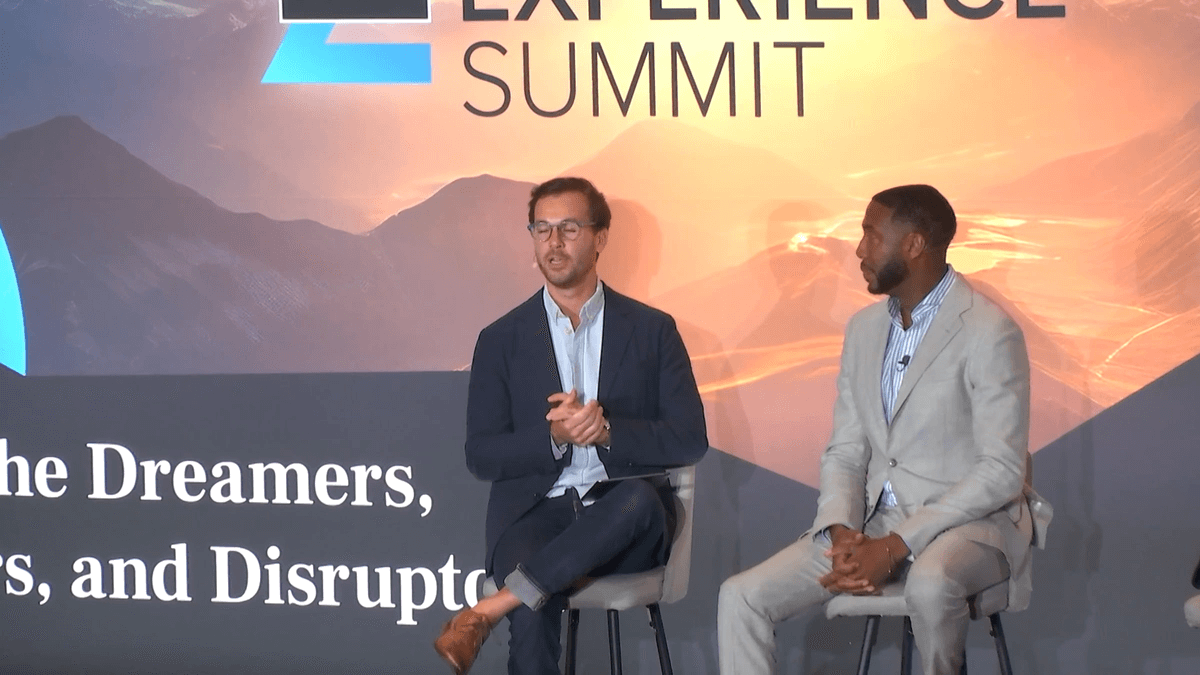
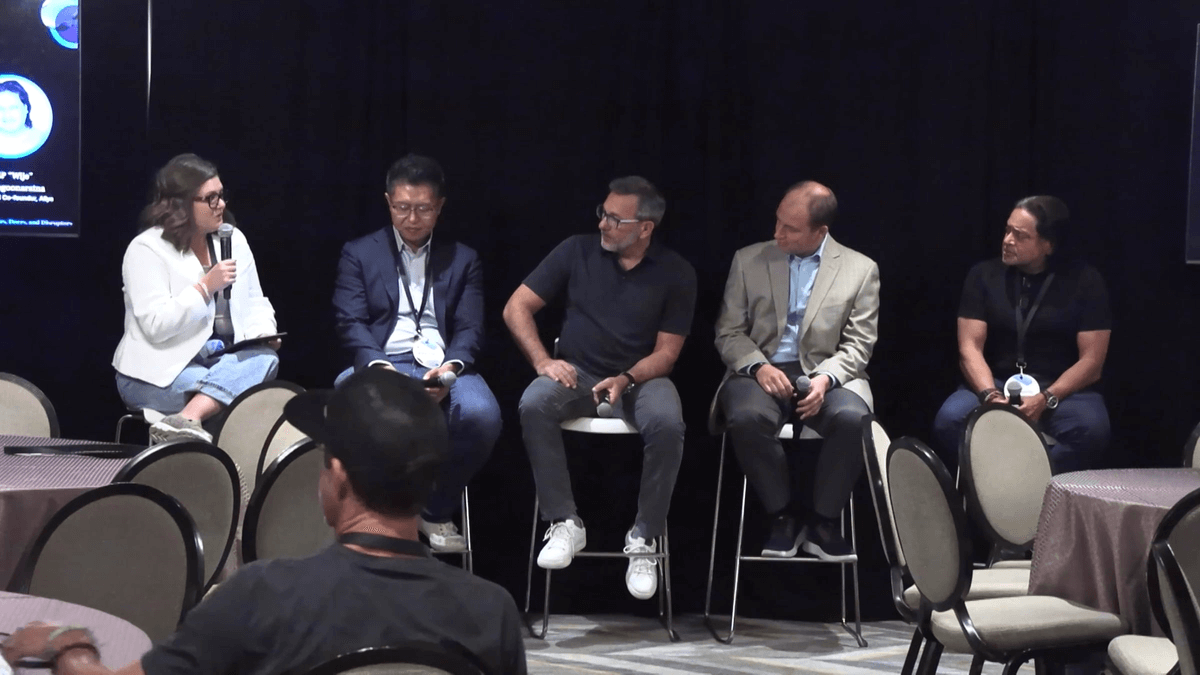
If we could wave a magic wand to design the perfect banking system — one that is diverse, dynamic, and balanced to deliver the ideal outcomes for consumers, SMBs, businesses, and financial providers, what does it look like? What should we keep? What should we change? Do new banks and services emerge? Do old ones die? This session will dive into these questions and more.
Transcript
All right.
Are we ready to go? Yes. Okay.
That's the afternoon energy that I'm looking for.
I appreciate that. My name is Alex Johnson.
I write a newsletter called FinTech Takes.
I am delighted to be moderating this session.
What should the U.S. banking system look like?
You might have noticed on the agenda that
this is the session that doesn't look like all the others.
All the others are very practical, focused on tactics.
What can we do? What's actually happening in the market?
We're gonna get deeply theoretical
and have a discussion about
what should the US banking system look like?
I have the exact right mix of folks
to have this conversation with.
So before we go any further, I would love it if each
of you could introduce yourselves.
Why don't we just go down the
line. So, Lizzie, start with you.
Hi, everyone. I'm Lizzie Hartley.
I'm a partner at TTV Capital.
We are early stage FinTech investors.
We're proud investors of MX.
We invest in seed
and series A stage companies,
so relatively early in their journey
and stay with them all the way through the amazing growth
of companies like we see with MX.
I'm based in San Francisco.
Awesome. Jeff. Cool.
Yeah. I'm Jeff Otero.
I'm the VP of Experience Design at ENT Credit Union in
lovely Colorado Springs.
ENT is 67 years old, somewhere over half a million members.
Started off actually on an Air Force base there
that doesn't exist anymore, really.
And, yeah. I've been with ENT
for just coming up on four years, and unlike everybody else
here, I'm new to financial services.
My background, was software before that
and before that, 10
and a half years with the Walt Disney Company.
Jeff was an Imagineer. I was, yeah.
Did you see that murmur? Yeah, that
was pretty cool. And if you go far enough
back, I was an architect
and went to business school and all that fun stuff.
So it's an interesting mix.
Awesome. Ashwin.
Hey everyone. Ashwin Vasan.
I'm a partner with FS Vector.
FS Vector is an advisory firm
and a lobbying firm based in Washington DC.
We help fintechs — I like to say —
with everything from licensing to lobbying
and all innovative financial services.
I would say more broadly, I spent a bunch
of my career at the CFPB, most recently left the agency,
with my second stint in 2023, where I oversaw, the team
that wrote, many of the rules
and policies, including the open banking roles.
And I'm excited
to not speak in an official capacity on this topic.
Sorry. You are gonna have
to officially comment on behalf of this.
I've got some questions later. All right.
So, as again, you can tell exact right mix
of folks to have this conversation.
I think the thing that strikes me about a lot
of the things that are being talked about at this
conference, whether it's competition in financial services
or innovation in financial services,
we're essentially dancing around a core question, which is,
what should the U.S. banking system look like?
And again, it's highly theoretical.
Most people tend to
answer this question in a very narrow sense.
so they'll focus on a question like, well,
how many banks should there be in the U.S.?
By the way, does anyone know off the top of their head
how many banks there are in the U.S. right now?
Just shout it out if you know.
42. Yeah, it's,
it's a little over 4,500.
Last I looked.
And of course it depends a little bit on how you count.
What's interesting though, is that
that is down from, I have the number right here.
Uh, 15,000 banks in 1985, right?
So we know that the banking system is consolidating.
But the question is, what does that mean?
15,000 is definitely more than
4,500. Is 15,000
the right number? Is 4,500 the right number? In Canada —
and I'm just gonna pick on our neighbors
to the north probably a couple times in this session, just
'cause there's such an interesting contrast.
There are 32 banks
and three credit unions for the whole country.
The top five banks in Canada control roughly
90% of the market.
Is that good? Is that bad? It's really hard to say. Right?
And the inspiration I had for this session
and for putting this together, really came from
a speech that acting comptroller Mike Sue gave,
where he talked about what the composition of
a banking system should look like
and tried to tackle it from a first principles perspective.
And his contention, which I think I largely agree with, is
that the composition should match the economy
and the market that it's serving.
And so maybe Canada's banking market should look different
than the U.S. banking market, which should look different than
Australia, which should look different than the U.K. which
should look different from India.
And specifically, his contention in the speech was that
the banking market should reflect the fact
that the U.S. economy is large, dynamic,
meaning that it constantly changes and reinvents itself,
and diverse — meaning that there's lots
of different communities, there's lots of different
segments of customers in the market.
There's a wide range of different small businesses,
large enterprises, so large, diverse and dynamic.
And I think that's a useful place
to start when thinking about this.
So I think Lizzie, I'd like to go
to you with the first question.
When you think about competition, obviously
you invest in FinTech companies, as I understand it,
some of them, like MX as an example, are working
to help banks and credit unions
modernize, become more competitive.
Some are trying to compete directly
with banks and credit unions.
What's the right mix?
How do you think about the role of competition in creating
a better financial system?
It's a great question.
And our firm has been around
for 25 years investing in early stage FinTech companies.
And so you're right, we've invested in both
software serving financial institutions
and enabling them to be more digital
and serve their customers.
And also trying to invest in companies that are disruptive
to traditional financial services.
incumbents and I,
there's not necessarily a winner in either business model.
It's very different. I think we have examples in both
categories that are important to highlight.
But more than anything, we look to invest in companies
that are solving problems that exist today.
And we sometimes look for sexy problems
and things that get a lot of hype like crypto
and AI and all these things.
But some of our best companies have been building
software to solve a problem that is an observable event.
Something that is very, very straightforward.
You can take Greenlight, for example, one
of our portfolio companies in Atlanta,
and it started with the founder having to dole out cash
to his kids all the time.
And he was like, what the heck? This is so annoying.
Why am I pulling out cash and giving this to my kid?
Why can't they just have their own credit
card or debit card?
And that was really the inspiration behind Greenlight.
And we've seen that company grow significantly.
And it started really as a direct to consumer product
and had a ton of success in the direct to consumer side.
And then banks sort of woke up
and were like, oh, interesting.
Maybe we should white label that
and offer that to our customers as well.
And so there's a way to both be disruptive
and also enable banks
and work with them to offer more products
that they may not be able
to innovate within their own organization,
but that they can offer to their customers.
And so we work with several bank partners.
We've strategic LPs in our fund that invest in us,
and we look to them really,
and we try to hear what problems they face,
what problems their customers face.
And then we go searching in the market
to find a company trying to solve one of those problems.
And, you know, we meet 10
to 15 companies a week at a minimum.
And so there's probably some founder out there trying
to solve one of those problems.
And those are the companies that we try to invest in.
Got it. Jeff, you said this
as if it's an embarrassing fact
that you haven't worked mostly in financial services.
That's a point of pride. You should be proud about that.
So as our resident person
who hasn't spent all their time in financial services,
how do you think about the role of
competition in sort of shaping the market?
I love competition. That also keeps me up at night.
So I guess you could say it's a love, fear relationship,
But it's great
because as Lizzie talked about, I mean,
and having come from a software company,
our focus is on understanding our users
and understanding the problems they're trying to solve.
The jobs to be done would be the language
that we'd use.
Mm-hmm. And to bring that same mentality
to a financial services organization, especially one
that's been around for, you know, over 60 years, you can see
how, you know, things kind of, it's not calcified,
but you can get to the point where things like, we do it
because this is the way you do it.
Sure. And to be able to bring in that different sort
of mentality and really understand,
bring design thinking into
what the organization is doing, not just in digital.
'cause my team is also responsible for
all the member touchpoints with the credit union.
And so really trying to think about what is the job
to be done at each of these things and how can we do that?
And that's all because competitors, both fintechs
and other financial institutions are all innovating,
doing things and doing a great job of solving some
of those problems because that's what they're focused on.
So I think it's good for us.
Yeah. Ashwin, here's your first opportunity
to speak officially for the CFPB.
I'm just trying to get you in trouble.
The, uh,
I think the CFPB is a relatively pro competition agency in a
lot of ways, especially relative to other regulators.
But there's also a consumer harm aspect
that can come out of innovation.
I think we've seen certainly recently a lot of challenges
with startups
or with disruptors breaking things, things that,
you know, consumers rely on.
So when you think about kind of the role of competition in,
I guess ultimately delivering better outcomes
for consumers, where's that kind of balance?
I mean, I think it's a — one
of the nice things about working in, first of all,
I'll start, I'll have a lot of respect
for the acting comptroller, the OCC.
Right? But yes. You know, I think the framing
of the question, the framing of it is
how many banks should we have?
Feels kind of narrow. Yeah. Yeah.
Like, you know, if you look at the major,
at least consumer facing markets, you know, the largest one
multiple trillions in assets is mortgages was essentially a
federally run program with a non-bank distribution channel.
Student loans are federally run, auto has a
substantial footprint in non-banks.
You know, you've got credit cards,
but it's basically like eight players.
Yeah. And Kelvin's here, you may take offense.
So you know, it,
it really depends on the product, right?
And so just counting banks
and pretending that banks are sort of like
all the same.
And very uniform is a little misleading.
And I think yeah, like when the CFPB looks at it,
we looked at it in a very functional way.
Yeah. Right? Is competition
working in the mortgage market?
And if it's working in a way
that gets better products at cheaper prices to consumers,
essentially it's a pretty clear north star.
And if you go market by market, there are a lot
of dysfunctions in different ways in all of those.
And I think, again, how many banks is less important
to it than how like the market is actually
performing for consumers.
And even if, you know, if,
and I can, we can go product by product,
but I think there are different pinch points in
each as well that like create those challenges.
Yeah. No, I think that's very well said.
I mean, the first principles way of thinking about this is
that competition needs to be a function of
what makes this market work well, what leads
to better outcomes for consumers?
What allows for enough choice, right.
That you do have the ability to move around
and find the best option for you.
Lizzie, I wanna come back to you
because the flip side to innovation
and competition is stability.
Right? And speaking of acting comptroller, Sue,
that's kind of their principle job is
to make sure we have a nice stable banking system.
I promised we'd pick a little bit on our neighbors
to the north and Canada, but Canada's really interesting
to me because obviously the big five banks
are very dominant from a market share perspective.
I would say it's probably not a stretch to say
that they have a relatively close working relationship
with regulators in Canada.
That relationship is probably beneficial from the
perspective of being able to slow down,
or perhaps stop innovation
or disruption, which is a natural sort
of instinct for incumbents.
But the flip side is
Canada has a very stable banking market, right.
Apart from when us in the U.S.
or other parts of the world sort
of disrupt the global economy, Canada just sort
of chugs along and doesn't really
have a lot of financial crises.
So I know you guys have invested in Canada specifically.
So I'm curious, what is the sort of trade off
that you think about when it comes to sort
of introducing competition into markets
that really don't have a lot
and kinda that role of stability
So different from Greenlight.
We invested in a company called Koho, which is trying
to disrupt completely the banks in Canada.
So they are building a no fee challenger bank in Canada.
And it's another fun founder story where the founder grew up
with a single mom and she was always working several jobs,
and it was a tough financial life for him growing up.
And when he sort of reached an age of maturity
and had money of his own, he went back
and did sort of a deep dive of his mom's financial profile
and realized that she had paid so many fees over the course
of her lifetime because
of the banking system in Canada that allowed that.
And so what really sticks out to me in Koho,
the difference between good financial products
and great financial products over a
lifetime can be enormous.
And so Daniel Eberhard went out to start Koho,
which is a bank that offers products with no fees,
and he has over, I think, a million customers to date.
And so you can see that there's clear product market fit,
and there is a need and a demand in
that market for something different.
And there's no doubt, we see this in the U.S.
and Canada all the time.
Fintechs move really, really fast,
and they often times break things.
And so not every fintech is stable.
And that's why we've seen
so many fintech companies I think shut down over the past
five, 10 years, etc.
But when you do have a fintech that is built with dignity
and strength to be stable
and build true financial products
to serve a market in a compliant way that is, you know, safe
for everyone involved, it can have a really big
outcome for consumers.
All right. So you teed me up perfectly
for my next question, which I'm also gonna direct back
to Ashwin because I told him I'd
give him all the hard questions.
There are, again, 4,500+ banks in the U.S.
One of the benefits of that is that there are a lot
of small banks that are willing
to let new market disruptors build on top
of their infrastructure.
And on top of their charter. This is a loaded question,
given everything that's happened over the last 18 months,
but has banking as a service been a net plus
or a net negative for
the market as a whole?
I think about it a little differently.
I mean it feels like a natural consequence
of not having a regulatory framework that is like more
functionally driven and very bank centric.
So when banks are the only players that can get access
to the payment system, get access to deposit insurance,
get access to national preemption
then everyone wants to work with banks.
And yeah, I'm sure there have been great partnerships.
Some have benefited small banks,
some have benefited fintechs, some haven't.
That's natural in the market.
But the deeper dysfunction is
that there's only one gateway.
And not every country does it that way.
I think, so I don't, it's sort of more neutral on it.
It feels like an inevitable consequence
of our regulatory architecture
and one that is probably here to stay
and one will have to figure out how to make.
Right? Yep. So I, you know, being a pragmatist,
I think you sort of, we take this wave of
enforcement actions and consent orders
and say, well, how do we build on this to make it
more constructive?
Yeah. I would say that there's, one
of the things in banking though,
and you'll see with,
I think maybe you've written about this, Alex, is
with these partner banks as they're going
through these consent orders and the compliance
expectations are growing.
You sort of further that kind
of — banking is a scale job, right?
It's essentially bits and bytes and it's technology.
So you've got a lot of natural economies of scale,
many parts of the banking ecosystem.
And so, you know, 4,500 banks,
if you're gonna have 4,500 banks, you are going
to have technology service providers
that are much more concentrated.
And the core service providers are a perfect example.
Because the fundamental job of it's, you know, it's not,
you know, a bar
it's not getting a haircut, right?
Yeah. It's not like a people intensive, it is something
that naturally scales.
And in a modern economy, if you're gonna choose like 400,
4,000, 500 distribution points,
there's gonna be something under
that has competitive concerns.
And so that's gonna drive the
customer experience one way or another.
So again, back to my initial point,
broadening it away from just banks
and how many banks you need is kind
of misses the point. 'cause, you know,
I think that's fair. I mean
one of the things I'm working on right now is a
piece talking about banking as a service,
and it kind of looks at the difference between
software businesses, which, Lizzie, to your point,
are great at solving problems
and focusing on, like delivering great end user experiences
or products to consumers,
but they're very deterministic by their nature, right?
Like, you have inputs, you have outputs,
it's very predictable, it scales very well.
That's why investors love
and give great multiples to SaaS businesses.
I think what we've learned through all the things
with banking as a service is
that banking is a probabilistic business.
Right? It's not a deterministic business.
And what that means is there's always a probability
of bad things happening.
You're managing risk. And so it doesn't scale the same way.
And, you know, I think Ashwin to your point,
it'll be interesting to see how this wave
of consent orders plays out,
because a lot of the response I'm seeing from regulators
so far is, well,
if you're having a compliance problem, throw more bodies at it.
Right? And there's a limit to how many banks can do that,
especially at a smaller scale.
Jeff, coming back to you, the other thing that I wanted
to ask about based on the fact that you work
for a credit union that's based in
Colorado is rural banking.
Right. And this comes up a lot in the discussion about
what should the U.S. banking market look like?
Because there are consumers
that live in banking deserts.
Right. And I have the stat right here.
According to the Fed,
12 million Americans live in a banking desert.
A banking desert is defined
as a geographic area without a physical bank branch within a
specified distance.
Two miles for urban communities, five miles
for suburban communities,
and 10 miles for rural communities.
Looking at the map, Colorado doesn't have
as many banking deserts as other states,
but it does have some. How do you think about the role of
A credit union sort of being in market
and being able to address the
local concerns of your members?
Yeah, we're actually working on
a new branch in Alamosa right now,
which isn't exactly rural,
but I mean, it's starting to get out there.
Sure. Because we're pretty much up
and down the I 25 corridor from Pueblo up to, you know,
Fort Collins and Loveland.
So Alamosa, I think from my house,
it's like over a three hour drive to get there.
It's a long way to deposit a check.
It is, isn't it? Yeah.
But, and then we're looking at mountain towns
and things beyond that
which are smaller and smaller markets.
But I think having the rootedness in
that area, having been there for over six decades
is one thing that, you know, gives us some solidity that,
that people find valuable.
But the other thing is, I know at the Alamosa branch
and then other ones we do, they're really trying to recruit
and build up a different kind of branch manager,
someone who really is gonna go,
become part of that community,
obviously will live there,
but at the same time really be part of what they're doing.
Understand in that case, like Ag loans and things,
which is a whole new realm for us.
And so really becoming an expert
and a key part of the community wherever we are.
And I think that's something else that'll help.
And that's what I think is really cool about our
opportunity wherever we are, is having boots on the ground.
Yeah. And not just boots on the ground,
but actually we live there,
we work there, all those different things. Relationships
on the ground. Exactly.
History too.
But at the same time, marrying
that with the best in technology, the best in convenience,
and so trying to bring people those options.
But we've gotta figure out the economics of what
that looks like as we go further and further out to the west
and maybe out to the east, into the plains.
I mean, the reach
of physical distribution is really interesting to me.
And Nick, in the previous session referenced
that Chase is planning
to build a hundred branches in low income communities across
the country, and they see a pretty strong
economic case for doing that.
They have, I think, a similar idea, which is
to have folks working in the branch
who are really like rooted in those communities.
Lizzie, I think the thing I'm curious about from like a
fintech investment technology perspective is
when we're defining banking deserts,
we're defining them based on proximity to a physical branch.
It's 2024, we don't necessarily need to do everything,
in a physical branch.
In fact when Elon Musk worked at Scotiabank
as an intern a million years ago,
that was the first observation he had, right?
Is that money is all just ones and zeros.
There's no reason for any
of this cost or this infrastructure.
I don't know that I totally buy that,
but I do see the point, and I think there are a lot
of things that banks
and credit unions have done to sort of justify the existence
of branches rather than make branches a strength
or a point of differentiation from more of a fintech lens.
How do you think about the difference between reaching
underserved consumers
and small businesses digitally versus
doing it through a branch?
Well, a small funny anecdote is,
I just got married recently, and my husband
and I went to open our first joint checking account. Did
you go to a branch? And
I was online, we bank at Chase.
And I was like, weird.
I can't find where I can open a joint account online.
And I was like, this is so embarrassing.
I invest in fintech companies.
And he's looking to me like,
what do you mean we can't open this digitally? And so
Haven't you fixed this yet?
We went to a branch, turns out you can't open
a joint checking account
online. You have to do it in person.
And I was prepping for this panel
and I was like, wow, this is so important to talk about.
It's perfect because this bank, you know, you'd expect them
to have best-in-class digital services, and
they spend like half a billion dollars
on technology a year.
And they,
you still can't open
a joint checking account digitally.
And so it just sort of reemphasized that.
I do believe that we are still in a hybrid world
where you'll need physical branches,
but you also need digital solutions.
And consumers are getting more used
to digital solutions.
And so they're looking for that online first
before going into branches, really for convenience.
This came up last night also, if Barb is in the crowd,
we were talking Wintrust Bank,
they really only invest in branches.
And that's because their customers love coming in.
They have served cookies and coffee for a long time,
and that's what their customers want.
And they don't want a digital solution.
And so it's sort of interesting to really be thinking about
what the consumer wants
and who your customer,
what your customer wants, and who your customer is.
And so I think you touched on something really interesting.
Personalization is a huge theme in the
investment world right now.
Like all of these companies are looking to verticalize
and get super personalized in their product offerings
to address underserved markets.
And that can be farmers, that can be the aging population.
We're invested in a company called Charlie
that serves the aging population,
and they give early access to social security deposits.
And they are a digital first company.
And we invest in a company called Curb Waste.
It's building software for waste haulers,
and they have payments with that.
And so it just sort of makes you realize that there are
so many different demographics
and types of consumers out there,
and they all need different things,
and they all want different things,
and they're coming to expect those in their banking.
And so I think you do need branches,
but you also will need the digital solutions
and how you marry the two together
and make the economics work is sort of the key.
That's where it starts to get really cool.
I mean, that's what attracted me to go to work
for it four years ago, is that that promise of being able
to bring the digital
and the physical together, if you will, and,
and have the whole be greater
than the sum of those parts.
And I think what it, you know, the nature of
what you do in a branch
or what you can do with a branch starts to change.
Like we're experimenting with designs for some
of our future branches where it's not full
of offices and everything like that.
It's full of meeting rooms in the emphasis is on one-on-one
meetings, on group meetings,
creating flexibility in the space.
So maybe after you're done with the kind of banking day,
you could pull a bunch of chairs out there
and you could have classes on, you know,
financial wellness on that kind of stuff.
And so again, when you start to move out into some
of those mountain towns, maybe we, it's not economical
for us to build all that square footage ourselves,
but if we've got a small footprint, then can we work
with other facilities there to do those kinds of things?
But I think gathering together, like fewer
and fewer people are willing to put up with having to go
to a place to do a transaction, I should be able
to open my joint account online.
That's ridiculous. I think we can do that.
You can come to, you know,
Wrong state, but solve
that problem. Yeah.
But, but all that said,
I think bringing those relationships in,
and then for us as a credit union, having the opportunity
to bring people together, I think there's power there
and helping people improve their financial wellness that,
is just, it's really attractive
and it's kind of fun to be reaching towards that.
Absolutely. I mean, the other thing
that you touched on there,
and I think actually, both end
and, some of the companies
that you mentioned are a good example of this is
in the credit union space forever, we've had this concept
of field of membership, right?
And one of my, I think, critiques
of both community banks
and credit unions over the last, say 30 years is
that they become a little flabby about field of membership
and about just defining
who your customer segment is really concisely.
And I think that's where fintech is sort of demonstrating
how much we've sort of drifted away from that.
I was doing a strategy consulting session with a,
credit union a while ago that works with
airline employees.
That's kind of their specialty
and their field of membership.
And they're like, well, what kind
of product could we build that would be unique?
And I'm like, well, what's a thing that you guys know
that no one else knows and no one else understands?
And they thought about it for a second
and they're like, well, there's this special type of housing
that exists on airports inside the security perimeter
that's only available for pilots to buy.
And they buy them because,
if you're constantly going through different hubs,
you need a place to stay, but you have
to meet very specific requirements.
There's a lot of paperwork, they're difficult to underwrite,
and they're like, we do a lot of those mortgages.
Do you think that's specialized?
I'm like, yeah, that is like perfect.
Like go build a better digital version of that.
That sounds amazing. Like, that's something that, you know,
and no one else knows.
So I guess maybe Jeff, to go back to you real quick,
when you think about defining a field of membership,
not in terms of geography necessarily,
but in terms of like what you know about your members
that other people don't know, what are some things
that stand out as opportunities that you guys can do?
And you mentioned like Ag loans
and things that are specific to Colorado,
but like, where do you think those opportunities are?
And this is just me talking now,
so just thinking about where I'd love to see us go,
but, I'm really fascinated by the idea of, so we are,
even though we don't talk about this a lot,
we are a not-for-profit financial co-op,
and really starting to lean into the co-op piece
of it a lot more.
So for instance, we do a lot
of charitable work throughout the communities
that we serve, but it's really the employees
that are doing it and how can
we invite the members into that?
How can we actually all start working together
to improve and transform our own personal financial lives,
but then also the lives of those around us.
And so I think that's actually something that,
again, is unique to being in a spot.
I realize maybe it doesn't quite go where
you're thinking, but no.
How can we actually come together
to help improve everything?
We recently became the official banking partner
of the Broncos and the Broncos,
and part of the affinity there between the,
I was gonna say, talk about Affinity.
That's a good one. Yeah.
Well, and but also too, it's,
there's a charitable organization
Affinity too, because
both organizations are involved in some
of the same things, and how can we even do that to kind
of enlarge what we're all doing together,
I think is really, really, really exciting.
Yeah, I don't know. No,
That's a good one. One thought,
I'm just gonna chime in from the
fintech investment perspective.
You talk a lot about these very niche products,
and that's something that we do see all the time,
especially in these verticalized
markets that I talked about.
And our first question always as investors is
how big is this opportunity?
And how big can this be?
And sometimes we see things that are super cool
and super innovative and definitely address a problem
and a need, but it's not big enough
to see a billion dollar outcome.
And so that's where I think it's on the banks
to innovate on those specific things
and not rely on fintechs to have that innovation.
And again, you know,
your customers more than investors do.
Yeah. So just something to keep in mind. I
Love that we don't have to try to win the entire country.
It's huge, right? Yeah. It's absolutely huge.
Well, and I think Lizzie, to your point,
the other thing that reminds me of
that I think is really interesting is there is this,
I think, kind of gap in the middle of the market, which is,
hey, that's a great idea.
Banks and credit unions,
because of the nature of how they build products
and their technology capabilities
and just the way they think about product
development, probably aren't gonna build that.
It's not a billion dollar outcome,
so we can't really invest in it, but it's a good idea
and it should exist in some capacity in the market.
And I do think, when I think about this large question of
what should the U.S. banking system look like, one
of the things I would like to see is a mechanism
for allowing those kinds of things to exist, right?
And even if it doesn't turn into a billion dollar exit,
that's a return the fund winner for a vc.
How can we do that? Right.
And there are examples I think,
that are starting to proliferate.
Like there's a digital bank
that was started called Roger, that's for
new military service members, right?
And it's specifically geared towards new service members
that are just sort of reconciling the financial challenges
of being on active duty and sort of figuring that out.
And obviously there's a lot of
predatory financial services that target service members.
And so they're trying to sort of cut
that out and be a better answer.
It was created by Citizens Bank of Edmond in Oklahoma.
But what's most interesting
to me is they are not talking about essentially franchising
that model and making it available
to other community banks and credit unions.
And that's a very cool model to me,
because to your point, Jeff,
they don't really care about customers outside of Oklahoma.
Like that's outside their market.
So if you want to use our technology
to go serve service managers, go do that.
Yeah. Right. And so I think getting back
to our core question, what should the U.S.
banking system look like?
There is a benefit to that almost co-opetition model.
And if you only have five banks,
I don't think you necessarily have that.
So I wanna wrap up by actually asking each of you
to wave a magic wand
and pretend for a second
that you could reshape the U.S. banking
market however you want it.
Real quickly,
you can pick on any particular part that you would like.
What is a thing that you would change and why?
And Lizzie, maybe we'll start
with you and we'll go all the way down.
Sure. I can go first. Sure. You have a great answer.
I, it's a hard question.
It is, and it's hard to envision it changing
dramatically in a short period of time.
And I think that's because of all the regulation
in the industry, but I do hope for more.
The ability to commercialize
with banks right now is very challenging.
And fintechs that do have billion dollar opportunities
Often times can't commercialize with banks
because they don't move fast enough.
And realistically, fintechs are on time clock of time
and capital, and they only have so much time
and so much capital to prove to their investors
that customers wanna buy their product.
And even if banks love the product
and wanna use it, their bureaucracy moves
so much slower
that they can't often times partner with fintechs.
And so we see so many fintechs die before they really should
because they've, because the sales cycle with banks is
so long, and for a long time, fintechs filled that void.
Fintechs hold to fintechs, and that was a great solution.
It was a faster way to get revenue, sort
of showing product market fit,
but not landing those big whale deals.
Those sort of came later and there was
after some more validation in the market
where banks got more comfortable working
with those fintechs.
But that's not happening as much right now.
Partially 'cause of the bass meltdown.
There's a lot more fragility in the fintech market.
And so we're just seeing buying
of software go down in the space.
And so my hope is that fintechs are able
to sell into banks more easily,
and banks are more receptive to taking a risk on early stage
companies to really move, move the ball forward.
Yeah, I think that's a great call.
The distinction between the amount of time
that fintech companies have
and the piece at which banks move
is a really great observation. Jeff, how about you?
I'm really fascinated by the potential of
what AI could bring to the banking experience in kind
of two different realms.
One is certainly bringing capabilities to consumers
that they, a lot of people just can't afford
or have access to today.
Bringing intelligence,
bringing advice, bringing all kinds of things.
I think a lot of people
and myself included, actually pretty lazy when it comes
To their money.
And, but if you could imagine now AI giving me,
I can actually have a tax accountant with me all the time.
I can have a bookkeeper, I can have a financial advisor,
and they're all in my phone or whatever.
I think it's pretty amazing. We've
got a long way to go to get there.
I mean, we gotta get past hallucinations and
all the, the craziness we have today,
but still, there's great potential.
And then for the institutions to be able to use it
to make ourselves more efficient.
And to be able to focus our resources more on
the customer facing, member facing services.
So we always maintain our human face
and you're always talking to a person,
but there's just incredible technology behind it
that can help us get things done faster, more efficiently.
I think there's great potential in both
realms. So I'm excited about that.
It's a good one. You get the bonus point
for mentioning AI, so well done there.
And I will say that
to your point on the consumer side, the idea
of AI being able to empower like perfect discovery
for consumers where it's like you're always getting the best
answer, you're always finding the best product
that has some really big implications for the structure
of the U.S. banking market, right?
Yeah. Like that notion,
I think should really scare Prudential bank regulators
because suddenly, like deposits
are flying all over the place.
Yeah. You're constantly refinancing loans,
like it's a much more portable market.
The CFPB would be happy,
but maybe some others might be a little challenged.
And then on the institution side
I mean you hear Sam Altman from OpenAI talk about this,
like, there's gonna be a billion dollar company
that has one employee, right?
And it's like, how far can we push operational efficiency
and what does that allow us to do in terms of number
of companies versus number of employees?
So I think that's a really great answer.
Ashwin we’ll end with you.
I mean, since I think my perspective is,
is primarily as an ex-regulator, I would probably go back
to something I said earlier, which is
I think the regulatory framework between the federal
and state level and then also between banks
and non-banks is pretty patchworky.
Yeah. Yeah. And I think it creates a
lot of weird incentives.
And since we're waiving wands,
because in no way do I imagine this to be a reality,
but I, you know, a universe where,
or a world where, you know, like if you're lending,
you have certain clear requirements at the federal level,
and it's whether you're a bank or non-bank, and you,
and then you're overseen for
that if you're taking people's money bank
or non-bank, same requirements and overseen in the same way.
Yeah. Right. If you're moving money, same thing.
And I think the absence of that creates a lot of,
of friction and complexity.
Yeah. I work for a firm that
we do 50 state licensing strategies all the time.
Right. So it's against my economic interest.
Yeah, yeah. But
Some not sponsored by FSV,
But some simplicity on
that front I think would be welcome.
But it's a long way from where we've evolved
for various historical and institutional reasons.
Ashwin hates the dual banking system. That's the takeaway.
That's not
No, No. I mean, it, it's
a really good point, right?
'cause I do think the other thing that
you touch on there that's really important is
it's very, very difficult to navigate these things.
And like one thing that I was very surprised
to learn recently is that the number
of de novo banks in the U.S. has just plummeted since the,
the Great Recession.
Right? And a lot of times the regulatory response
to a crisis will be well-meaning,
but the consequence of it is
that it's suddenly a lot less attractive to start a bank.
And maybe it's more attractive to start a fintech company
that can build on top of a bank.
And so you get these very strange incentives.
But one of the things I'm very cognizant of from a banking
as a service perspective is the more we sort
of crack down on the space, again for very good reasons,
the more we're sort of raising the floor of
what you need in order to participate in this system.
Right. And one of the things that I constantly hear right in
the newsletter is I'll get someone who reaches out
and it's a person who's never worked in financial services
before, but they have a vision for a thing
that should exist that they want to build.
And it's brilliant, right? And they give me the pitch.
And they're probably not the smoothest
entrepreneur 'cause they've never done it before.
The pitch is a little rough around the edges.
Often times they're coming from a diverse
or minority background,
and I love everything they're pitching.
And at the same time, I know their odds
of getting VC funding are very low
and their odds of being able
to get a bank partner are increasingly low
because there's just not enough capital.
There's not enough bank partners to go
around for all of those things.
So when we cut off the bottom of the market
and make it hard for new entrepreneurs to come in
and try things, I worry about that a lot.
So with the remaining four minutes that we have,
if anyone has any questions about how we would restructure
the U.S. banking market with the unlimited power
that we have up here we'd be happy to entertain those.
I also can just wait you out in complete silence.
'cause I was a public school teacher. So
What would you do about data ownership?
About what? Data Ownership?
Data ownership. It's a good question.
Maybe Ashwin, we’ll start with you
and we can work our way down.
Can you say more about the question? Sorry. I feel like
today we don't own our data.
Access to the data,
but yeah. We do anything different.
Oh, you can wave a magic wand.
You have unlimited power. Yeah.
I mean, if I could, yeah. I mean
I don't think I can imagine the technological control world
of technologies that would sort
of put data ownership completely in the hands of consumers.
Yeah. Maybe we'll get there in 10 years.
I just, I don't have that technologist mindset,
but yet in theory it sounds for me. That's a good idea.
Yeah. I've had two magic wands.
One would be I can own it
and two would be I can monetize it. Yeah.
Jane Barratt is smiling somewhere.
You just said that. Go ahead, Lizzie.
I'm gonna take a slightly different approach
to the question that sort of inspired
by a conversation I had last night with
the Chief Data Scientist of MX
and the power of the insights of data.
And right now, consumers don't really benefit from a lot
of the signals that we give to the market on
how we're spending, where we're spending,
what we're spending on, etc.
And so companies like MX can add so many more layers
of personalization that can benefit the consumer
that then they're happy about.
And so if companies like MX can have ownership of the data
and then use that
to actually enhance the customer experience,
I think no one cares who owns their data if it's helping
them and providing them more opportunities, better
services and better products that they can buy.
Yeah. I mean, I think building on that,
just one quick thing I would add is that,
I think the vision for open banking in a broad sense in data
ownership is a lot more transparency for consumers, right?
Because I think one thing we don't have right now is a sense
of, am I getting screwed by my bank?
And the problem is, it's not in the interest of the bank
to broadcast the fact that, yeah,
you haven't checked your savings rate recently.
And so we didn't ask if you wanted a higher savings rate.
And it turns out I'm not getting a good deal.
And the thing I think is really cool about just the shift
towards data ownership is it makes it easier for consumers
to share access to the data, which then makes it easier
for competitors to my incumbent financial institution
to say, you know what,
you're not getting a great deal there.
And we're starting with basic transaction data.
We're starting with pricing, we're starting with a couple
of things, but I don't think there's any reason why in the
future, particularly with generative AI
and its ability to handle more unstructured data sets,
why can't I share a history of every single
customer service chat that I've had with my bank
and have someone else analyze that
and tell me things I might not know about
how I'm getting served by that bank
and how I could potentially do better.
And that's like a radical shift in transparency
that's enabled, I think, by this data ownership.
And Ashwin, to your point, it's gonna take us
a long time to get there.
This is very pie in the sky,
but these are the first kind of baby steps towards that.
And I think that could really
restructure the market in a fundamental way.
Mm-Hmm. Awesome. That is all the time we have.
Please join me in thanking everyone
for this wonderful session.
Lizzie is a Partner at TTV Capital focused on early stage investments.
Prior to joining TTV, Lizzie was a Senior Vice President at Citi Ventures, the corporate strategic investment arm of Citibank. At Citi Ventures, Lizzie helped launch and lead the development of the digital asset strategy resulting in a new investment category. In addition, Lizzie helped lead investments in fintech including and supporting portfolio companies through a strategic partnership with Citi. Her professional experience also includes time in financial services across the utilities and infrastructure sectors.
Lizzie is passionate about working with entrepreneurs who use new technology to transform fintech across categories. Lizzie is particularly interested in helping companies navigate the financial services landscape to identify and develop meaningful partnerships to expand their reach.
She earned her Bachelor of Arts in Environmental Studies and Economics from Dartmouth College.
Alex Johnson is the founder of Fintech Takes, a media brand that sits at the intersection of financial services, technology, and public policy. Alex has 20+ years of experience in banking and fintech, and his newsletter is read by 30,000+ founders, executives, regulators, and investors in the financial services industry. Alex is based out of Bozeman, Montana, and spends all of his non-work time chasing his three children around.
Jeff Otero
Vice President of Experience Design, Ent Credit Union
Jeff Otero, Vice President of Experience Design at Ent Credit Union, leverages his diverse expertise in architecture, business, software, and themed entertainment design to lead a dynamic team of designers. Under his guidance, the team focuses on elevating both digital and in-person experiences for credit union members, ensuring innovative and seamless interactions at every touchpoint.
Ashwin Vasan
Partner, FS Vector, and Former CFPB Associate Director
Ashwin was most recently Associate Director of Research, Monitoring and Regulations at the Consumer Financial Protection Bureau (CFPB). He oversaw a team that led the bulk of the CFPB’s policy development work (research, reports, and regulations) and served as an advisor to Director Rohit Chopra. In addition to his time at the CFPB, he was formerly at Capital One and McKinsey & Company.
In his role at FSV, he will advise FSV clients, which include fintechs, banks and other financial institutions, on a wide variety of business strategy and regulatory matters.