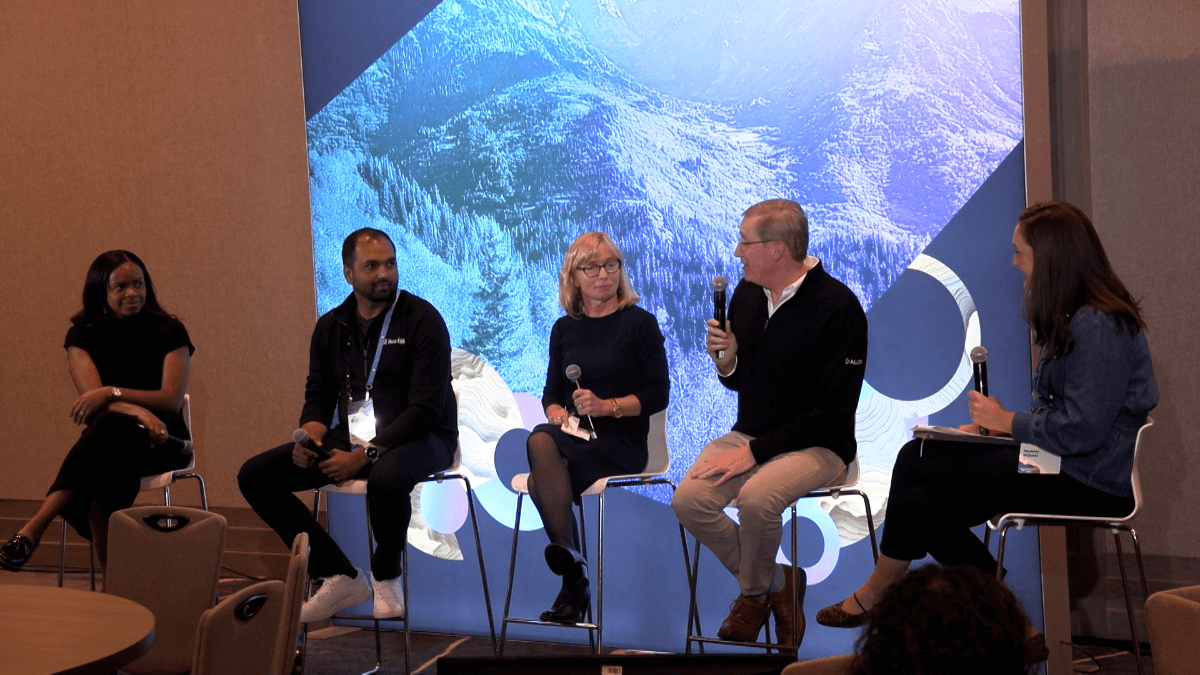
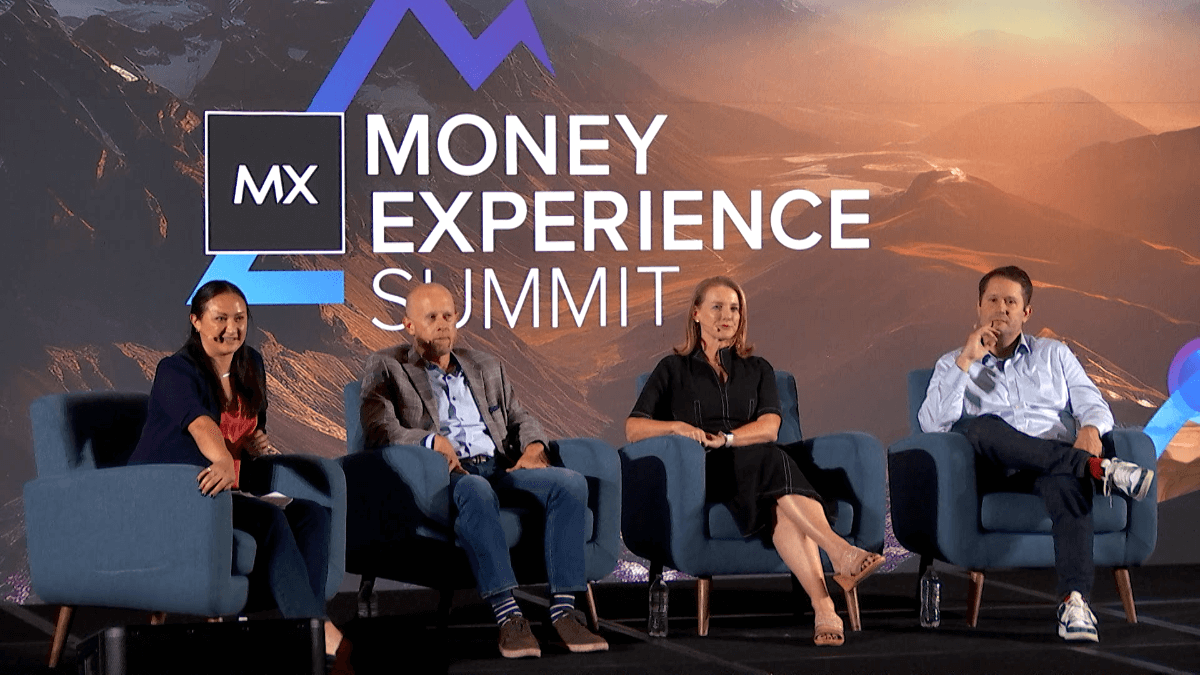
The State of Financial Services and Welcome to Money Experience Summit 2025
MXS 2025 kicks off with a fireside chat about the state of financial services from the Honorable Rodney E. Hood, former acting Comptroller of the Currency and Chairman of the National Credit Union Association.
Transcript
Well, thank you
and on behalf of the whole team at MX, welcome
to the beautiful Deer Valley in Utah
and we thank you so much for making this trip here.
So reflecting on this incredible group of people
that are here in the room today, I'm struck
by the commonalities between you, you
and the companies you represent are committed to action.
Turning data into action is the core of what we do at MX,
and that's why we bring you all together.
We've seen brilliant partnerships form friendships
when we assemble groups like this.
You connect, you share, and you have fun.
We're also proud to be hosting the Financial Data Exchange
board meeting today, so make sure you say hi.
over lunch, the board directors will be around.
And now please join me in welcoming our esteemed guest,
the Honorable Rodney Hood, who's a technology-forward
former banker, former federal regulator,
and a longtime advocate for financial inclusion.
Thank you Chairman Hood, for being here with us today.
Good Morning. Wow,
what a great looking crowd.
Especially after last evening's festivities.
You all rested quite well.
I can't begin enough to say, ladies
and gentlemen, that it is indeed an absolute honor
to open the Money Experience Summit here in Deer Valley,
Utah, hosted by our dear friends at MX, an institution
that has made its name
by transforming the financial experience as it looks
to empower the world to be financially strong.
Thank you for the kind invitation to join you today, Jane.
And I know Ryan Caldwell is here somewhere.
Thank you all at MX.
But most importantly y'all, please join me in applauding all
of the folks who planned this event.
They have done so seamlessly with great aplomb. Here, Here.
Let me begin you all with a quick quote
that captures the spirit of our gathering today.
And I quote, innovation is not about ideas,
it is about making ideas happen.
End quote, these words remind us that progress
and financial services comes when vision is translated into
execution, partnerships and tangible outcomes for consumers.
As Jane mentioned,
I am in fact the former Acting Comptroller of
the Currency, former NCUA Chairman.
And what makes me unique is that I've had the vantage point
of seeing both the regulatory system for banks
and credit unions and
that's given me a wonderful vantage point to see
how resilient and
how adaptable our U.S. financial institutions are today.
In fact, today our banking system
comprises over $30 trillion in assets.
The FDIC has reported along with the OCC, my old agency
and the NCUA, that all
of our regulated entities are well capitalized
and they have great liquidity.
Our institutions are profitable
and they are indeed positioned to withstand volatility.
I mentioned this to you all this morning
because this resilience is the very foundation
that makes partnerships for fintechs possible and necessary.
Technology has become the primary way
consumers experience money. It’s how they budget, borrow,
save, and invest.
And companies like MX are redefining that experience.
By turning raw data into clarity,
MX empowers consumers
to see their financial lives holistically
and in fact make very confident decisions.
This isn't convenience,
it's empowerment, it's inclusion.
MX proves that financial data when delivered transparently
and responsibly can close gaps in access
and in fact promote fairness.
Many of you who have heard me know this,
I know Jennifer Tescher knows this,
and I've often said that financial inclusion is indeed the
civil rights issue of our time.
I've said that not just when I was in government service,
but also in private service.
But at NCUA, I launched the Office of Innovation
and Access, which helped credit unions adapt to technologies
to reach underserved communities.
At the OCC I reestablished the Office
of Financial Technology, the first of its kind
among U.S. regulators.
These efforts signaled a very clear message.
Regulators understand
that innovation when managed responsibly can be a
powerful tool for inclusion.
And today, fintechs like MX Approving
that responsible data use
and fairness can be embedded into every digital experience.
As a former regulator
and a banker, I'm often asked, what do partnerships
that are successful look like?
I'm gonna briefly give you three.
First API data sharing. Banks partner
with MX allow customers to view all accounts: checking,
savings, loans, investments,
and one secure holistic dashboard.
That builds trust and confidence.
Second success model. Alternative credit modeling.
Credit unions, for instance, working with fintechs
to use rental and utility data have responsibly
extended credit to those who have been left vulnerable
to payday lenders and whatnot.
And it's been the credit invisible
of which there are about 70 million.
And then third example of a great success,
personalized financial guidance.
Institutions using fintech tools
to provide real time nudges, helping families save
for emergencies, avoid overdrafts and pay down debt.
These are all making a direct impact on financial health.
What's the common thread? The common thread is simple.
A strong, well capitalized institution,
a responsible innovation partner like MX,
and a shared focus on customer outcomes.
But as we look ahead, we can't ignore the growing role
of stable coins in digital assets.
Whether one views them with excitement
or caution, the reality, ladies
and gentlemen, is that millions
of Americans are already engaged
with these emerging technologies.
Roughly 50 million American households,
hold crypto assets according to the Federal Reserve surveys.
For banks, credit unions and fintechs alike,
the challenge you all is not whether to engage
but how to do so responsibly.
These technologies hold promises for faster payments,
expanded access, and new models for financial inclusion,
but they also pose risk if not integrated prudently
and pragmatically.
That is why it is so important for partnerships
between banks, credit unions
and fintechs to begin building awareness
and their models today.
Some may ask, but Rodney, you've worked
with all the regulators, at least in tandem
and you've been on various committees.
Are the regulators aligned?
And my answer to that is a resounding yes.
The OCC, the Federal Reserve,
and the FDIC are all deeply engaged on digital innovation.
From issuing and interpretive guidance on crypto custody
to exploring central bank digital currency,
to collaborating on supervisory frameworks.
In fact, I was one of the first regulators
to allow our national banks
to engage in crypto custody within
my second week on the job.
I also emphasized the principle of effective
but not excessive regulation
that remains the guiding philosophy.
Innovation and regulation are not enemies,
they are compliments.
So ladies and gentlemen,
before I sit down with Jane, I want you to know
that the future is indeed bright.
Our financial system is strong, our regulators are engaged,
and our innovators, companies like MX, are proving
that technology, data,
and partnerships can create a more inclusive
and resilient financial system.
Let us seize the moment to ensure innovation is not
just about efficiency, but about access.
Not just about speed, but about trust.
Not just about technology, but about people.
So as I close, I leave you
with the words from Winston Churchill
and I quote, “The empires
of the future are the empires of the mind.”
If we bring together strong institutions,
innovative partners,
and a shared vision for financial inclusion, the future
of finance would be nothing short of transformative.
So with that ladies and gentlemen, I will now sit down
with our dear friend Jane Barratt for a bit
of a fireside chat.
So I'll see you in just a bit. Over here.
Well, thank you so much for those wonderful comments.
As you said, you've had a very unique vantage point across
the spectrum of the industry.
How would you describe the current state
of financial services
and where does data sit in driving the next chapter of
as Winston Churchill, the empires
of the mind, how are we gonna move forward?
Exactly. Well first of all, you all, as someone
who has had the perch of looking at banks
and credit unions, the credit union
and banking system have never been stronger.
I mentioned earlier the capital levels are high,
the liquidity levels are high.
That means that the banks
and credit unions that are represented here today,
you all can take on these new challenges
because you don't have to worry about capital,
you don't have to worry about any of the other issues
related to safety and soundness
because the underpinnings are there.
But Jane, as it relates to data, I think that we need
to ensure that we're looking at data strategically.
I think we have mounds of data,
but how are we using that data
as the new competitive advantage?
Let's look at things such as predictive risk.
How can we look at data to prevent,
not only prevent, but identify fraud.
For instance, I got a call the other day from my banker,
telling me that someone was in a different part
of the country trying to buy blonde hair extensions
and they knew that that wasn't my typical buying pattern.
And it really isn't you all. I don't sit at home in DC
with blonde hair extensions.
So the point is how are we using data strategically,
competitively, and how do we use it as our advantage?
But I think that if you're gonna look at the data,
don't just examine it.
Really make sure that you're using it
to personalize the customer experience.
And I would also say, let's adhere to the responsibilities
of that data and what am I getting at there?
Making sure that you're being great stewards of the data,
looking at privacy, you looking at controls
and all those types of things.
But the main that I want to say is that it's data to be used
and, and I think you all at MX have fared it out
opportunities and great use cases.
So that's the one thing that I would say that I'm most proud
of, that the data that we have
to today when used strategically will really create some
win-win customer experiences.
Mm-hmm.
So there's many people in the room that really struggle
with legacy technology systems where you sort
of build on top of old cause
and middleware like it is deeply complex.
And at the same time, these financial providers have
enormous pressure to modernize.
So what role do you see technology partners playing in
modernization and creating
that resilient consumer-first ecosystem?
I think the role that technology providers can play is
first of all working
to understand the financial systems they're working with.
It's not a one-size-fits-all model,
and I know that MX understands that.
And for the banks and credit unions in the room, making sure
that you are one meeting with your examiners,
meeting with your regulators.
I know that may sound counterintuitive,
why would we want to do that?
And it's because they need to be a part of your journey
as you are making this this new bold step
because it keeps you from having surprises
during the examination process.
But the important thing though about the technology
partnerships is that the banks
and credit unions you have the customers,
the fintechs are the ability
to provide those agile technological solutions.
So when you bring the two of those together,
you're able to have a win-win.
But Jane, you mentioned the legacy systems.
So I've been meeting with FIS, Jack Henry and Pfizer
and talking about how do we remove those pain points.
I recognize that some of the larger G-SIB banks,
they really can buy the solution,
but some of the smaller institutions cannot.
And I think from what I'm hearing, you will see a lot
of the legacy providers looking to provide more solutions,
for the community banks and for the credit unions
and really being more of a partner,
not just selling a service
but selling a solution that can really be transformative.
But the main thing is about the dialogue involving your
regulators on that journey,
but also making sure that as you embrace the fintechs,
that they get to understand you and you understand them.
Because I often see some folks, they will choose a provider,
but they don't recognize all of its opportunities.
They're choosing it because the peer across the street did.
So I think again, let's just look at knowing the people
with whom you're doing business and we'll go from there.
That's great. Well, you've,
you've been consistently vocal
and passionate about financial
inclusion throughout your career.
So how do you see data paired with the right partnerships
as being a driver of serving underserved communities?
Oh, the data that we have access to today, I look at it
as a strategic imperative.
I love the fact that when I mentioned from the podium
that some of the things that you were seeing,
let me go a little deeper.
The data that you're seeing through the Office of Reach,
that was a group with that, the OCC, it's the Roundtable
for Economic Access and Change.
It was the group, you all, that really helped a lot
of the banks in this room
and beyond look at using cashflow lending.
They were the ones that helped us test and validate that.
Or during my time at the NCUA where we created the office
of not only financial technology
but access advancing communities through credit, education,
stability, and support. What we're finding is
that the data is being used now more creatively.
We're not just looking at traditional credit reporting
technology, but we're looking now at the holistic thing.
How have you paid your rent, your
utilities and things of that nature?
Those are some of the strategic use cases that we're seeing.
And if there's anything I want to take away with
that you all wanna take away to
that is the regulators are here to help you all.
I know that does sound bizarre,
but they really are, the regulators, all of the ones
with whom I've worked in the past
and even presently, they are looking
to advance community investment, economic development,
and not just through the Community Reinvestment Act, but
because they recognize if we're gonna have a strong
functioning economy, we need to have all
of those individuals in the mainstream economy.
And the reason I take financial inclusion so seriously is
because I knew what happens when you don't have access.
I know about the 40% of our American households
who don't have access to $400 in an emergency
or the 77 million households who are credit invisible.
You all these individuals are not just left vulnerable
to pernicious predatory payday lenders,
but if you don't have a credit score,
you can't get the car to go to and from work.
You can, in many instances, in many
of the companies here without a credit
score, good luck getting a job.
And also, what about the budding entrepreneurs
who need credit to advance their ideas
and bring those to fruition?
Those are all of the things
that if you don't provide financial inclusion, a lot
of hope it's diminished.
So big picture is let's use data plus partnerships
to have inclusion at scale.
I love that. Did you see in your time at the NCUA
or OCC particular institutions —
You don't have to name them by names, you can use anecdotal,
but ones that really expanded their member base
or customer base by deploying programs like this.
I did. We have seen a number of institutions, you all
that have been able to not only grow market share,
but to grow customer loyalty.
Imagine that 40% of households that I just mentioned that
who could not typically get a loan for $400.
Well, think about it. When that bank
or credit union for that matter, when they make
that investment in them that is building trust,
they are then able to recognize that this is an organization
that cares about them.
They can go from getting that loan to getting a credit card
to getting a mortgage and all that.
So what has happened is it's been great marketing
and then it's not though meant to be turned on
and off like a faucet.
Yes, it has to be an iterative, ongoing process.
And Jane and Jennifer,
and I know Jennifer talks a lot about financial inclusion,
you all, I have evolved in my whole premise
around financial inclusion.
I, in my early days as a young banker
and even as a regulator, I'm afraid to say
that I often left people with the notion
that if I got you into the door to get a checking account
Jane Barratt is the Chief Advocacy Officer and Head of Global Public Policy at MX. Jane is a long-time investor and champion of financial strength. In her role, Jane collaborates with financial institutions, regulatory bodies, and industry groups to ensure people have better financial outcomes via secure access to their data. She is a financial educator through LinkedIn Learning. Prior to MX, Jane was CEO of GoldBean, and spent two decades driving growth for Fortune 500 companies.
The Honorable Rodney E. Hood
Former Acting Comptroller of the Currency and Chairman of the National Credit Union Association
The Honorable Rodney E. Hood is a distinguished financial services executive and board director with nearly three decades of leadership in banking, regulation, risk management, and financial inclusion. He has held multiple presidential appointments — serving in the Administrations of President George W. Bush and President Donald J. Trump, including service as Acting Comptroller of the Currency and as Chairman of the National Credit Union Administration (NCUA). In doing so, he became the first individual in U.S. history to lead both federal regulatory agencies responsible for insured depository institutions. While Acting Comptroller, he also served on the Board of Directors of the Federal Deposit Insurance Corporation (FDIC), as a voting member of the Financial Stability Oversight Council (FSOC), and as Chairman of the Federal Financial Institutions Examination Council (FFIEC).
Mr. Hood currently serves as an independent director on the boards of the Federal Home Loan Bank of Atlanta and Zest AI. At FHLBank Atlanta, he is a member of the Audit Committee and the Compliance & Enterprise Risk Management Committee. He also serves on the International Advisory Board for Strategic Resource Management (SRM) and as a Board Observer for two financial technology firms, Vestwell and ModernFi. His prior career includes senior leadership positions with JPMorgan Chase, Wells Fargo, NationsBank (now Bank of America), GE Capital, and the U.S. Department of Agriculture. He also served on the University of North Carolina System Board of Governors and as Chairman of NeighborWorks America.
Internationally, Mr. Hood has been recognized as a World Economic Forum Young Global Leader, a Salzburg Global Fellow, and a Young Leader with the American Council on Germany. He frequently engages in global financial forums, advising and collaborating with central bankers and regulators across the UK, EU, Japan, Africa, and the Middle East.
A frequent author and speaker, Mr. Hood has been published in the Wall Street Journal, American Banker, and other leading outlets. He brings to board service a unique blend of regulatory insight, global perspective, and a career-long commitment to responsible growth and consumer access.