



See where your consumers go. Control how they get there.

Data Access is MX's Open Finance API. It replaces credential scraping with governed, consent-based OAuth connections, then turns every external connection into a signal you see and act on, before the relationship is gone.

Trusted by the world's best Financial Institutions and FinTechs

A blind spot and a cost center

Most institutions run a data-sharing practice they never designed. Consumers hand their bank password to third-party apps, and those apps scrape and store it. The institution never sees it.

Invisible

Every external connection made through credential scraping is invisible to the FI. Retention risk stays hidden until the consumer has already left.

12+ months

to build secure OAuth infrastructure with Financial Data Exchange (FDX) compliance in-house, with ongoing maintenance and still no intelligence layer.

30%+

of screen-scraping connections fail, and they break on every front-end update, landing on the FI as fraud, load spikes, and contact-center volume.

Secure the pipe. Then use what flows through it.

Securing the data leaving your walls is the foundation. Seeing what moves through it is the growth. Each capability, with the proof it has earned so far.

Your consumers' external financial lives, finally visible

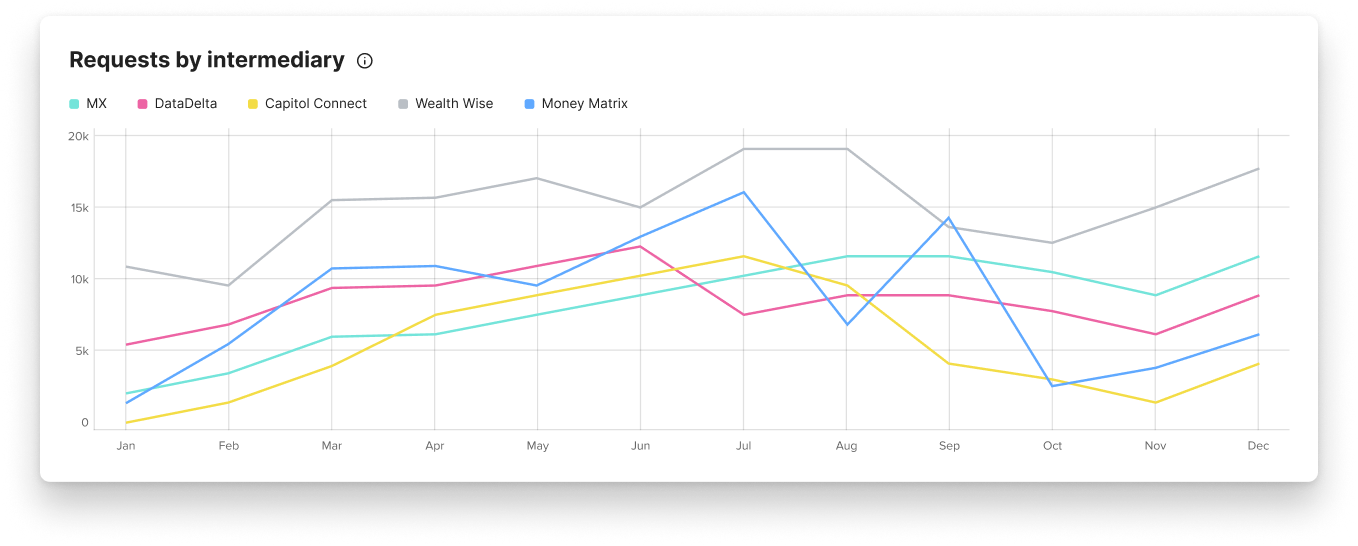
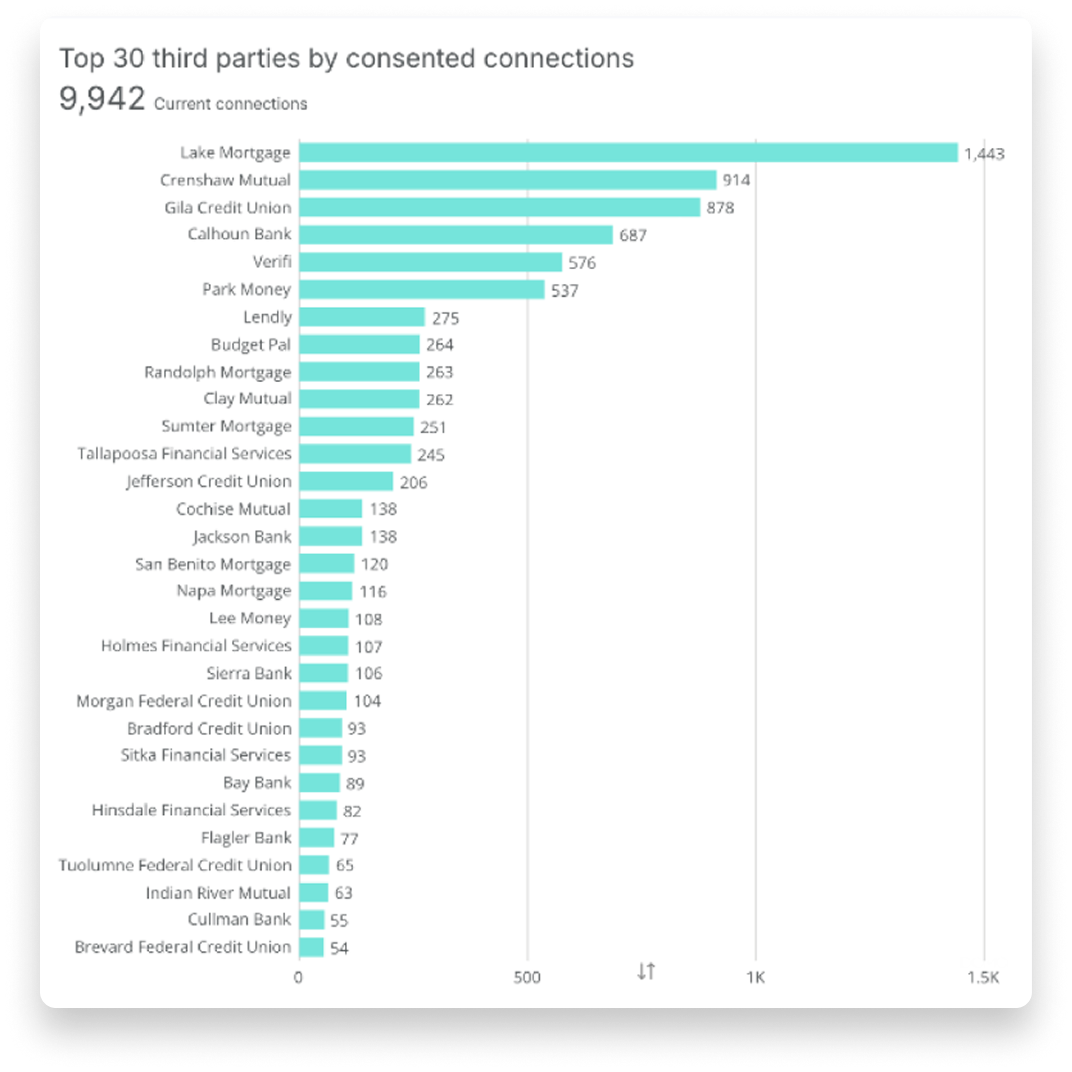
The Data Provider Portal gives near-real-time visibility into external behavior: which apps consumers use, which institutions they hold accounts with, which fintechs they engage. A consumer funding a competitor savings product? Connecting to a mortgage lender? MX puts that visibility into Customer Analytics, so you can keep and grow those consumer relationships. Already have an FDX API? This intelligence layer works on top of it. You built the pipe; now see what flows through.
Your consumers' external financial lives, finally visible

Credentials that never leave. Connections that do not break.

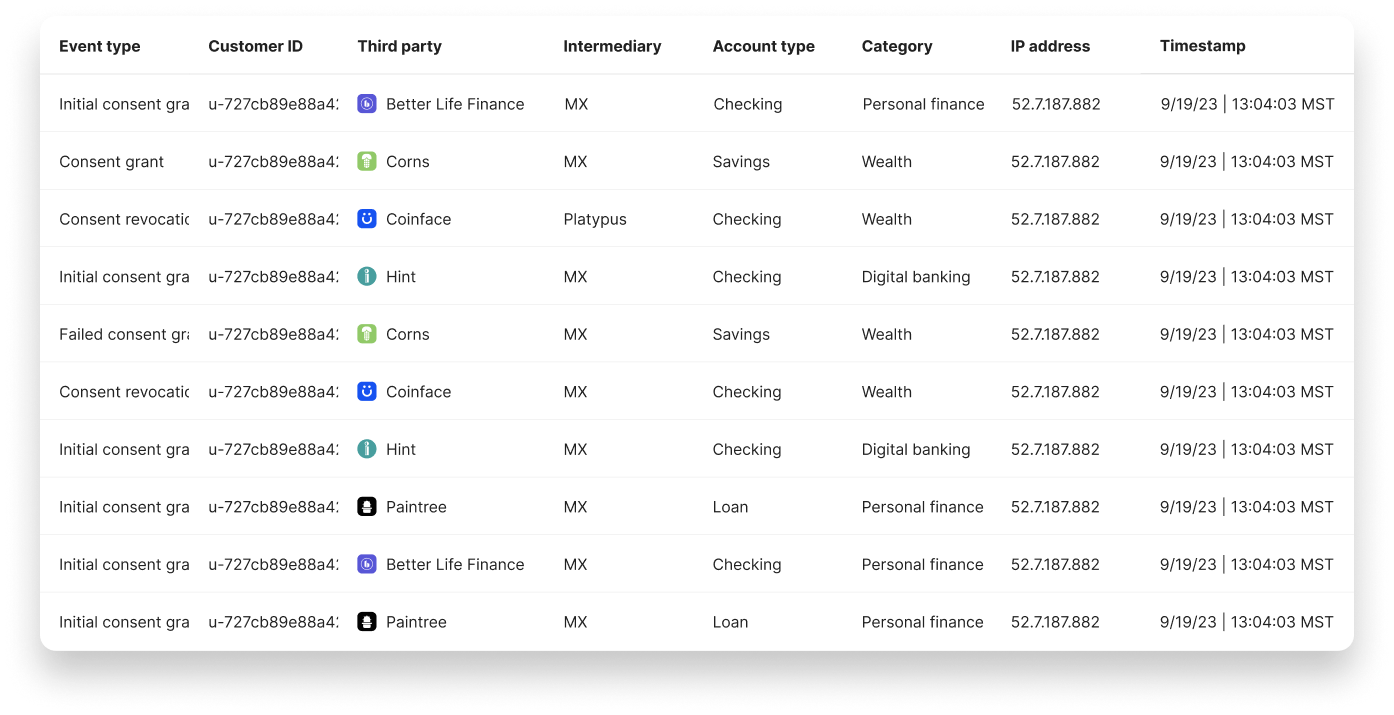
Data Access replaces credential scraping with an FDX-standard OAuth API. Consumers stop handing bank passwords to third-party apps, tokenized connections stay stable through front-end changes, and server load from scraping bots drops sharply. In the Consent Management widget each consumer sees every app with access and revokes any connection at any time, so dormant credential exposure ends.

95%

Cut screen scraping by 95% after launching its open banking API, moving credential-based connections to secure, tokenized access. Citizens Bank

Credentials that never leave. Connections that do not break.

Full governance. Any aggregator. Live in as few as 6 weeks.

MX is aggregator-agnostic: you control which aggregators connect, set rate limits and maintenance windows, and revoke access in real time, with no walled ecosystem and no vendor lock-in. MX handles aggregator onboarding, FDX version updates, and first-line triage after go-live, so the relationship stays yours without the operational burden. This is a full product with support, not a spec you have to build and maintain.

Full governance. Any aggregator. Live in as few as 6 weeks.

300+

MX runs this infrastructure across 300+ clients and is on a path to 4,000+ FIs. Implementation takes as few as 6 weeks, versus 12+ months to build in-house. Live connections, all managed by MX

Three places a Data Access signal turns into growth

Grow Deposits

Grow Deposits

Loyalty and Retention: Early warning when a consumer starts drifting, while there is still time to act. See the path on Grow Deposits →

Grow Lending

Grow Lending

Multi-Product Capture: Spot when a borrower is ready for a refinance, a line of credit, or a card, and offer it first. See the path on Grow Lending →

Grow Cards

Grow Cards

Loyalty and Retention: Flag the cardholder shifting spend elsewhere while the relationship is still yours. See the path on Grow Cards →

Powering consumer data is table stakes. This is the edge.

Payroll

A direct deposit starting to route to another institution, surfaced while there is still time to keep it.

See the path →
Savings

A consumer funding a competitor savings or checking product you move to win back.

See the path →
Mortgage

A connection to a mortgage app or lending platform, a live borrowing signal to act on first.

See the path →
Wallet

Everyday spend and tools shifting to a third-party fintech, off-us, flagged early.

See the path →

How it Works

1

Translate to FDX

MX's FDX adapter maps your core and online-banking APIs to the FDX standard, and your OIDC provider issues OAuth tokens. Three internal roles needed: product owner, technical lead, legal contact. Live in as few as 6 weeks.

2

Consumers permission each connection

Consumers grant access through the Consent Management widget: tokenized, revocable, no password shared. Credentials never leave your organization, and you keep the record.

3

You govern who gets access

In the Data Provider Portal you set rate limits and maintenance windows, onboard new aggregators, and revoke access in real time. Aggregator-agnostic, no lock-in.

4

See and act on what flows through

High-intent signals stream live across consent events and feed Customer Analytics, Aggregation, and Direct Deposit Switch, so you intercept churn and market your own products first.

Featured Client Stories

Case Study

Informative Research

Informative Research runs mortgage lending on MX connectivity, including Data Access OAuth, with a connection success rate above 99%. Real proof that governed connections beat credential scraping, which fails at 30%+.

"Data quality is very important. If you look at the use case associated with mortgage lending, there is a very high bar of data that needs to be provided. And we've worked in partnership with MX to continually drive that bar higher."

Brian Francis, Head of AccountChek, Informative Research

Read more
Informative Research

Case Study

U.S. Bank

U.S. Bank runs a Developer Portal on MX so its fintech partners get secure, governed access to consumer data. That is the core of Data Access: an FI publishing an open finance API on its own terms.

"The U.S. Bank Developer Portal, combined with our fintech partners, gives our customers more options than ever before. This is one of the ways we are moving at speed and scale at U.S. Bank to help our customers bank when, where, and how they want."

Gareth Gaston, Executive Vice President of Omnichannel, U.S. Bank

Read more
U.S. Bank

Case Study

VyStar Credit Union

VyStar Credit Union, one of the largest US credit unions, uses MX's connectivity API to integrate open finance with its core banking system, alongside data enhancement. A named FI live on Data Access connectivity.

"We've been impressed not only with MX's world-class data enhancement tools, but also with the alignment of our missions to empower financial strength through member advocacy."

Joe Colca, Senior Vice President of Digital Experience, VyStar Credit Union

Read more
VyStar Credit Union

Case Study

YNAB

YNAB connects more than a million accounts through MX, over half via secure OAuth, so users are not left with broken connections. Proof that OAuth connectivity, the mechanism behind Data Access, is stable at scale.

"In the beginning it was simply the data aggregation service that we needed MX to provide. And over the years, it's grown into more of a partnership..."

Jannelle Worrell, Bank Connections Lead, YNAB

Read more
YNAB

See where your consumers go, before they are gone

Talk to MX about replacing credential scraping with Open Finance you govern, and turning every connection into a signal you act on.

Research the industry runs on

Research

Financial health in an age of tension

Optimism and anxiety, side by side, how consumers really feel about their money heading into 2026.

Blog

The untapped competitive advantage of open banking

Sharing data out isn't a compliance cost, it's the fastest path to primacy. Open banking, done right, compounds into loyalty.

Blog

Where progress meets pressure: the state of open banking in the U.S.

Webinar

2026 financial industry predictions

Case Study

Top bank drives a 20% lift in direct deposit switching

Research

The engagement effect

Stronger engagement drives stronger financial wellness, and the data shows how the two reinforce each other.

Blog

Why connection is the greatest strength in banking

Blog

How FIs can leverage agentic AI to drive growth

Blog

Why financial wellness starts with account aggregation

A complete financial picture is the foundation of wellness, and it starts with aggregation.

Blog

Understanding CFPB Section 1033

Blog

The great wealth transfer is your new retention strategy

Blog

When fraud looks like trust

When fraud wears the face of trust, consumers lose. Seeing what flows through the pipe is how you stop it.

Open banking APIs, answered

What data and digital teams ask before they build or buy.

An open banking API is a secure connection that lets a consumer share their financial data with an app or another institution, without handing over their bank password. The consumer approves the connection, the bank issues a token instead of a credential, and the consumer revokes it at any time. It replaces screen scraping, where an app stores the password and logs in as the consumer.

Screen scraping needs the consumer's password. The app stores it, logs in as the consumer, and reads the screen. It breaks every time the front end changes, it looks like fraud to the bank, and the bank cannot see who is connected. An open banking API uses a token the bank issues and controls. Connections stay stable, every one of them is visible, and the consumer turns any of them off.

FDX is the Financial Data Exchange, the industry standard for how financial data is shared in North America. It defines the format and the rules, not the security certification. MX Data Access maps your core and online banking APIs to the FDX standard, and your OIDC provider issues the OAuth tokens. MX also handles FDX version updates, so the standard staying current is not your maintenance burden.

You do. Every connection runs through your governance. You choose which aggregators connect, set rate limits and maintenance windows, and revoke access in real time. Each consumer sees every app that has access and revokes any of them. Nothing connects without your permission.

MX Trust Center

Security and Compliance, Verified

See more info on security
SOC 2

SOC 2 Type II

Independently audited controls for security and availability

PCI

PCI DSS

Card data handled to payment-industry standards.

SOC 3

SOC 3

A public report you can read without an NDA

CCPA

CCPA

Aligned with California consumer-privacy rules.

GDPR

GDPR

Aligned with EU data-protection requirements.